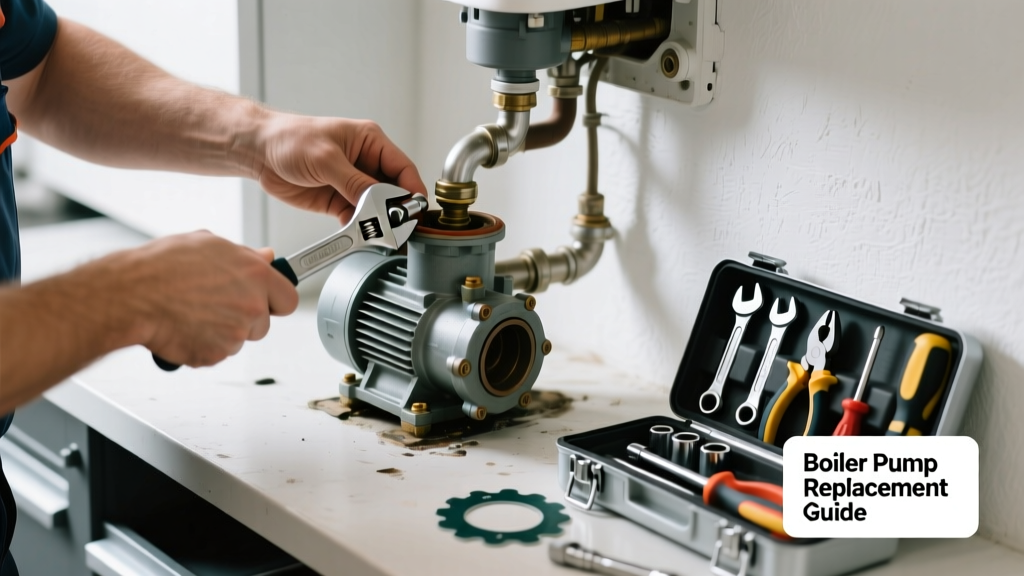
If your boiler isn’t circulating hot water — radiators stay cold, pressure drops, or you hear grinding or buzzing from the pump housing — the circulator pump may have failed. A seized impeller, burnt-out motor winding, or leaking seal are common culprits, and replacing just the faulty component (not the whole pump) can save $120–$300 over a full unit swap.
Quick Diagnosis
Before assuming the pump itself is dead, rule out these frequent misdiagnoses:
- No power to the pump (check circuit breaker, fused spur, and thermostat wiring)
- Airlock in the system causing false 'no flow' symptoms
- Blocked strainer or debris jamming the impeller (especially after recent system work)
- Faulty zone valve or controller sending no run signal
- Low system pressure (< 1.0 bar) preventing pump activation
Tools & Materials Needed
| Item | Purpose | Estimated Cost |
|---|---|---|
| Combination wrench set (8–19 mm) | Tightens/loosens pump flange bolts and union nuts without rounding | $25–$45 |
| Drain hose & bucket (5+ gal) | Drains water from pump section only — avoids full system drain | $8–$15 |
| Replacement pump cartridge (e.g., Grundfos UPS 15-50, Taco 007) | Swappable internal assembly; matches your existing pump model exactly | $65–$185 |
| PTFE tape & silicone grease | Seals threads and lubricates O-rings to prevent leaks during reassembly | $4–$9 |
| Multimeter (with continuity test) | Confirms motor winding resistance (should be 10–30 Ω); open circuit = dead coil | $30–$75 |
Step-by-Step Fix
Most modern wet-rotor circulator pumps use modular cartridges — meaning you replace only the motor/impeller assembly, not the entire pump body. Follow this sequence:
- Shut off power and isolate the pump: Turn off boiler power at the fused spur, close both isolation valves (inlet and outlet), then open the bleed screw on the pump’s top vent to release pressure.
- Drain just the pump section: Attach a drain hose to the lowest drain valve near the pump, open it until water stops flowing (usually ~1.5 liters). No need to drain the whole system.
- Remove the pump head: Unscrew the four retaining screws holding the motor housing. Gently pull the cartridge straight out — don’t twist or pry, or you’ll damage the ceramic shaft seal.
- Inspect and replace: Check for cracked impeller vanes, white crystalline deposits (hard water scale), or burnt insulation smell. Install new cartridge, hand-tighten screws evenly in crisscross pattern, then torque to 2.5 N·m (per Grundfos 2022 Service Manual).
- Refill, vent, and test: Close drain valve, slowly reopen isolation valves, bleed air from pump and nearest radiator, then restore power. Listen for smooth hum and check for leaks at unions after 10 minutes.
When to Call a Pro
DIY replacement crosses into dangerous territory when:
- Your boiler is sealed-combustion or condensing with integrated controls (e.g., Viessmann Vitodens, Worcester Greenstar) — pump signals tie into flue gas monitoring
- You measure <1 Ω or >100 Ω on motor windings — indicates shorted or degraded insulation risking shock hazard
- The pump body itself is cracked or corroded (not just the cartridge) — requires full pump replacement and possible pipe modification
- Your home has a pressurized unvented cylinder system — incorrect refilling risks thermal expansion tank failure
"Over 68% of premature circulator pump failures stem from improper system water chemistry — not manufacturing defects." — CIPHE Technical Bulletin No. 17, Chartered Institute of Plumbing and Heating Engineering, 2023
Prevention Tips
Extend pump life by addressing root causes, not just symptoms:
- Add inhibitor annually (e.g., Fernox MB1) — test pH and inhibitor concentration every 12 months with test strips
- Install a magnetic filter (e.g., MagnaClean) on the return line — captures iron oxide before it reaches the pump
- Run the pump weekly during summer 'off-season' for 10 minutes to prevent rotor seizure
- Maintain system pressure between 1.0–1.5 bar — pressures below 0.8 bar cause cavitation damage over time
Can I reuse the old pump housing with a new cartridge?
Yes — if the housing shows no cracks, warping, or corrosion around the sealing surface, and the mounting feet are intact. Most Grundfos, Lowara, and Wilo housings last 15+ years with proper water treatment.
What’s the difference between a pump cartridge and a full pump replacement?
A cartridge contains only the motor, rotor, and impeller — designed for quick field swaps. A full pump includes housing, terminals, and flanges. Cartridge replacement costs ~40% less and takes under 30 minutes if you’ve done it before.
Why does my new cartridge make a high-pitched whine?
That’s usually air trapped in the rotor chamber. Bleed the pump’s top vent screw while the boiler is running (wear gloves — it’s hot). If noise persists after 2 minutes, check for misaligned impeller or voltage mismatch (e.g., installing a 230V cartridge on a 115V system).
Do I need to flush the whole system before replacing the cartridge?
No — unless water tests show >50 ppm dissolved iron or conductivity >500 µS/cm. A localized drain and refill is sufficient. Full flushes risk disturbing settled sludge into other zones.
Is it safe to replace the pump while the boiler is hot?
No. Wait until the boiler cools below 40°C (104°F). Hot water expands under pressure — opening isolation valves on a hot system can cause scalding steam bursts or sudden pressure release.
How often should I replace the pump cartridge?
Every 8–12 years under ideal conditions (treated water, stable pressure, no frequent cycling). In hard-water areas without inhibitors, expect 4–6 years — evidenced by reduced flow and rising electricity use (track kWh/month via your smart meter).
A working circulator pump is the quiet heartbeat of your heating system — and catching failure early means you’re back to warm radiators in under an hour. Keep your inhibitor levels up, install that magnetic filter, and treat the pump like the precision component it is: clean, lubricated, and never left idle for months on end. For related issues, see our guides on boiler pressure drops when heating and radiator cold at top hot bottom.