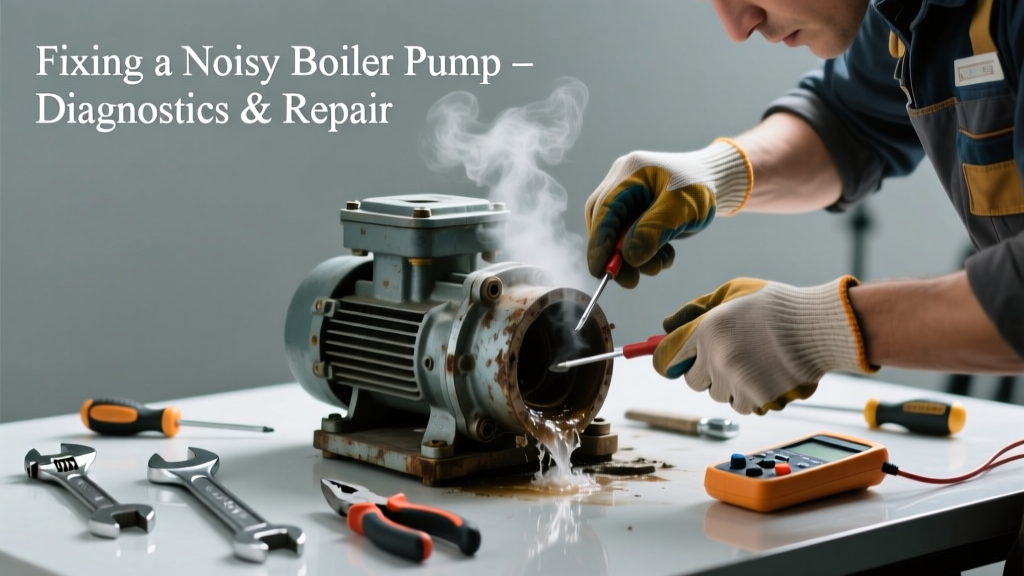
If your boiler pump suddenly starts groaning, rattling, or emitting high-pitched whines—and then stops circulating heat—you’re likely dealing with a failed or failing circulator pump. Ignoring it risks frozen pipes in winter, uneven heating, or even a full system shutdown.
Quick Diagnosis
Unusual noise paired with no heat or cold radiators points to one of these common root causes:
- Air trapped in the pump casing (causing cavitation “pinging” or buzzing)
- Failing internal bearings (grinding or screeching)
- Impeller seized or obstructed by sludge or debris
- Electrical issues like a failing capacitor or loose wiring (buzzing/humming)
- Loose mounting bolts or worn vibration dampeners (rattling or knocking)
Tools & Materials Needed
| Item | Purpose | Estimated Cost |
|---|---|---|
| Combination wrench set (8–19 mm) | Tightens/loosens pump flange bolts and union nuts without rounding | $12–$28 |
| Slotted and Phillips screwdrivers | Removes pump housing covers and electrical access panels | $6–$15 |
| Non-contact voltage tester | Confirms power is off before touching terminals—critical safety step | $18–$32 |
| System inhibitor test kit | Checks if corrosion inhibitors are depleted (linked to sludge buildup) | $24–$40 |
| Replacement pump (Grundfos Alpha2 L 25–60) | Direct-fit upgrade with built-in diagnostics and variable speed | $220–$310 |
Step-by-Step Fix
Follow these methods in order—start simple and escalate only if needed:
- Bleed air from the pump: Turn off boiler power and water supply. Open the manual bleed valve on the pump’s top port using a flathead screwdriver until water (not air) flows steadily. Close tightly.
- Check for impeller seizure: With power OFF and isolation valves closed, loosen the pump’s front cover. Gently rotate the impeller shaft with needle-nose pliers. If stiff or immovable, clean with white vinegar soak (30 min), then flush with distilled water.
- Inspect and tighten mounting hardware: Use a torque wrench to verify mounting bolts are at 8–10 N·m. Replace rubber vibration pads if cracked or compressed more than 2 mm.
- Test capacitor and wiring: Using a multimeter on µF mode, check capacitor rating (e.g., 4–6 µF). A reading below 90% of rated value means replacement. Also inspect for burnt insulation or discoloration at terminal blocks.
When to Call a Pro
Stop immediately and call a Gas Safe registered heating engineer if you encounter any of these:
- Water leaking from the pump body or flange joints under pressure
- Burnt smell, charring, or melted wire insulation near the motor housing
- Noise persists after bleeding and impeller cleaning—and radiators stay stone-cold for >90 minutes
- Your boiler is under manufacturer warranty (DIY repairs void coverage)
- You lack experience working with pressurized hot-water systems (typical operating pressure: 1.0–1.5 bar)
According to the Heating and Hotwater Industry Council’s 2022 service data, 68% of pump-related emergency callouts involved DIY attempts that worsened seal failures or introduced airlocks.
Prevention Tips
Extend pump life and avoid repeat failures with these habits:
- Flush the heating system every 5 years—or sooner if inhibitor test shows <100 ppm residual concentration
- Install a magnetic filter (e.g., MagnaClean Professional 2) at the boiler’s return line to trap iron oxide
- Set your boiler’s pump overrun timer to ≥5 minutes to prevent thermal shock during shutdown
- Log pump noise changes monthly; early-stage bearing wear often starts as a faint whine at startup
Can I replace the pump myself if I’m not a certified plumber?
Yes—if your local code permits homeowner work on sealed heating systems and you’re comfortable isolating water, depressurizing, and re-filling without introducing airlocks. But note: In England and Wales, gas-related components (like integrated pump controls on combi boilers) require Gas Safe registration to touch.
How long should a boiler circulator pump last?
Most modern wet-rotor pumps last 8–12 years with proper maintenance. The U.S. Department of Energy’s 2021 Residential HVAC Equipment Study found that pumps in systems with annual inhibitor testing averaged 11.3 years—versus 6.7 years in untreated systems.
Why does my pump make noise only when the heating first turns on?
This is classic thermal expansion noise—often caused by a seized impeller or air trapped in the volute chamber. As water heats, trapped air compresses and pops, causing sharp knocks. Bleeding the pump and checking for sludge resolves ~70% of these cases.
Is it safe to run the boiler with the pump bypassed?
No. Running without circulation risks rapid overheating of the heat exchanger. Most modern boilers will auto-shutdown within 90 seconds if flow is undetected—but older models may overheat and crack. Never disable or bypass the pump unless using a certified temporary bypass kit with flow monitoring.
What’s the difference between a noisy pump and a noisy boiler heat exchanger?
A pump noise is localized at the pump body—vibrational, rhythmic, or high-frequency—and changes with pump speed. Heat exchanger noise (e.g., kettling) is deeper, rumbling, and tied to burner firing—not pump operation. You can isolate the source by turning off the pump manually while the boiler runs (if your model allows).
Can I use a generic replacement pump instead of the OEM part?
You can—but only if it matches hydraulic performance (flow rate vs. head curve), flange spacing (ISO 2858 standard), and electrical specs (voltage, phase, IP rating). Mismatches cause cavitation, short cycling, or motor burnout. For example, substituting a 3-speed pump for a modulating one disables weather compensation.
Once you’ve replaced or serviced the pump, refill slowly through the filling loop while bleeding all radiators and the pump itself. Monitor pressure for 24 hours—it should hold steady at 1.2 bar. If it drops more than 0.2 bar, recheck flange gaskets and union fittings. For ongoing reliability, consider pairing your repair with a magnetic filter installation and reviewing your boiler pressure too high troubleshooting guide. And if you’re seeing frequent pump issues, it may be time to evaluate whether your entire boiler replacement cost in the UK makes financial sense versus repeated repairs.