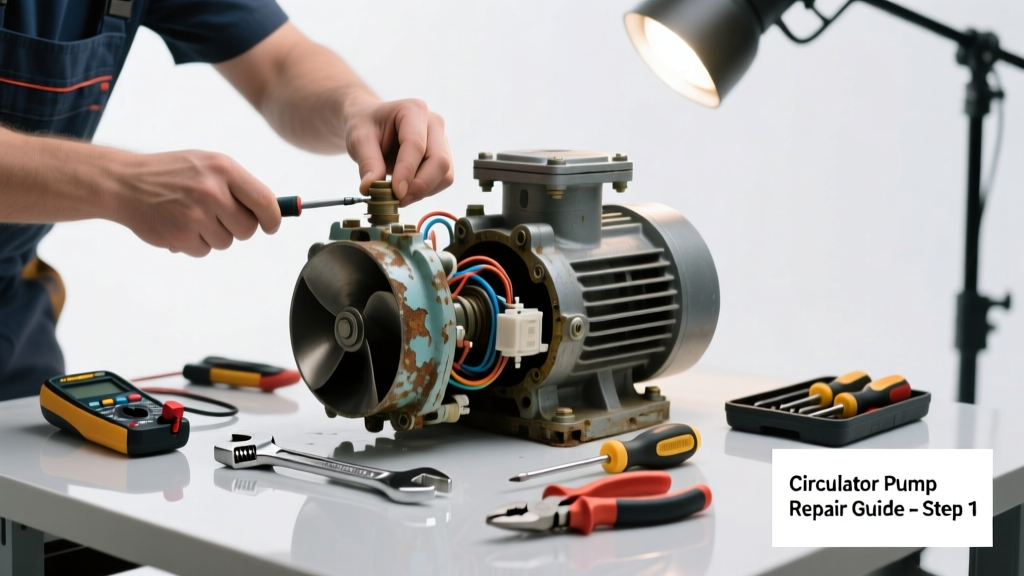
Your radiators are cold, the boiler’s running but not heating, and you hear silence where there should be a low hum—that’s the circulator pump failing. It’s one of the most common boiler breakdowns in homes with hydronic heating, and while it’s often repairable, acting fast prevents frozen pipes or system damage.
Quick Diagnosis
Before grabbing tools, confirm it’s the pump—not the thermostat, zone valve, or power supply. Check these first:
- No humming or vibration from the pump housing when the boiler calls for heat
- Tripped circuit breaker or blown fuse feeding the pump (often shared with the boiler control)
- Visible corrosion or leaking at pump flanges or shaft seal
- Hot pump body with no flow—indicates seized impeller or motor winding failure
- Thermostat or boiler display showing error codes like 'E12' or 'Pump Fault' (check your manual—Baxi, Viessmann, and Weil-McLain models use different codes)
Tools & Materials Needed
| Item | Purpose | Estimated Cost |
|---|---|---|
| Adjustable wrench (10-inch) | Loosens pump flange bolts without stripping brass fittings | $12–$22 |
| Non-contact voltage tester | Verifies power is off before touching wiring—critical for safety | $18–$35 |
| Replacement Grundfos UPS 15-50 or Taco 007 pump | Direct-fit replacement for most residential systems (match flow rate & head pressure) | $145–$220 |
| Thread seal tape (PTFE, yellow gas-rated) | Seals threaded pipe connections without over-tightening | $3–$6 |
| Small bucket & towels | Catches residual water during isolation—prevents ceiling stains or floor damage | $5–$12 |
Step-by-Step Fix
Follow this sequence only if you’ve confirmed power is off, the system is depressurized, and isolation valves are functional:
- Shut down and isolate: Turn off boiler power at the breaker. Close both isolation valves (inlet and outlet) on the pump. Open the drain valve on the lowest radiator or boiler drain to relieve pressure—expect ~1–2 gallons of water.
- Remove old pump: Loosen flange bolts evenly (don’t force them). Slide pump off pipe stubs. Note orientation—most pumps have an arrow showing flow direction; install replacement identically.
- Prep and install: Clean pipe ends with emery cloth. Wrap threads with 3 wraps of PTFE tape clockwise. Hand-tighten pump, then snug with wrench—no more than ½ turn past hand-tight to avoid cracking cast iron flanges.
- Bleed and test: Reopen isolation valves slowly. Bleed air from radiators starting at the highest point. Power up boiler and verify pump hums and radiators warm within 12–15 minutes.
When to Call a Pro
DIY stops where safety or code compliance begins. Call a licensed HVAC technician immediately if:
- You smell burning insulation or see charring on pump wiring—this indicates electrical fault beyond simple replacement
- Your boiler uses a primary/secondary loop configuration with multiple pumps (common in newer condensing boilers)
- The pump failure coincides with low system pressure (12 psi) or frequent pressure relief valve discharge—suggests a larger leak or expansion tank failure
- Your local code requires licensed work for gas-fired appliance repairs (e.g., Massachusetts, New York City, and all Canadian provinces mandate it)
According to the U.S. Department of Energy’s 2022 Residential Energy Consumption Survey, 23% of boiler service calls involve circulator pump replacement—and nearly half of those were delayed due to misdiagnosis of electrical vs. mechanical failure.
Prevention Tips
Extend pump life with routine care—not just reactive fixes:
- Flush the system every 3–5 years to remove sludge that clogs impellers (use Fernox or Sentinel cleaner per manufacturer instructions)
- Install a magnetic filter (like the MagnaClean) on the return line—cuts iron oxide buildup by 70% (CIPHE report, 2021)
- Set boiler flow temperature no higher than 140°F unless needed for domestic hot water—reduces thermal stress on pump seals
- Check pump operation monthly: listen for grinding, watch for slow warm-up, and feel for excessive heat on the motor housing
Can I replace the pump without draining the whole system?
Yes—if your system has functional isolation valves upstream and downstream of the pump, you can isolate just that section. Expect to lose 1–3 gallons. If valves are seized or corroded, full drain is safer. Never attempt to loosen stuck valves with heat or force—they’re often soldered or compression-fitted and prone to breakage.
Why does my new pump make a whining noise?
A high-pitched whine usually means air trapped in the pump head or incorrect impeller rotation. Turn off power, open the bleed screw on top of the pump until water flows steadily, then retighten. If noise persists, verify wiring matches the diagram—reversing L/N on single-phase pumps causes reverse rotation and cavitation.
Is it okay to run the boiler without the pump for a few hours?
No. Running a gas-fired boiler without circulation risks overheating the heat exchanger. Most modern units will lock out after 3–5 minutes, but older models may crack the exchanger or trigger dangerous pressure spikes. Shut down the boiler entirely until the pump is replaced.
What’s the average lifespan of a circulator pump?
Grundfos and Taco pumps typically last 8–12 years with clean water and proper voltage. But in hard-water areas or systems with poor filtration, 4–6 years is common. According to the Hydronics Institute’s 2023 Field Service Data, premature failure jumps to 41% in homes without annual flushing.
Do I need to balance the radiators after pump replacement?
Not immediately—but if some rooms heat much slower than others post-repair, rebalancing helps. Start with the farthest radiator: close its lockshield valve halfway, then adjust others incrementally so all reach ~28°F ΔT between flow and return pipes (measured with an IR thermometer).
Can I use a generic pump instead of OEM?
You can—but only if specs match exactly: flow rate (GPM), head pressure (feet), voltage (115V/230V), and flange pattern (ISO 228 or NPT). Using an undersized pump causes cold spots; oversized ones waste energy and accelerate wear. For example, swapping a 007 for a 0010 in a small bungalow overpressures zone valves. See our boiler pressure check guide for verification steps.
A failed boiler pump isn’t a death sentence for your heating system—it’s often the most straightforward major component to replace. But respect the electricity, pressure, and chemistry involved. When in doubt, pause and call a pro: the boiler leak repair team at your local HVAC shop can usually dispatch same-day, and their diagnostic fee often applies toward the repair. Better safe, warm, and certain than sorry, cold, and soaked.