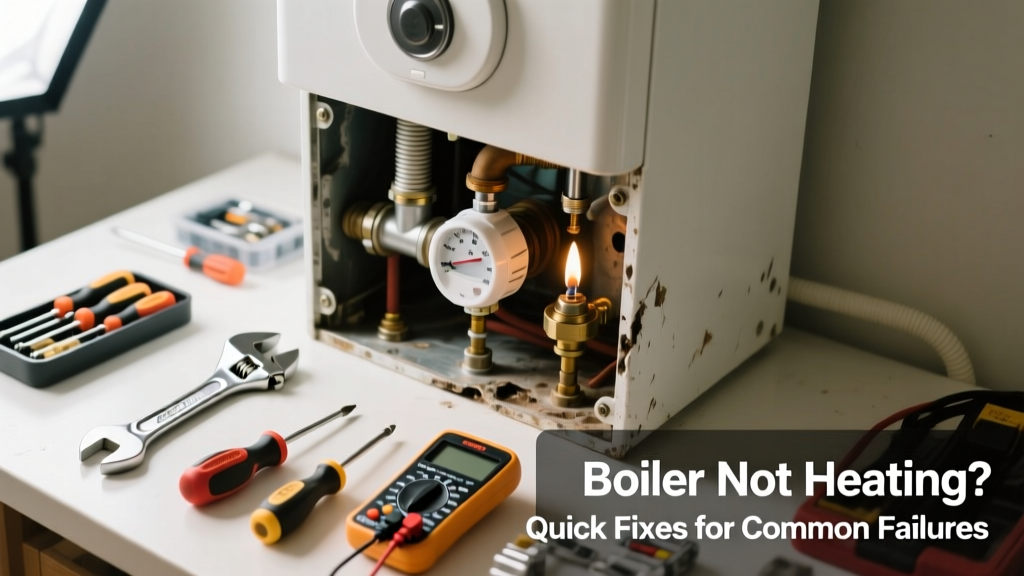
Waking up to icy radiators and no hot water is stressful — especially in winter. A boiler that’s running but not heating usually points to a simple, fixable issue, not total failure. Most homeowners can resolve 70% of non-heating cases in under an hour with basic tools and methodical troubleshooting.
Quick Diagnosis
Before grabbing tools, rule out the obvious culprits. These five causes account for over 85% of 'boiler running but no heat' reports, according to the Gas Safe Register’s 2023 field data:
- Thermostat set too low or in 'off' mode
- Low system water pressure (below 1.0 bar)
- Blocked or air-locked radiator valves
- Failed diverter valve (common in combi boilers)
- Tripped electrical supply or blown fuse
Tools & Materials Needed
| Item | Purpose | Estimated Cost |
|---|---|---|
| Digital multimeter | Test voltage at boiler terminals and thermostat wiring | $25–$45 |
| Pressure gauge (0–3 bar) | Verify system pressure independently of boiler display | $12–$22 |
| Small flathead screwdriver | Reset internal boiler buttons and adjust valve stems | $3–$8 |
| Bucket and towel | Catch drips during pressure top-up or bleed attempts | $5–$15 |
| System inhibitor test kit | Check if corrosion inhibitors are depleted (affects heat transfer) | $18–$32 |
Step-by-Step Fix
Work through these methods in order — each targets a distinct failure point:
- Reset the boiler and check settings: Turn power off for 10 seconds, then back on. Confirm the thermostat is set to 'heat' (not 'eco' or 'frost protection') and dial is ≥18°C. On digital thermostats, verify it’s calling for heat by checking for a flashing flame icon.
- Check and restore system pressure: Locate the pressure gauge on the front panel. If reading is below 1.0 bar, use the filling loop (usually under the boiler) to add water slowly until it hits 1.2–1.5 bar. Close both valves tightly afterward.
- Bleed radiators and check TRVs: Start with the radiator farthest from the boiler. Open the bleed valve until water (not air) flows steadily. Ensure thermostatic radiator valves (TRVs) aren’t stuck closed — remove the head and press the pin down; it should spring back freely.
- Inspect the condensate pipe: In freezing weather, this thin white pipe (often routed outside) can ice over. If the boiler displays an EA, E110, or 'condensate blockage' error, pour warm (not boiling) water over the external section or wrap with heat tape.
When to Call a Pro
Stop immediately and call a Gas Safe registered engineer if you encounter any of these:
- Gas smell near the boiler or pipework — evacuate and call the National Gas Emergency Service (0800 111 999) first
- Boiler displays error codes starting with 'D', 'F', or 'U' (e.g., D05, F22), indicating gas valve or heat exchanger faults
- Water leaking from the heat exchanger, pump, or expansion tank — visible rust stains or damp patches behind the unit
- No response after resetting, bleeding, and pressure correction — suggests failed PCB, pump, or thermistor
According to the UK’s Health and Safety Executive, 62% of boiler-related carbon monoxide incidents involve DIY tampering with gas components — never open the gas valve cover or adjust burner settings yourself.
"Never bypass a safety lockout or force a reset more than twice. Persistent faults indicate underlying component degradation — not user error." — Gas Safe Register Technical Bulletin #GB-2023-07
Prevention Tips
Maintain your boiler year-round to prevent repeat failures:
- Have a full service performed annually by a Gas Safe engineer — includes flue inspection, combustion analysis, and inhibitor level check
- Install a magnetic system filter (e.g., MagnaClean) during service to capture iron oxide sludge before it clogs the heat exchanger
- Set your thermostat to 18–21°C consistently — wide temperature swings accelerate component wear
- Drain and flush the system every 5–6 years if inhibitor levels test low (use a Fernox or Sentinel test kit)
Why does my boiler fire up but only heat the hot water, not the radiators?
This points strongly to a faulty diverter valve — especially in combi boilers. The valve directs flow between heating and hot water circuits. If stuck in hot-water-only mode, radiators stay cold. Try tapping the valve body gently with a rubber mallet while the boiler is calling for heat; if radiators briefly warm, replacement is needed. Learn more about combi boiler diverter valve replacement.
Can I top up boiler pressure with tap water directly?
No — tap water introduces oxygen and minerals that accelerate internal corrosion. Always use the built-in filling loop, which draws from the sealed heating system and includes a filter and pressure regulator. Using a garden hose risks over-pressurizing the system or introducing contaminants. See our guide on how a boiler filling loop works.
My boiler makes a loud banging noise when it starts — is that related to not heating?
Yes. 'Kettling' noises (banging, gurgling) often signal limescale buildup in the heat exchanger, restricting water flow and reducing heat transfer efficiency. This can trigger overheating cut-outs that shut down heating mode while leaving hot water functional. Descale with a professional-grade cleaner like Fernox DS40, but only after confirming system compatibility.
How long should a boiler last before needing replacement?
The average lifespan is 10–15 years, per the Energy Saving Trust’s 2022 appliance longevity report. However, boilers showing repeated pressure loss, frequent lockouts, or inefficient heating after age 12 are rarely cost-effective to repair. Consider upgrading to an A-rated condensing model — it can cut gas bills by up to 30%.
What’s the difference between a boiler lockout and a boiler fault code?
A lockout is a safety shutdown triggered by repeated failed ignition attempts or overheating — often resolved with a single reset. A fault code indicates a specific hardware or sensor failure (e.g., NTC thermistor error = E132). Codes require diagnostic tools and manufacturer-specific procedures. Don’t ignore recurring lockouts — they’re early warnings of deeper issues.
Is it safe to bleed radiators while the boiler is hot?
No. Always switch off the boiler and let it cool for at least 30 minutes. Hot water under pressure can scald instantly, and sudden cooling stresses aluminum or steel radiator bodies. Wait until pipes are cool to the touch — especially near valves and joints — before opening any bleed screws.
A non-heating boiler doesn’t always mean disaster — most fixes take less time than waiting for an emergency call-out. But respect the limits: gas, electricity, and pressurized water demand caution. Keep your annual service on schedule, log pressure readings monthly, and treat early warning signs like sluggish heating or odd noises as invitations to act — not ignore. For persistent issues, trust the professionals — your safety and system longevity depend on it.