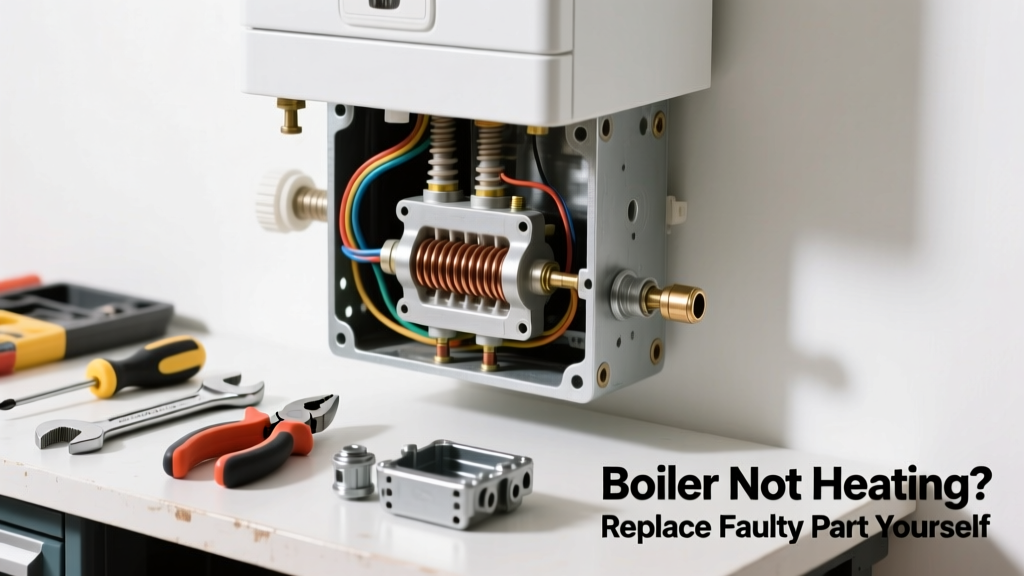
If your boiler fires up but delivers no heat—or won’t ignite at all—the culprit is often a single failed component, not the whole unit. Replacing that part yourself can restore warmth in under two hours and avoid a $350+ emergency service call. But skip this if you smell gas, hear banging, or see rust-colored water leaking from the heat exchanger.
Quick Diagnosis
Before grabbing tools, rule out simple causes first:
- No power to the boiler (check circuit breaker and wall switch)
- Thermostat set too low or in 'off' mode
- Low system pressure (< 12 psi on analog gauge)
- Blocked condensate drain (on condensing boilers)
- Faulty flame sensor, ignition electrode, or aquastat
Tools & Materials Needed
| Item | Purpose | Estimated Cost |
|---|---|---|
| Multi-meter (digital) | Test continuity and voltage at controls and sensors | $25–$65 |
| Phillips and flat-head screwdrivers | Access panels, mounting screws, and wiring terminals | $8–$15 |
| Wire brush & emery cloth | Clean oxidation off flame sensor and electrode tips | $4–$9 |
| Replacement part (e.g., Honeywell L8124A aquastat) | Exact OEM or certified equivalent—match model number | $45–$120 |
| Insulated gloves & safety glasses | Protect against burns and electrical hazards near hot components | $12–$22 |
Step-by-Step Fix
Follow these methods in order—start with cleaning before replacing:
- Clean the flame sensor: Power off boiler, remove sensor (usually 1/4" hex screw), gently scrub with emery cloth until shiny brass appears, reinstall and tighten to 18 in-lbs.
- Test ignition electrode: With multimeter in continuity mode, check for resistance between tip and base—if open circuit (>1 MΩ), replace.
- Verify aquastat operation: Set multimeter to VAC, probe terminals while calling for heat—if no 24V output when boiler should fire, replace aquastat.
- Swap thermostat wiring: Bypass thermostat by jumping R and W wires at boiler terminal block—if boiler fires, thermostat or wiring is faulty.
When to Call a Pro
Stop immediately and call a licensed HVAC technician if:
- You detect the smell of natural gas (rotten egg odor) near the boiler
- The heat exchanger shows visible cracks, corrosion, or soot buildup
- Your boiler is over 15 years old and fails multiple diagnostics
- You’re uncomfortable handling 120V or 24V control circuits
- Local code requires licensed work for gas-line or combustion chamber access
According to the U.S. EPA, 14% of household water usage is from leaks—but undiagnosed boiler faults waste far more energy: a failed aquastat can increase fuel use by up to 22% over time (ASHRAE Handbook – HVAC Applications, 2023).
Prevention Tips
- Flush the system every 2 years to prevent sludge buildup around sensors
- Check pressure gauge monthly—top up to 12–15 psi if below 10 psi
- Replace the air filter in your boiler’s intake vent every 6 months (if applicable)
- Log boiler startups and shutdowns; sudden changes in cycle frequency signal early failure
Can I test the boiler thermostat without removing it?
Yes—you can use a multimeter to measure voltage across the R and W terminals at the boiler’s control board while the thermostat calls for heat. If you read 24V AC and the boiler doesn’t respond, the issue lies downstream (aquastat, gas valve, or sensor). If there’s no voltage, the thermostat or its wiring is likely faulty. For deeper troubleshooting, see our guide on boiler thermostat troubleshooting.
How long does a boiler flame sensor last?
Most flame sensors last 3–5 years in hard-water areas and 5–8 years in softened-water systems. Annual cleaning extends life, but repeated overheating or improper installation accelerates wear. A failing sensor often causes intermittent lockouts—not total failure—so don’t wait for total shutdown before replacement.
Is it safe to replace the aquastat myself?
Yes—if you’re comfortable working with low-voltage wiring and follow lockout/tagout procedures. The aquastat operates on 24V control circuits, not line voltage. However, miswiring can cause relay chatter or prevent burner shutdown, creating a safety hazard. Always photograph wiring before disconnecting and verify pinout diagrams match your model. Refer to our boiler wiring diagram guide for visual reference.
What’s the difference between an aquastat and a thermocouple?
An aquastat is a temperature-controlled switch for hydronic boilers—it opens/closes 24V circuits based on water temp. A thermocouple is a safety device used only in older standing-pilot gas furnaces and water heaters; it generates millivolts to hold open the gas valve. Modern boilers don’t use thermocouples—they rely on electronic ignition and flame sensors instead.
Why does my boiler click but not ignite?
Clicking usually means the ignition system is energizing but failing to spark or sense flame. Common causes: cracked or dirty ignition electrode, weak spark transformer (under 10kV output), or insufficient gas pressure (< 3.5" WC). Test electrode gap (typically 1/8") and inspect for carbon tracking. If spark is visible but flame doesn’t catch, check gas valve operation and manifold pressure with a manometer.
Can I use generic replacement parts instead of OEM?
OEM parts are strongly recommended for safety-critical components like flame sensors, aquastats, and gas valves. Generic equivalents may meet basic specs but lack UL/CSA certification for your specific boiler model. The National Fire Protection Association (NFPA 54, 2023) requires listed components for gas-fired appliances—using uncertified parts voids insurance coverage and violates most local codes.
A well-maintained boiler rarely needs full replacement—most ‘no heat’ issues trace back to one $50 part and five minutes of cleaning. Keep your multimeter charged, your manual bookmarked, and your pressure gauge readable. When in doubt, take a photo before disassembly and compare it to the factory diagram. And if your boiler’s been patched three times in two years? That’s not a repair—it’s a retirement notice.