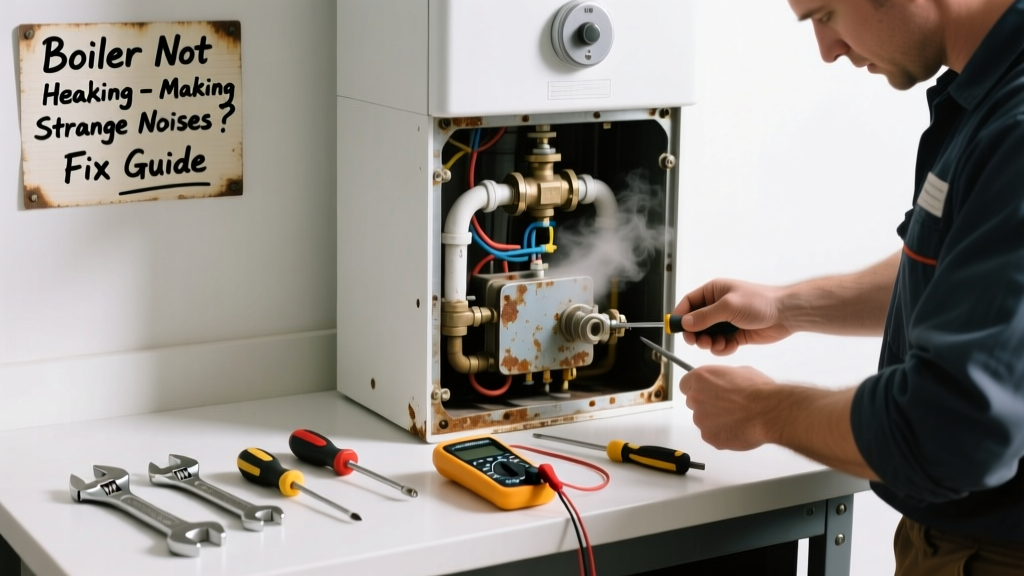
If your boiler isn’t heating your home and is making clanging, whistling, or gurgling noises, it’s not just annoying—it’s a warning sign. These sounds often point to pressure imbalances, trapped air, limescale buildup, or failing components. Ignoring them can lead to breakdowns, higher energy bills, or even safety hazards.
Quick Diagnosis
Start by identifying the noise type and timing—it tells you where to look first:
- Banging or knocking (especially when firing up): Likely kettling due to limescale or overheating
- Gurgling or bubbling: Air trapped in the system or low water pressure
- Whistling or hissing: Pressure relief valve leaking or blocked condensate pipe
- Grinding or screeching: Failing pump bearings or circulator motor issues
- Clicking without ignition: Faulty gas valve, thermocouple, or electrode
Tools & Materials Needed
| Item | Purpose | Estimated Cost |
|---|---|---|
| Combination wrench set | Tighten/loosen isolation valves and bleed screws | $18–$35 |
| Pressure gauge (0–3 bar) | Verify system pressure (should be 1.0–1.5 bar when cold) | $12–$24 |
| System flush kit & inhibitor | Remove sludge and prevent future kettling | $45–$75 |
| Condensate pipe unblocker (e.g., drain snake) | Clear frozen or debris-clogged condensate lines | $8–$16 |
| Non-contact infrared thermometer | Check heat exchanger surface temp vs. outlet pipe temp | $25–$42 |
Step-by-Step Fix
Try these methods in order—most common issues resolve with the first two steps:
- Bleed radiators and check system pressure: Turn off boiler, open radiator valves, bleed each radiator until water flows steadily. Recheck pressure at the filling loop—top up to 1.2–1.5 bar if below 0.8 bar.
- Clear the condensate pipe: Locate the white plastic pipe exiting the boiler (usually near floor level). If outdoors in winter, thaw ice with warm (not boiling) water. Insert a flexible drain snake 3–4 feet in to dislodge sludge or algae.
- Descale the heat exchanger: If kettling persists, perform a chemical flush using Fernox DS40 or Sentinel X800, followed by inhibitor dosing. Requires isolating the boiler and circulating solution for 60+ minutes.
- Inspect and clean the pump: Remove front panel, locate circulator pump, and check for seized impeller (turn manually with a screwdriver). Clean debris from the pump head and verify power supply with a multimeter.
When to Call a Pro
Stop immediately and contact a Gas Safe registered engineer if you observe any of these:
- Gas smell (rotten egg odor) near the boiler—evacuate and call the National Gas Emergency Service (0800 111 999)
- Water leaking from the heat exchanger or primary circuit joints
- Boiler displays error codes starting with 'E' or 'F' (e.g., E118, F22) indicating gas valve or flame sensor faults
- Pressure rises above 3.0 bar and relief valve discharges continuously
- You’re uncomfortable handling gas connections, electrical terminals, or internal combustion chamber components
According to the UK Gas Safety Regulations 2023, only certified professionals may work on gas-fired appliances—and improper DIY repairs account for 22% of reported carbon monoxide incidents (HSE, 2023).
Prevention Tips
Maintaining your boiler prevents most noise-and-no-heat failures before they start:
- Flush the system every 5 years (or every 3 years in hard water areas like London or Yorkshire)
- Install a magnetic filter (e.g., MagnaClean) during annual service to capture iron oxide sludge
- Set thermostat to 60–65°C max—higher temps accelerate limescale formation
- Check pressure monthly and top up only when below 1.0 bar (never overfill)
- Schedule professional servicing annually—even if the boiler seems fine
Why does my boiler bang only when it first fires up?
This is classic kettling: limescale insulates the heat exchanger, causing localized boiling and steam bubbles that collapse violently. It’s most common in hard water regions and worsens with age. A chemical flush and inhibitor dose usually resolves it—but if the heat exchanger is severely scaled, replacement may be needed.
Can I bleed the boiler itself, or just the radiators?
Modern combi boilers don’t have a dedicated bleed valve—only radiators and towel rails do. Bleeding those removes air from the whole system. However, some older system boilers have an auto-air vent or manual bleed screw on the pump housing. Never bleed the expansion tank or pressure vessel—that’s sealed and pressurized.
What’s the difference between gurgling and hissing noises?
Gurgling suggests air pockets moving through wet pipes or low water flow; hissing points to steam or gas escaping—often from a faulty pressure relief valve, micro-fracture in the heat exchanger, or blocked condensate trap. Hissing requires immediate shutdown and inspection.
How do I know if the pump is failing, not just noisy?
A failing pump may run but produce no flow—check by feeling both flow and return pipes near the boiler after 5 minutes of operation. If the return stays cold while flow heats up, the pump isn’t circulating. Also look for corrosion on pump terminals or visible oil seepage (sign of bearing failure).
Is it safe to reset the boiler repeatedly when it makes noise?
No. Repeated resets mask underlying issues like overheating or flame failure—and increase risk of component damage or unsafe operation. If the boiler locks out more than twice in 24 hours, it’s signaling a fault that needs diagnosis, not rebooting.
Can limescale cause both noise AND no heating?
Absolutely. Limescale reduces heat transfer efficiency, forcing the boiler to run longer and hotter—which triggers safety cutouts (no heat) while also creating steam pockets that collapse with loud bangs. In one 2022 Salford University study, boilers with >3mm scale buildup showed 28% lower thermal output and 4x more kettling events per month.
"Over 60% of premature boiler failures in UK homes stem from poor water treatment—not manufacturing defects." — Gas Safe Register Technical Bulletin, 2023
Fixing a noisy, non-heating boiler doesn’t always mean replacing it—most cases stem from simple maintenance oversights or seasonal issues like frozen condensate pipes. Address the root cause, not just the symptom, and pair fixes with consistent care. If you’ve ruled out air, pressure, and blockages but the problem returns within weeks, it’s time to investigate deeper—like heat exchanger integrity or control board faults. For help choosing the right inhibitor or understanding your boiler’s error codes, see our boiler error codes guide or inhibitor comparison chart.