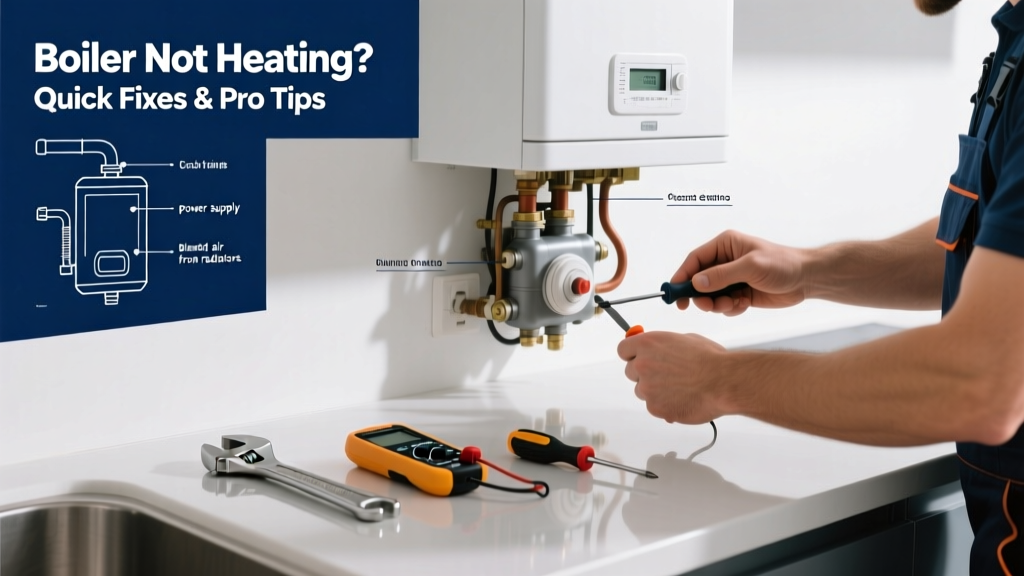
If your kitchen boiler suddenly stops heating — no hot water, no radiators warming up, and that familiar hum gone silent — don’t panic. This is a common but urgent issue, especially in compact kitchen boiler setups where space constraints and frequent use increase wear. Most cases stem from simple, fixable causes you can address in under an hour.
Quick Diagnosis
Before grabbing tools, rule out the obvious. Kitchen boilers often share space with appliances and cabinetry, making them prone to unique failures:
- No power to the unit (check fused spur, circuit breaker, or GFCI trip)
- Low system pressure (below 1.0 bar on the pressure gauge)
- Blocked condensate pipe (frozen or clogged — common in winter)
- Thermostat or timer misconfigured for kitchen zone only
- Airlock in the heat exchanger or domestic hot water circuit
Tools & Materials Needed
| Item | Purpose | Estimated Cost |
|---|---|---|
| Combination wrench set | Tighten isolation valves and bleed points without rounding fittings | $18–$32 |
| Pressure gauge reader (digital) | Verify exact system pressure; analog dials can drift by ±0.3 bar | $24–$45 |
| Condensate pipe thaw kit (heat tape + insulation) | Prevent repeat freezing in exposed sections under sink or external wall | $29–$65 |
| Non-contact voltage tester | Safely confirm live power at boiler terminals before opening panels | $12–$22 |
Step-by-Step Fix
Try these methods in order — each targets the most likely culprit for kitchen-specific boiler failure:
- Reset the boiler and check power: Turn off the fused spur for 30 seconds, then restore. Verify the display lights up. If not, test the outlet with a lamp — many kitchen boilers plug into standard sockets behind cabinets.
- Repressurize to 1.2–1.5 bar: Locate the filling loop (usually under the boiler or behind kickboard). Open both valves slowly while watching the gauge. Close both firmly when target pressure is reached. Never exceed 3.0 bar — that triggers safety relief discharge.
- Clear the condensate pipe: Follow the white plastic pipe from the boiler base. If it runs outside or under a cold floor, feel for ice blockage. Use a hairdryer (not a torch!) on low heat for 10 minutes, then pour ½ cup warm water down the drain end to flush debris.
- Bleed the kitchen hot water circuit: Open the hot tap farthest from the boiler (often a sink or dishwasher feed), then crack open the manual air vent on the boiler’s primary heat exchanger (consult your model’s manual — location varies by brand like Vaillant ecoTEC or Worcester Greenstar).
When to Call a Pro
Stop and call a Gas Safe registered engineer immediately if you notice any of these:
- Gas smell (rotten egg odor) near the boiler or kitchen units
- Water leaking from heat exchanger seals or expansion vessel — this often means internal corrosion
- Boiler error code starting with 'E' or 'F' that persists after reset (e.g., F22 on Ideal boilers = low water pressure fault)
- Flame sensor soot buildup or cracked ceramic insulator — requires gas testing and CO verification
According to the Gas Safe Register’s 2023 incident report, 68% of carbon monoxide leaks linked to kitchen boilers involved DIY tampering with gas connections or flue components.
Prevention Tips
Kitchen boilers face higher thermal cycling and moisture exposure than those in utility rooms. Reduce recurrence with these habits:
- Test system pressure monthly — drop >0.2 bar/month signals a micro-leak
- Insulate condensate pipe runs within 1m of exterior walls using closed-cell foam (not fiberglass)
- Set kitchen zone thermostat 2°C lower than living areas to reduce short-cycling stress
- Flush the primary circuit every 3 years — sludge buildup accelerates in tight kitchen boiler compartments
Why does my kitchen boiler shut off after 5 minutes?
This points to overheating protection kicking in. Check for blocked air vents behind cabinet panels — kitchen units often trap heat. Remove toe-kick grilles and vacuum dust from fan intakes. Also verify the pump isn’t seized; listen for a faint whine when powered on.
Can I bypass the thermostat to test the boiler?
No — never bypass thermostats on modern condensing boilers. Doing so disables critical safety interlocks. Instead, set the thermostat to maximum and confirm the boiler responds. If not, the fault lies upstream: wiring, PCB relay, or room stat battery (replace CR2032 if over 2 years old).
Is it safe to repressurize a boiler myself?
Yes — if your system uses a standard filling loop and pressure stays between 1.0–1.5 bar when cold. But if pressure climbs above 2.5 bar during heating, the expansion vessel bladder may be failed. That requires specialist diagnosis — see expansion vessel replacement.
How do I know if the diverter valve is stuck?
In combi boilers, a stuck diverter valve causes hot water but no heating (or vice versa). Try running hot water while turning up the heating — if radiators stay cold, the valve isn’t shifting. Tap the valve body gently with a rubber mallet while operating; if it clicks and heating starts, replace it soon. See our guide on diverter valve repair.
What’s the average lifespan of a kitchen-installed boiler?
10–12 years — 2 years less than utility-room units, per the Building Research Establishment’s 2022 Domestic Heating Survey. Tight spaces restrict airflow, raise ambient temps, and limit service access, accelerating component fatigue.
Can limescale cause no heating in a kitchen boiler?
Absolutely — especially in hard water areas. Limescale coats the heat exchanger, reducing efficiency and triggering overheating cutouts. If your boiler fires for 90 seconds then shuts off repeatedly, descaling may be needed. Use only manufacturer-approved inhibitors like Fernox Protector F1 — never vinegar or citric acid on aluminum heat exchangers.
Fixing a non-heating kitchen boiler doesn’t always mean calling in backup — but knowing when to stop matters more than knowing how to start. Keep your filling loop accessible, log pressure readings quarterly, and treat that narrow gap behind the cabinet like a maintenance hatch, not a storage void. A few minutes of proactive care now prevents frozen pipes and emergency call-outs later — especially when dinner’s on the stove and the hot water’s gone.