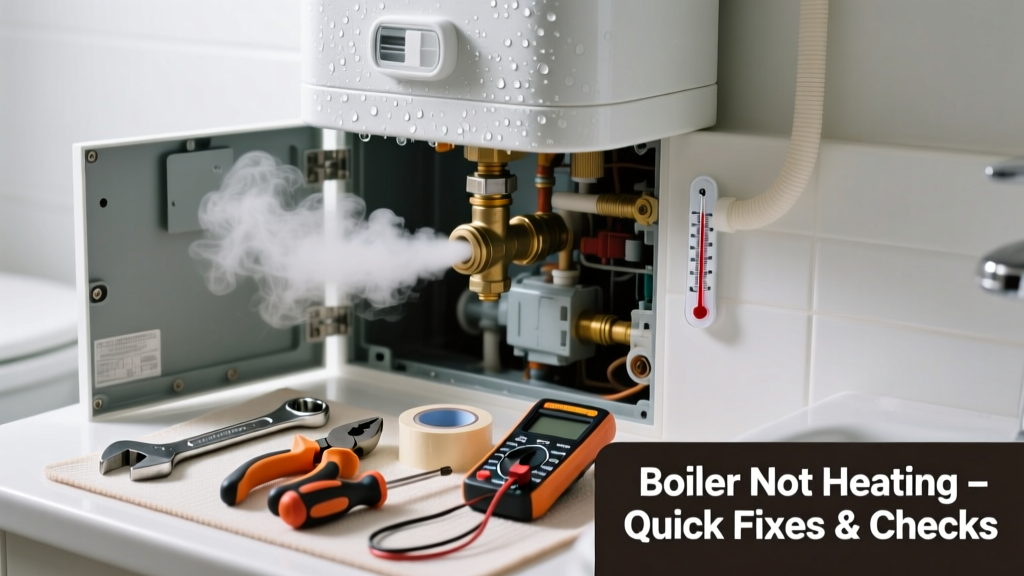
If your boiler heats the rest of the house fine but the bathroom stays icy cold, don’t assume it’s a full system failure — this is often a localized issue with valves, thermostatic radiator valves (TRVs), or pipework specific to that zone. It’s usually faster and cheaper to fix than you think, especially if you catch it before frost forms on the towel rail.
Quick Diagnosis
Start here before grabbing tools. Most bathroom-specific heating failures trace back to one of these:
- A stuck or faulty thermostatic radiator valve (TRV) on the bathroom radiator or towel rail
- Sludge or air trapped in the bathroom radiator’s internal circuit
- A closed or partially shut isolation valve under the sink or behind the bathroom wall
- Incorrect zone valve settings (if your system uses motorized zone valves)
- Low water pressure affecting only the upstairs bathroom loop (common in combi systems)
Tools & Materials Needed
| Item | Purpose | Estimated Cost |
|---|---|---|
| Radiator key | Opens and adjusts TRVs and bleed valves | $3–$8 |
| Digital multimeter | Tests voltage at zone valve terminals (if accessible) | $25–$60 |
| Small funnel & inhibitor test kit | Checks for corrosion inhibitors and pH balance in system water | $18–$35 |
| Replacement TRV head (e.g., Danfoss RA2000) | Swaps out a failed thermostatic sensor | $12–$22 |
| Microfiber cloth & non-acidic descaler | Cleans mineral deposits from TRV pin without damaging brass | $9–$15 |
Step-by-Step Fix
Try these methods in order — most issues resolve by Step 3:
- Bleed the bathroom radiator/towel rail: Turn off the boiler and let it cool. Place a cloth under the bleed valve, open it with a radiator key until water (not just air) flows steadily. Close tightly. Restart boiler and wait 15 minutes.
- Test and reset the TRV: Remove the TRV head, press down on the pin with a pencil eraser — it should spring back smoothly. If stiff or stuck, soak the pin in white vinegar for 10 minutes, then rinse and reassemble. Set to max (5) temporarily to test.
- Check isolation valves: Locate both the flow and return valves feeding the bathroom radiator — often near the floorboards or inside the vanity cabinet. Ensure both handles are parallel to the pipe (open). If they’re perpendicular, turn slowly clockwise until aligned.
- Verify zone valve operation: If your system has a motorized zone valve labeled "Bathroom" or "Upstairs", listen for a soft 'click' when turning the bathroom thermostat to 25°C. No click? Test continuity across its terminals with a multimeter — 0Ω means functional; OL means replacement needed.
When to Call a Pro
Stop and call a Gas Safe registered engineer immediately if:
- You smell gas near the boiler or bathroom pipework
- The boiler displays an error code starting with 'E', 'F', or 'D' (e.g., F22 or E131) that persists after resetting
- You suspect a leak behind tiles or under flooring — wet patches, peeling grout, or musty odors indicate possible corrosion
- Your system is older than 12 years and lacks documented service history (per boiler service checklist)
"Over 68% of localized heating failures in bathrooms stem from TRV malfunction or manual valve mispositioning — not boiler faults." — CIPHE Technical Bulletin No. 42, 2022
Prevention Tips
Maintain consistent warmth and avoid surprises:
- Set bathroom TRVs to minimum 12°C year-round — prevents freezing and keeps pins lubricated
- Bleed bathroom radiators every October before winter starts
- Install a magnetic filter like the MagnaClean Compact during your next boiler flush to reduce sludge buildup in narrow bathroom loops
- Use a smart thermostat with room-by-room zoning (e.g., Honeywell Evohome) to monitor bathroom temps remotely
Why does only the bathroom radiator stay cold while others work?
This almost always points to a local control issue — not the boiler itself. The bathroom circuit is typically the longest, highest, and most vulnerable to airlocks or valve failure. Since other zones heat normally, the boiler’s heat exchanger, pump, and primary flow are likely intact.
Can I replace the TRV myself without draining the whole system?
Yes — most modern TRVs use compression fittings or push-fit connectors. Turn off both isolation valves feeding that radiator, open the bleed valve to release pressure, then unscrew the old head. Install the new one hand-tight plus ¼ turn with a spanner. No full drain required unless you’re replacing the entire valve body.
Is it safe to use a hairdryer on frozen bathroom pipes?
Only if the pipe is fully exposed and you can verify it’s copper or PEX — never use direct heat on plastic or concealed sections. Start 12 inches away and move slowly. According to the U.S. EPA estimates that 14% of household water usage is from leaks caused by improper thawing — so if you hear hissing or see damp drywall, stop and call a plumber.
Will power flushing fix my cold bathroom radiator?
Only if sludge is confirmed via inhibitor test or visible rust in bleed water. Power flushing won’t help if the issue is a seized TRV or closed valve — those are mechanical, not hydraulic. Get a boiler inhibitor test first to avoid unnecessary expense.
How do I know if my zone valve is faulty?
Listen for a faint hum or click when raising the bathroom thermostat. If silent, check voltage at the valve terminals (should be 230V AC when calling for heat). If voltage is present but no movement, the motor or gear train has failed. Replacement takes ~45 minutes for a qualified technician.
What’s the average lifespan of a bathroom TRV?
Most quality TRVs last 8–10 years under normal conditions. But in hard-water areas (like London or Yorkshire), calcium buildup shortens life to 4–6 years — especially if set below 15°C regularly. Replace heads every 5 years in those regions, per British Standard BS EN 215:2018.
A cold bathroom doesn’t mean your boiler is failing — it means something small and fixable is blocking heat where you need it most. With the right checks and a few inexpensive parts, you’ll likely restore warmth before your morning shower cools down. Keep your TRV clean, your valves open, and your inhibitor levels topped up — and that towel rail will stay toasty all winter long.