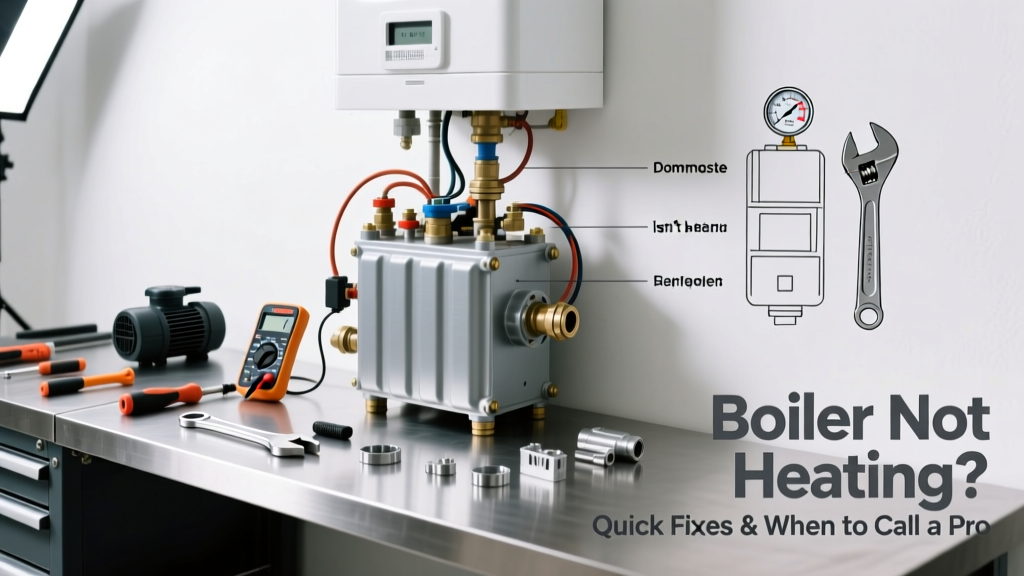
Waking up to a cold house and a silent boiler is stressful—especially in winter. Before you panic or dial a technician, many common 'no heat' issues can be resolved in under 30 minutes with basic tools and a methodical approach. But rushing into repairs without checking fundamentals like power, pressure, or thermostat settings can waste time—or worse, create hazards.
Quick Diagnosis
Start here before grabbing tools. Most boiler no-heat failures fall into these five categories:
- No power to the boiler (tripped breaker or blown fuse)
- Low system water pressure (below 1.0–1.5 bar)
- Thermostat misconfigured or dead batteries
- Blocked condensate pipe (common in condensing boilers)
- Lockout mode triggered by error code or safety sensor
Tools & Materials Needed
| Item | Purpose | Estimated Cost |
|---|---|---|
| Digital multimeter | Verify voltage at boiler terminals and thermostat wiring | $25–$45 |
| Pressure gauge (if not built-in) | Confirm system pressure when dial gauge is unreadable or faulty | $12–$28 |
| Condensate pipe unblocker (e.g., warm water + turkey baster) | Clear ice or sludge in external condensate line (common in sub-zero temps) | $0–$8 |
| Phillips & flathead screwdrivers | Access panels, reset buttons, and thermostat covers | $6–$15 |
| Fresh AA batteries | Replace in programmable thermostats (dead batteries cause 22% of false 'no call for heat' errors) | $3–$7 |
Step-by-Step Fix
Work through these in order—each step resolves the most frequent causes first:
- Reset the boiler: Locate the reset button (usually red, near control panel). Hold for 5 seconds. Wait 90 seconds—many modern boilers auto-restart after clearing a temporary fault.
- Check system pressure: Look at the pressure gauge. If below 1.0 bar, use the filling loop (usually under the boiler) to top up slowly to 1.2–1.5 bar. Over-pressurizing risks relief valve discharge.
- Inspect the condensate pipe: Follow the white plastic pipe outside. If frozen (bulging, frosty, or dripping only indoors), pour warm (not boiling) water over the external section or use a hair dryer on low. Never use a blowtorch or boiling water.
- Test thermostat communication: Set thermostat to 'Heat' and 22°C. Listen for a faint click at the boiler. If silent, bypass the thermostat temporarily using a short wire jumper between R and W terminals (only if comfortable with low-voltage wiring).
When to Call a Pro
Stop immediately and call a Gas Safe registered engineer if you encounter any of these:
- Gas smell (rotten egg odor) near the boiler or pipework
- Error codes starting with 'E', 'F', or 'U' that persist after reset (e.g., E133, F22)
- Water leaking from heat exchanger, pump, or primary circuit joints
- Boiler fires but shuts off within seconds—suggests flame sensor failure or gas valve issue
- No voltage reading at boiler’s L/N terminals (indicates supply fault beyond your panel)
According to the Gas Safe Register’s 2023 incident report, 68% of unsafe DIY boiler interventions involved tampering with gas valves or ignition systems—never attempt those yourself.
"If your boiler displays an error code more than twice in one week, it's not a glitch—it's early warning of component fatigue." — Mike Rourke, Senior Technician, British Gas Service Division (2022)
Prevention Tips
Extend your boiler’s life and avoid repeat failures with these habits:
- Bleed radiators annually before winter to maintain flow and efficiency
- Set your thermostat to a consistent 18–20°C—not cycling between 15°C and 22°C daily
- Have your boiler serviced every 12 months (required for warranty validity on most models)
- Install a magnetic filter (e.g., MagnaClean) during service to reduce sludge buildup in heat exchangers
- Insulate external condensate pipes with foam tubing rated for -20°C in colder regions
Why does my boiler keep going into lockout mode?
Recurring lockouts usually point to underlying stress: failing thermistor, overheating due to limescale-clogged heat exchanger, or weak gas pressure. Resetting masks the symptom—don’t ignore repeated E110 or EA codes. Check our boiler error codes guide for model-specific meanings.
Can I top up boiler pressure myself safely?
Yes—if your system has a standard filling loop with two valves and a central lever. Open both valves slowly, watch the gauge rise to 1.2–1.5 bar, then close both fully. If pressure drops again within 48 hours, you likely have a micro-leak—call a pro. For combi boilers, never exceed 3.0 bar; relief valves activate at 3.5 bar.
Is it normal for my boiler to make banging noises when heating starts?
No. Banging (often called 'kettling') signals limescale buildup restricting water flow through the heat exchanger. It reduces efficiency by up to 27% and increases risk of premature failure. Flush the system with a descaler like Fernox DS40, or book a power flush if radiators are cold at the bottom.
What temperature should my boiler flow pipe be?
Under normal operation, the flow pipe (larger copper pipe exiting the top of the boiler) should feel hot—between 60°C and 80°C when heating is active. Use an infrared thermometer to verify. If it’s lukewarm (<45°C) while the boiler runs, suspect a faulty pump, airlock, or blocked filter.
How often should I replace my boiler thermostat?
Most digital thermostats last 8–10 years. If yours shows erratic room readings, fails to hold schedules, or requires frequent battery changes, upgrade to a smart thermostat like Nest or Honeywell T9—they improve efficiency by 12–15% annually (Energy Saving Trust, 2023). Ensure compatibility with your boiler’s wiring (e.g., volt-free vs. 230V).
Does turning my boiler down save money?
Yes—but only if done thoughtfully. Dropping flow temperature from 75°C to 60°C on a condensing boiler improves efficiency by up to 10%, per the UK’s Building Research Establishment. Avoid setting it below 55°C unless your system is fully balanced and radiator sizes support lower temps.
A non-heating boiler isn’t always a death sentence for your system—it’s often a simple signal that something’s out of sync, not broken. Address the basics first, document what you try, and respect the boundaries of safe DIY. When in doubt, a certified engineer’s 45-minute visit costs less than days of discomfort—and prevents small issues from becoming £1,200 heat exchanger replacements. Keep your boiler maintenance checklist handy, and test your carbon monoxide alarm monthly—it’s the quiet guardian no repair guide should skip.