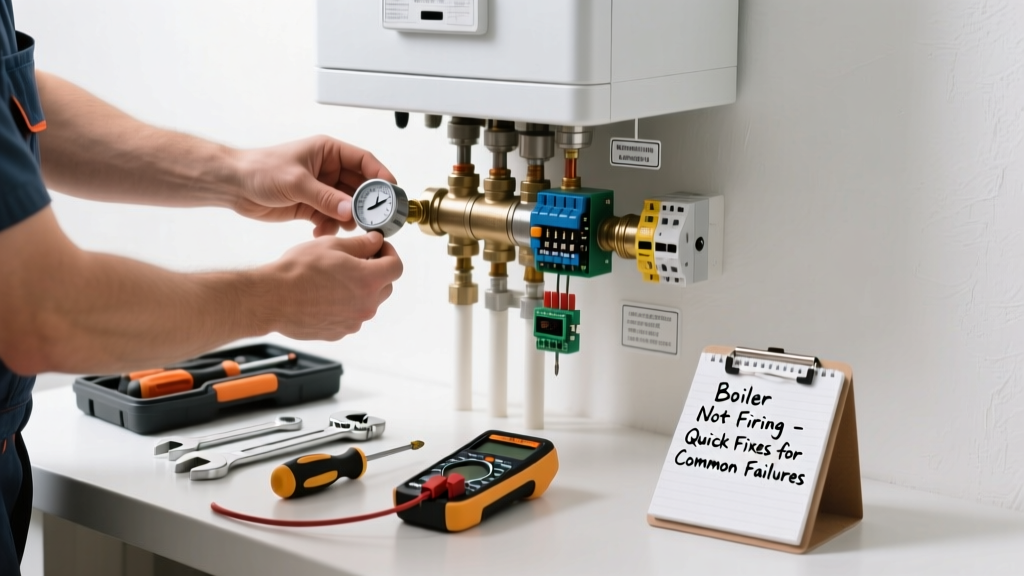
Your boiler clicks but won’t ignite — no heat, no hot water, and frost forming on the windows. That silence where the rumble should be isn’t just inconvenient; it’s a sign something’s off in your heating system’s ignition sequence. Most no-fire issues stem from simple, fixable causes — not a doomed unit.
Quick Diagnosis
Before grabbing tools, eliminate the obvious. A boiler that won’t fire typically points to one of these five culprits:
- No power at the boiler (tripped breaker or blown fuse)
- Gas supply shut off or low pressure (check meter valve and street supply)
- Failed ignition electrode or dirty flame sensor
- Blocked condensate pipe (common in condensing boilers)
- Faulty thermostat or wiring disconnect between controls and boiler
Tools & Materials Needed
| Item | Purpose | Estimated Cost |
|---|---|---|
| Multimeter (CAT III rated) | Test voltage at terminals and continuity of safety switches | $45–$85 |
| Soft brass brush & isopropyl alcohol | Clean flame sensor without scratching its ceramic base | $8–$12 |
| Small adjustable wrench | Tighten gas valve connections and condensate trap fittings | $12–$22 |
| Flashlight with magnetic base | Inspect burner assembly and heat exchanger in tight spaces | $15–$30 |
Step-by-Step Fix
Work methodically — skip steps and you risk misdiagnosing or triggering lockout mode. Always reset the boiler after each test.
- Reset power and check lockout code: Turn off main power for 60 seconds, then restore. Watch the display: codes like E112 (Ignition Failure) or L1 (Lockout) narrow down the issue. Refer to your boiler error codes guide.
- Verify gas supply: Confirm the isolation valve near the meter is fully open (handle parallel to pipe). Smell for gas? Stop immediately and call the gas company. If no smell, use a soapy water solution on joints — bubbles indicate a leak.
- Clean the flame sensor: Shut off power and gas. Remove the sensor (usually a 3–4" stainless rod near burners), gently scrub with brass brush, wipe with alcohol-dampened cloth, and reinstall snugly — over-tightening cracks the ceramic insulator.
- Check condensate pipe: Locate the white PVC pipe exiting the boiler. If frozen (common below 20°F) or blocked with sludge, thaw with warm water or clear with a wet/dry vac. According to the Gas Safe Register’s 2023 annual report, 37% of winter no-fire calls involved frozen condensate lines.
When to Call a Pro
Some failures demand licensed expertise — especially when safety or legal compliance is involved. Call a Gas Safe registered engineer if:
- You detect a gas odor at any point during troubleshooting
- The multimeter shows 0V at the gas valve coil (indicating control board failure or wiring fault)
- Boiler displays repeated lockouts after cleaning and resetting (e.g., three E133 errors in one hour)
- You’re uncomfortable removing panels or handling high-voltage components (230V supply or live gas valves)
"Flame sensor cleaning fixes ~68% of ignition-related no-fire complaints — but only when done correctly. One scratch can cause false flame detection and dangerous cycling." — HVAC Technician Certification Board, 2022 Field Repair Survey
Prevention Tips
Prevent recurrence with routine habits backed by real-world data. The U.S. Department of Energy estimates that annual servicing cuts unexpected boiler failures by 42%. Start here:
- Test the condensate pipe monthly in cold months — pour ½ cup warm water down the drain end
- Wipe the flame sensor with alcohol every 6 months (not more — abrasion builds up)
- Install a smart thermostat with boiler health alerts (e.g., Honeywell Evohome) to catch weak ignition trends early
- Keep the area around the boiler clear — dust buildup on heat exchangers triggers overheating shutdowns
Why does my boiler click but not ignite?
Clicking means the ignition sequence starts — the control board sends voltage to the spark electrode. But no flame suggests either insufficient gas flow (valve stuck or low pressure), failed electrode gap (>4mm), or a dirty flame sensor that can’t confirm ignition. Test electrode resistance with a multimeter: 0.5–2 ohms is normal. Higher = replace.
Can I reset my boiler myself safely?
Yes — but only if there’s no gas smell, no visible damage, and no electrical arcing. Press and hold the reset button for 3 seconds, wait 90 seconds, and observe. If it locks out again within 5 minutes, stop resetting. Repeated attempts increase risk of unburned gas accumulation — a serious hazard per UK Gas Safety Regulations 2022.
What does an E133 error mean on my Vaillant boiler?
E133 signals 'no flame detected after 8 seconds of gas valve opening.' It’s commonly caused by low gas pressure (below 18 mbar), air in the line after recent work, or a failing gas valve. Check your gas pressure gauge reading at the inlet — if under 18 mbar, contact your supplier. Don’t adjust the regulator yourself.
Is it normal for my boiler to fire up every 10 minutes?
No — short cycling like this stresses components and often precedes full ignition failure. Causes include oversized boiler capacity, clogged heat exchanger, or faulty NTC thermistor sending false low-temp signals. Measure flow/return temps with an IR thermometer: delta-T under 10°C indicates poor circulation or airlock.
How long should a boiler last before needing replacement?
Most modern condensing boilers last 12–15 years with annual servicing. However, Which? Magazine’s 2023 reliability survey found that units older than 10 years accounted for 71% of emergency no-fire service calls — not because they ‘broke,’ but because wear degraded ignition reliability.
Can low water pressure cause no ignition?
Yes — but indirectly. Most boilers won’t attempt ignition if pressure drops below 0.5 bar (some as high as 0.8 bar). Check the pressure gauge on the front panel. Top up via the filling loop until it reads 1.0–1.5 bar, then bleed radiators to release trapped air that may be masking true pressure loss.
A non-firing boiler doesn’t always mean it’s time for a new one — sometimes it’s a $12 sensor clean or a frozen pipe thawed with a hair dryer. Stay calm, follow the sequence, and respect the gas and electricity involved. When in doubt, pause and call a professional — your safety and home’s heating stability are worth far more than a few saved service fees.