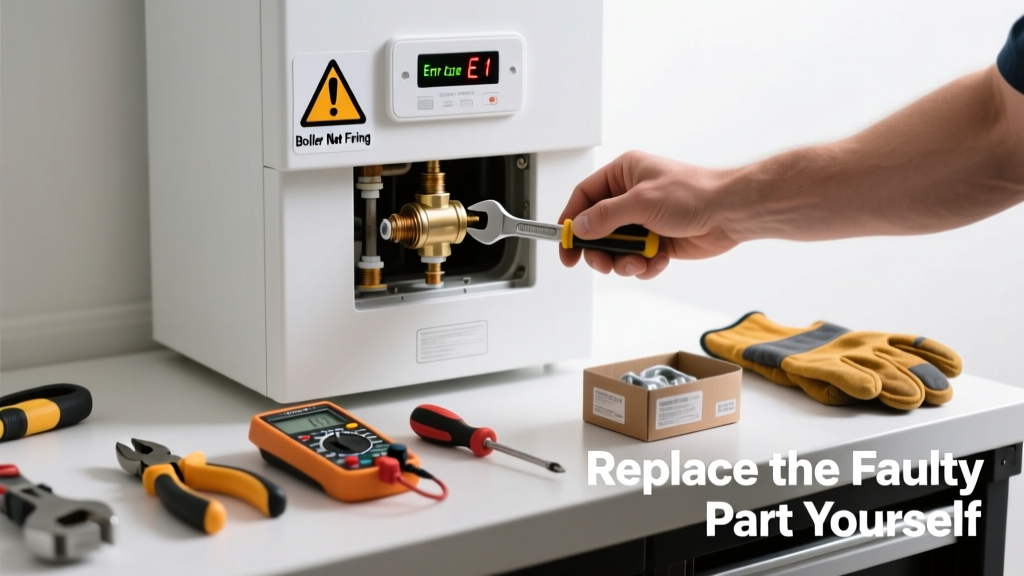
If your boiler isn’t firing — no ignition, no heat, just cold radiators and a silent unit — the culprit is often a single failed component, not the whole system. Most homeowners can identify and replace it in under two hours, avoiding a $200+ service call. But rushing in without proper diagnosis risks misdiagnosis or safety hazards.
Quick Diagnosis
Before grabbing tools, rule out simple causes:
- No power to the boiler (check circuit breaker and wall switch)
- Gas supply shut off (verify valve position and utility status)
- Low water pressure (below 12 psi on analog gauge or flashing 'L' on digital display)
- Blocked condensate trap (common on condensing boilers — look for gurgling or error code E27)
- Faulty thermostat wiring or dead batteries (test with manual override)
Tools & Materials Needed
| Item | Purpose | Estimated Cost |
|---|---|---|
| Multimeter (digital, CAT III rated) | Test voltage at ignition electrode, gas valve, and control board terminals | $45–$85 |
| Phillips #2 and flat-head screwdrivers | Access panels, terminal covers, and mounting hardware | $8–$15 |
| Ignition electrode (model-specific) | Replaces carbon-fouled or cracked spark rod (e.g., Baxi 630997, Worcester 2004015) | $22–$48 |
| Gas valve solenoid kit (if applicable) | Fixes intermittent gas flow; includes O-rings and coil | $35–$72 |
| Condensate neutralizer tablet pack | Prevents acidic condensate corrosion in PVC drain lines | $14–$26 |
Step-by-Step Fix
Follow these methods in order — most failures are resolved by step 1 or 2:
- Replace the ignition electrode: Power off boiler, remove front panel, locate ceramic-tipped rod near burner. Unscrew mounting bracket, disconnect wire, install new electrode aligned 3–4 mm from burner port. Tighten gently — over-torquing cracks ceramic.
- Test and replace flame sensor: Use multimeter in microamp mode (µA) while boiler attempts ignition. A healthy reading is 1.5–5.0 µA. Clean with fine steel wool if below 1.0 µA; replace if cleaning fails or tip is pitted.
- Reset high-limit thermostat: Locate red reset button (often behind access panel near heat exchanger). Press firmly — if it clicks and stays in, power cycle and test. If it trips again within 90 seconds, suspect blocked flue or failing pump.
- Clear condensate trap: Turn off power and gas. Disconnect clear PVC trap, empty into bucket, flush with warm water and 1 tsp white vinegar. Reinstall with level bubble centered.
When to Call a Pro
Stop and call a Gas Safe registered engineer (UK) or licensed HVAC technician (US) if:
- You measure less than 24V AC at the gas valve terminals during ignition attempt — points to PCB failure or transformer issue
- Boiler displays error codes starting with 'D', 'F', or 'U' (e.g., F22 on Vaillant, U0 on Navien) — indicates combustion or pressure sensor faults
- You smell gas at any point — evacuate and call emergency services first, then your utility
- Your boiler is under warranty and opening the casing voids coverage (check manual — many require certified techs for part replacement)
Prevention Tips
Extend boiler life and avoid repeat failures with these habits:
- Flush the primary heat exchanger every 2 years using Fernox DS40 or Sentinel X100 descaler
- Replace the system filter (e.g., MagnaClean) annually — sludge buildup starves components of current
- Install a smart thermostat with boiler health monitoring (e.g., Nest Learning Thermostat with Heat Link Gen 3)
- Schedule an annual service —
According to the UK’s Gas Safe Register 2023 Annual Report, 68% of boiler breakdowns in homes without annual servicing involved ignition or sensor failure.
Can I test the gas valve with a multimeter?
Yes — but only for continuity and coil resistance. Set your meter to ohms (Ω), disconnect wires, and check for 30–120 Ω across solenoid terminals. A reading of OL (open loop) means the coil is blown. Never test live voltage across gas valve inputs unless trained — risk of explosion exists if gas leaks during testing.
How long does a replacement ignition electrode last?
Typically 5–8 years in hard-water areas and 8–12 years with regular maintenance. Electrodes degrade faster when the burner isn’t cleaned annually — soot buildup insulates the spark gap. Check yours during your boiler burner cleaning guide.
Why does my boiler fire once then shut off?
This ‘lockout after first ignition’ usually signals a failing flame sensor or draft inducer motor. The sensor detects flame via ionization current — if corroded or misaligned, it reads ‘no flame’ even when burning. Also inspect the small rubber hose connecting the inducer to the pressure switch for cracks or moisture blockage — a common cause of false draft fault errors.
Do I need to drain the system to replace the flame sensor?
No — the flame sensor mounts externally on the burner assembly and requires no pipe disconnection. However, you must power down the boiler completely and wait 5 minutes for capacitors to discharge. Always verify isolation with your multimeter before touching terminals.
What’s the difference between an ignition electrode and a flame sensor?
The ignition electrode creates the spark that lights the gas; the flame sensor (usually a stainless steel rod beside it) confirms the flame is present by measuring ionized current. On some models like Ideal Logic+ or Viessmann Vitodens, they’re combined into one dual-function rod — replacing one replaces both.
Can I use generic replacement parts?
Only if explicitly cross-referenced by the manufacturer. Using non-OEM electrodes or sensors with incorrect millivolt output or spacing can cause delayed ignition, sooting, or repeated lockouts. Check your boiler’s exact model number on boiler part cross-reference guide before ordering.
A properly diagnosed and replaced part restores reliable heating fast — but don’t skip the diagnostic steps. What looks like a simple electrode failure could be masking a failing pump or airlocked system. Keep your multimeter calibrated, your manual handy, and always prioritize gas safety over speed. And remember: if the boiler hasn’t fired in over 48 hours, especially in freezing weather, act quickly — frozen pipes are far costlier than a $30 sensor.