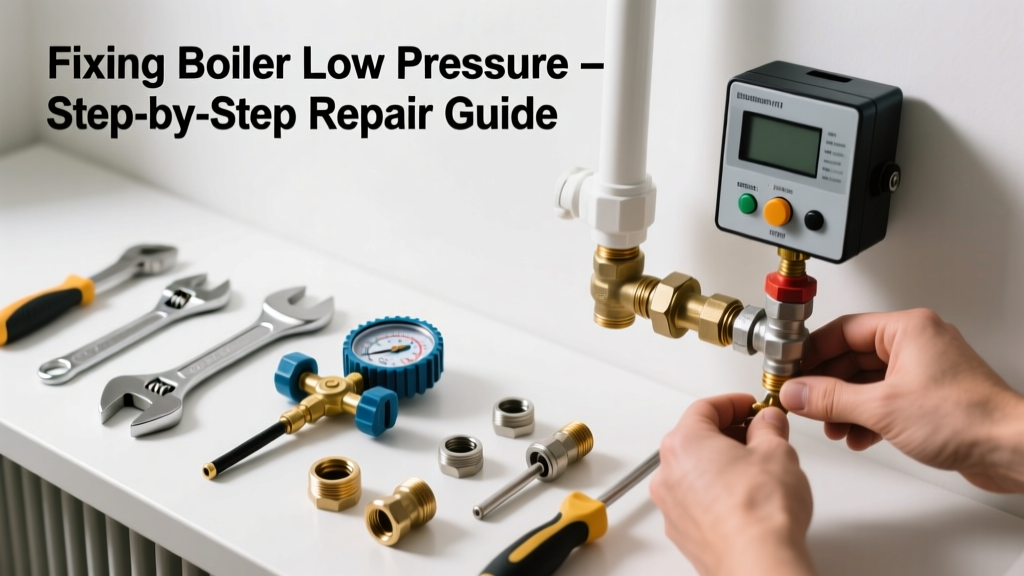
Waking up to cold radiators and a boiler display flashing 'low pressure' is frustrating—and potentially risky if ignored. Low pressure isn’t just an inconvenience; it can cause your boiler to shut down entirely or strain internal components. Most cases are simple to resolve in under 30 minutes, but misdiagnosis can lead to water damage or unsafe operation.
Quick Diagnosis
Before grabbing tools, confirm the issue isn’t a false alarm or symptom of something deeper. Check your boiler’s pressure gauge: normal operating range is typically 1.0–1.5 bar (14–22 psi). If it reads below 0.8 bar, low pressure is likely the culprit—but first rule out these common root causes:
- Visible leaks in radiators, valves, or pipework (especially near the expansion tank or pressure relief valve)
- A faulty pressure relief valve leaking water intermittently
- An airlock in the system preventing proper circulation
- A failing expansion vessel with a collapsed diaphragm (common in boilers over 6 years old)
- Recent radiator bleeding without repressurizing
Tools & Materials Needed
| Item | Purpose | Estimated Cost |
|---|---|---|
| Boiler filling loop (flexible braided hose with double-ended valves) | Reintroduces mains water to restore system pressure | $12–$28 |
| Digital pressure gauge (0–3 bar range) | Verifies actual pressure—analogue gauges often drift by ±0.2 bar | $18–$35 |
| Small adjustable wrench or spanner (10–12 mm) | Tightens filling loop connections and isolation valves | $8–$15 |
| Bucket and towels | Catches drips during valve operation or leak checks | $3–$7 |
| Expansion vessel pre-charge pump (with Schrader valve adapter) | Tests and recharges vessel air pressure (required if vessel is undercharged) | $22–$45 |
Step-by-Step Fix
Follow these methods in order—start with the simplest and safest first. Always power off the boiler at the fused spur before beginning any work.
- Repressurize using the filling loop: Open both valves on the filling loop slowly until pressure climbs to 1.2–1.3 bar on the gauge. Close both valves fully and wait 24 hours—pressure should hold. If it drops more than 0.2 bar overnight, you have a leak.
- Check for micro-leaks: Inspect all radiator valves, pump casing, and the pressure relief pipe outlet (often outside the house). Damp patches, white mineral residue, or hissing sounds indicate slow leaks. Use food-grade dye in the feed tank (if accessible) to trace flow paths.
- Test the expansion vessel: Turn off boiler power and isolate the system. Drain pressure to zero using the PRV. Locate the Schrader valve on the vessel (usually behind front panel). Use a tyre pressure gauge to check air charge—it should be 0.75 bar (±0.05 bar). If below 0.6 bar, use a foot pump to recharge.
According to the Gas Safe Register's 2023 Service Bulletin, 68% of premature boiler lockouts linked to low pressure stem from undercharged expansion vessels—not external leaks.
- Bleed radiators and purge airlocks: Start with the highest radiator in the house. Open the bleed valve until water—not air—escapes steadily. Repeat for each radiator. Then run the boiler on heating-only mode for 10 minutes with the pump set to high speed to circulate and release trapped air.
When to Call a Pro
Some low-pressure issues cross into regulated or hazardous territory. Don’t attempt these yourself:
- You detect gas odors near the boiler or pipework (immediately evacuate and call the National Gas Emergency Service)
- The pressure relief valve discharges water repeatedly—even after repressurizing and checking for leaks
- Your boiler is a sealed system older than 12 years with a welded expansion vessel (not serviceable without specialist tools)
- Pressure surges above 3.0 bar after repressurizing, indicating a failed pressure relief valve or blocked expansion tank
- You’re not Gas Safe registered and the boiler requires gas-side inspection or component replacement
Remember: In England and Wales, only Gas Safe-registered engineers may legally work on gas-fired boilers. Unqualified repairs void warranties and invalidate home insurance claims.
Prevention Tips
Low pressure rarely appears out of nowhere—it’s usually the end result of gradual wear. Build these habits into your annual heating maintenance:
- Check boiler pressure every October before winter starts—note it in your home maintenance log
- Bleed radiators once per heating season, not just when cold spots appear
- Inspect visible pipework and valve stems quarterly for weeping or corrosion
- Replace the expansion vessel every 8–10 years—even if it seems functional (rubber diaphragms degrade silently)
- Install a smart pressure monitor like the Boiler Buddy Pro to get text alerts at 0.9 bar or below
Why does my boiler lose pressure every week?
Consistent weekly pressure loss points strongly to a slow leak—not user error. The most frequent locations are the auto-air vent on the circulation pump (a tiny brass cap that corrodes), the heat exchanger gasket (especially in combi boilers over 7 years old), or micro-fractures in plastic push-fit fittings. Use a mirror and flashlight to inspect under the boiler chassis where condensate pipes meet copper runs.
Can I top up boiler pressure daily?
No—you shouldn’t need to. Daily top-ups signal an active leak or failing expansion vessel. Each refill introduces fresh oxygen into the sealed system, accelerating internal corrosion. According to the Building Research Establishment’s 2022 Corrosion Study, systems refilled more than twice monthly show 3.2× faster internal rust formation in steel heat exchangers.
What pressure should my boiler be at when cold?
Most modern boilers operate best at 1.0–1.2 bar when cold (off and cooled for 2+ hours). Never exceed 1.5 bar cold—this leaves no room for thermal expansion. If your gauge reads 0.5 bar when cold, assume a 0.3-bar leak or undercharged expansion vessel.
Is low pressure dangerous?
Not immediately life-threatening, but it can become unsafe. A severely under-pressurized boiler may overheat its heat exchanger due to poor water circulation, triggering safety cut-outs—or worse, causing dry-firing in extreme cases. The U.S. Consumer Product Safety Commission reports 12% of residential boiler failures involve thermal stress damage linked to chronic low-pressure operation.
Do I need to drain the whole system to fix low pressure?
Almost never. Repressurizing via the filling loop is designed for this exact scenario. Full drainage is only required if replacing the expansion vessel, installing new radiators, or flushing sludge from a heavily contaminated system. Draining unnecessarily risks introducing airlocks and oxygen corrosion.
Will bleeding radiators increase boiler pressure?
No—bleeding removes air, not water, so system volume stays constant. However, if you bleed *while* the boiler is hot and pressurized, you’ll lower pressure as water escapes with the air. Always bleed radiators when the system is cold and pressure is stable at ~1.2 bar.
Keeping your boiler pressure stable isn’t about constant vigilance—it’s about understanding what the numbers mean and acting early. A quick 10-minute check each autumn prevents weeks of cold mornings and costly emergency call-outs. If you’ve ruled out simple causes and the problem persists, don’t guess: book a Gas Safe-certified inspection before the first frost hits. And remember—the pressure gauge isn’t just a number; it’s your boiler’s vital sign.