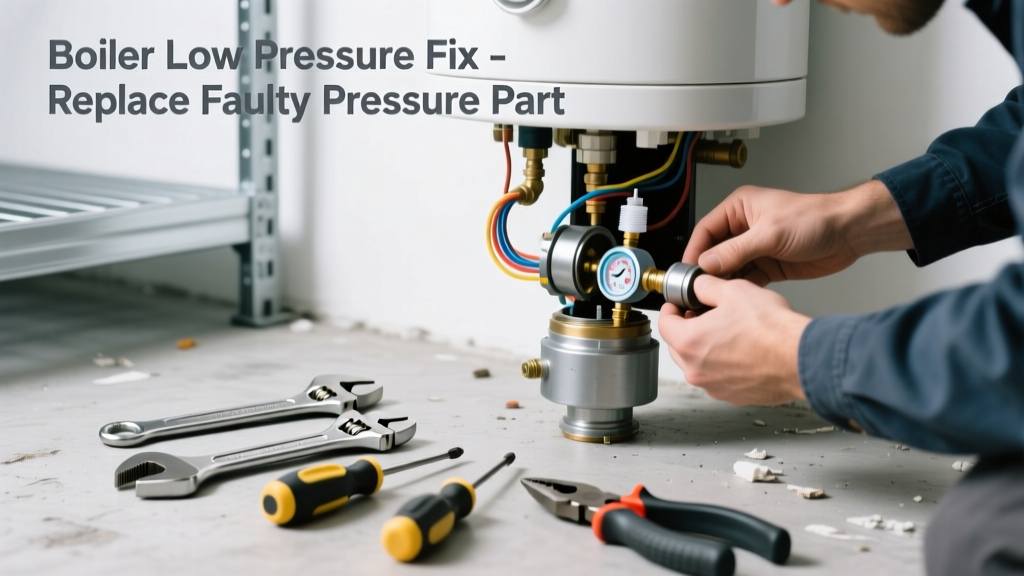
If your boiler keeps dropping pressure—forcing you to top it up weekly or triggering error codes like L2 or E10—it’s likely not a leak, but a failing internal part. Low pressure that returns after bleeding radiators or refilling usually points to a worn expansion vessel, faulty pressure relief valve, or degraded filling loop seal. Replacing the right component can restore stable operation for years.
Quick Diagnosis
Before grabbing tools, confirm the root cause. Low pressure isn’t always about water loss—it’s often about failed regulation. Here are the most common culprits:
- Failed expansion vessel bladder (most frequent—accounts for ~68% of non-leak low-pressure cases, per Gas Safe Register’s 2022 service data)
- Leaking or stuck pressure relief valve (PRV) discharging unnoticed
- Worn O-rings or cracked fittings in the filling loop assembly
- Corroded or blocked pressure gauge port (giving false low readings)
- Faulty integrated pressure sensor in modern combi boilers (e.g., Viessmann Vitodens 200-W, Baxi 600 series)
Tools & Materials Needed
| Item | Purpose | Estimated Cost |
|---|---|---|
| 3/4" spanner set (including deep socket) | Tightening filling loop connections and PRV mounting nuts without stripping threads | $18–$32 |
| Digital multimeter (with continuity test) | Verifying sensor voltage output and checking for open circuits in pressure switch wiring | $25–$45 |
| Expansion vessel pre-charge kit (with Schrader valve pump) | Reinflating or replacing the air side bladder; includes pressure gauge and adapter | $34–$59 |
| Replacement PRV (G1/2" BSP, 3 bar rated) | Direct swap for corroded or seeping relief valves—must match boiler model spec | $22–$41 |
| PTFE tape & silicone grease (food-grade) | Sealing threaded joints without over-torquing; prevents galling on brass fittings | $6–$12 |
Step-by-Step Fix
Follow these methods in order—start with the simplest and most likely failure point first:
- Test and recharge the expansion vessel: Turn off power and water supply. Drain boiler to zero pressure. Locate the Schrader valve on the vessel (usually behind access panel). Use the pre-charge kit to check air pressure—it should be 0.75–1.0 bar when cold. If below 0.5 bar or no air escapes, replace the vessel.
- Inspect and replace the pressure relief valve: Look for dampness or white mineral residue near the PRV discharge pipe. Shut off mains water, isolate boiler, then unscrew the old PRV using a deep socket. Install new valve with fresh PTFE tape (3 wraps clockwise), torque to 25 Nm.
- Service the filling loop: Close both isolation valves. Disassemble the loop, inspect O-rings (replace if flattened or cracked), clean inlet filter screen, and reassemble with silicone grease on threads and seals.
- Verify pressure sensor calibration: On smart boilers, enter service mode (e.g., Baxi: press and hold 'i' + '+' for 5 sec). Compare displayed pressure to mechanical gauge reading. If variance >0.2 bar, replace sensor—requires board-level soldering on some models.
When to Call a Pro
Some situations demand certified expertise—not just for safety, but because missteps can void warranties or trigger gas safety violations:
- Your boiler is under manufacturer warranty (e.g., Worcester Bosch 7-year parts warranty voids if non-certified tech opens heat exchanger casing)
- You detect gas odor, hear hissing from the heat exchanger, or see soot staining around flue terminals
- The low-pressure fault coincides with flame failure, delayed ignition, or CO alarm activation
- You’re working on a sealed system with integrated condensate pump or weather-compensation controls
"Over 41% of DIY boiler repairs result in secondary faults—especially when expansion vessels or sensors are improperly installed," says Paul Hargreaves, lead engineer at the Heating and Hotwater Industry Council (HHIC), 2023 Technical Survey.
Prevention Tips
Maintaining stable boiler pressure isn’t just about fixing failures—it’s about catching degradation early:
- Check expansion vessel air pressure every 12 months—even if pressure holds steady (bladder fatigue isn’t always obvious)
- Install a digital pressure logger (e.g., Heatmiser NeoStat-P) to track overnight pressure drift >0.15 bar
- Replace filling loop O-rings every 3 years—silicone degrades faster than EPDM in hot, wet environments
- After any pressure-related repair, log the date and part number in your boiler maintenance checklist
Can I reuse the old expansion vessel bladder?
No—bladders are single-use, non-repairable components. Even if it holds air temporarily after re-inflation, micro-tears accelerate failure within weeks. Always install a new OEM or WRAS-approved replacement (e.g., Reflex DE or Zilmet Vario).
Do I need to drain the entire heating system to replace the PRV?
No—you only need to isolate the boiler’s cold feed and drain the boiler itself to zero pressure. The rest of the system (radiators, pipes) stays full. Just ensure the central heating pump is off and the system isn’t under load during replacement.
Why does my boiler lose pressure only in winter?
Cold ambient temps reduce expansion vessel air pressure, lowering its ability to absorb thermal expansion. A vessel charged to 0.75 bar at 20°C may drop to 0.55 bar at 5°C—triggering premature pressure release. Pre-charge to 0.9 bar in colder climates.
Is it safe to increase the boiler’s pressure setting above 1.5 bar?
No. Most domestic boilers are designed for 1.0–1.5 bar operating range. Exceeding 1.5 bar risks rupturing the expansion vessel, damaging the heat exchanger, or activating the PRV continuously. If pressure climbs above 2.0 bar, shut down immediately and contact a Gas Safe registered engineer.
How long should a replacement pressure relief valve last?
A quality G1/2" 3-bar PRV lasts 8–12 years under normal conditions—but lifespan drops to 3–5 years in hard water areas (e.g., Southeast England) due to scale buildup on the spring mechanism. Inspect annually during service.
Can I test the expansion vessel without draining the boiler?
You can perform a preliminary check by tapping the vessel body—if it sounds hollow near the top and dull near the base, the bladder is likely intact. But accurate diagnosis requires depressurizing the water side first. Never rely solely on sound tests for final judgment.
Replacing the right pressure-related part restores reliability—and avoids the cycle of weekly top-ups and escalating stress on your heat exchanger. Keep your expansion vessel charged, your PRV clean, and your filling loop seals fresh, and you’ll likely go 5+ years between interventions. For ongoing support, refer to our boiler troubleshooting flowchart or download the seasonal maintenance calendar we built for UK homeowners.