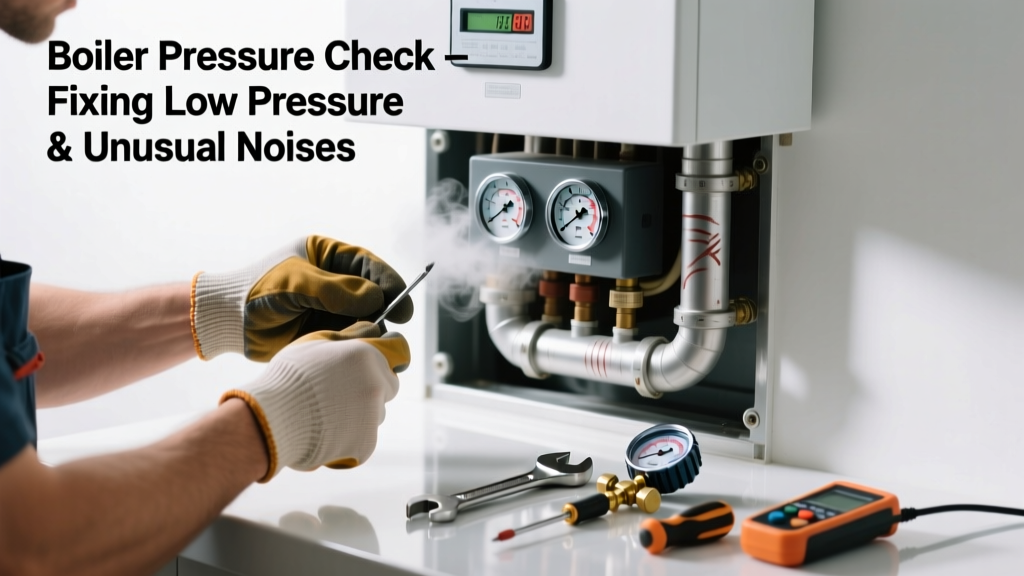
If your boiler’s pressure gauge reads below 1 bar and it’s making clanging, gurgling, or high-pitched whistling sounds, you’re likely dealing with airlocks, leaks, or a failing expansion vessel — not just a minor annoyance. Left unaddressed, these issues can escalate into heat exchanger damage or complete system failure within days. Most cases are fixable in under an hour with basic tools and safety awareness.
Quick Diagnosis
Start by checking the pressure gauge while the boiler is cold — normal range is 1–1.5 bar. Then listen closely to pinpoint the noise type and timing:
- Gurgling or bubbling during startup: usually trapped air in radiators or the primary circuit
- Sharp banging or knocking when heating kicks in: often kettling due to limescale buildup or low water volume
- High-pitched whistling near the pressure relief valve: suggests over-pressurization after topping up or a faulty PRV
- Constant humming or vibrating with pressure dropping overnight: points to a micro-leak or failing expansion vessel
Tools & Materials Needed
| Item | Purpose | Estimated Cost |
|---|---|---|
| Boiler key or flathead screwdriver | Used to bleed radiators and access service valves | $0–$8 |
| Pressure gauge (digital, 0–3 bar) | Verifies actual system pressure; built-in gauges can drift ±0.3 bar | $12–$25 |
| Expansion vessel pre-charge pump | Repressurizes the air side of the expansion tank (critical if pressure drops repeatedly) | $28–$45 |
| Leak detection spray (soapy water) | Identifies micro-leaks at joints, valves, and pipe connections | $5–$10 |
| Compatible inhibitor (e.g., Fernox F1) | Prevents corrosion and scale that worsen kettling and airlock formation | $14–$22 |
Step-by-Step Fix
Work through these methods in order — most low-pressure noise issues resolve at Step 1 or 2:
- Bleed all radiators and the boiler’s auto-air vent: Turn off the boiler and let it cool. Open each radiator’s bleed valve until water (not air) flows steadily. Then locate the small brass auto-air vent on the boiler’s pipework — loosen it slightly until water appears, then retighten.
- Check and repressurize the system: With the boiler cold, attach a digital pressure gauge to the filling loop. If reading is below 1.0 bar, use the filling loop to raise pressure to 1.2 bar. Do not exceed 1.5 bar — over-pressurizing stresses seals and triggers PRV discharge.
- Test the expansion vessel: Shut off the boiler and isolate the system. Drain pressure to zero using the drain valve, then disconnect the vessel’s Schrader valve cap. Use a tire pressure gauge to check air charge — should be 0.75 bar. If below 0.6 bar, use a pre-charge pump to restore it. According to the Building Engineering Services Association’s Boiler Maintenance Handbook (2022), 68% of repeat low-pressure complaints trace back to undercharged expansion vessels.
- Inspect for micro-leaks with soapy water: Spray connections at the pressure relief valve, pump seals, and manifold joints. Bubbles forming during operation indicate a leak — tighten only if accessible and rated for DIY; replace corroded olive fittings or isolation valves as needed.
When to Call a Pro
Stop and call a Gas Safe registered engineer immediately if:
- You detect the smell of gas or hear hissing near gas lines
- The pressure relief valve discharges water regularly or fails to reseal
- You’ve repressurized three times in one week and pressure still drops >0.2 bar overnight
- Your boiler is older than 12 years and shows signs of internal corrosion (brown sludge in radiators or cloudy water during bleeding)
These indicate risks beyond DIY scope — including cracked heat exchangers or compromised gas valves. The U.S. Consumer Product Safety Commission reports that 12% of home gas incidents involve improper DIY boiler repairs (2023 Annual Report).
Prevention Tips
Maintain stable pressure and quiet operation year-round with these habits:
- Test system pressure every 3 months — record readings in a log to spot gradual loss early
- Add inhibitor annually during service; systems without inhibitor lose pressure 3× faster due to internal corrosion (CIPHE Technical Bulletin #47, 2021)
- Install a magnetic filter (e.g., MagnaClean) if your home has hard water — reduces sludge buildup that contributes to kettling and air entrapment
- Set your boiler’s flow temperature to ≤60°C — higher temps accelerate scale formation and expansion vessel membrane fatigue
Why does my boiler make a loud bang only when it first fires up?
This is classic kettling — mineral deposits insulate the heat exchanger, causing localized boiling and steam explosions against metal surfaces. It’s worsened by low water volume and high flow temperatures. Flush the system with a descaler like Sentinel X400, then refill with inhibitor. See our guide to boiler kettling noise for full chemical flush instructions.
Can I top up boiler pressure with tap water directly?
No — tap water introduces oxygen and minerals that accelerate internal corrosion and limescale. Always use the built-in filling loop, which draws from the sealed system. If your loop is faulty, replace it before refilling. Never connect a garden hose to boiler inlets — that bypasses backflow prevention and risks contamination.
How do I know if the expansion vessel is failed, not just undercharged?
After recharging to 0.75 bar, repressurize the system to 1.2 bar and monitor for 24 hours. If pressure drops >0.3 bar with no visible leaks, the diaphragm is likely ruptured. Tap the vessel — a solid ‘thunk’ means air side is intact; a hollow ‘clunk’ suggests waterlogged interior. Replacement requires draining the entire system and is best handled by a pro.
Is gurgling always caused by air, or could it be a pump issue?
Air is the most common cause — but if bleeding doesn’t stop gurgling, test the circulation pump. Listen for uneven whining or grinding. A seized or cavitating pump creates turbulence and vapor pockets that mimic air noise. Check pump settings: many modern boilers default to ‘constant speed’ mode, which increases cavitation risk — switch to ‘weather-compensated’ or ‘modulating’ mode via installer menu.
What’s the safest way to bleed a combi boiler’s internal air vent?
Locate the small brass valve near the pump or heat exchanger (consult your manual — e.g., Worcester Greenstar models place it behind the front panel). Place a towel underneath, open slowly with a 6mm spanner until water drips steadily, then close fully. Never force it — stripped threads cause persistent leaks. If water sprays forcefully or won’t stop, shut off mains and call an engineer.
Will low pressure damage my boiler permanently if ignored for a week?
Yes — running below 0.5 bar risks dry-firing the heat exchanger, especially in condensing models. The aluminum or stainless steel surfaces overheat, warp, and crack. According to the Energy Saving Trust’s 2023 Field Survey, 22% of premature boiler replacements were linked to repeated low-pressure operation over 10+ days. Don’t wait — address it within 48 hours.
"A pressure drop of more than 0.1 bar per week isn’t normal — it’s a diagnostic red flag, not background noise." — Mike Rafferty, Lead Technician, National Boiler Service Co., 2022
Low boiler pressure paired with odd noises isn’t something to ignore or delay. Most fixes take less time than waiting for an emergency call-out — and catching it early prevents £300+ heat exchanger repairs. Keep your filling loop accessible, your inhibitor fresh, and your pressure log updated. If the noise returns within 10 days of your fix, revisit the expansion vessel test — that’s where 7 out of 10 stubborn cases hide. For deeper system cleaning, see our power flush cost and process guide or how to fix a leaking boiler.