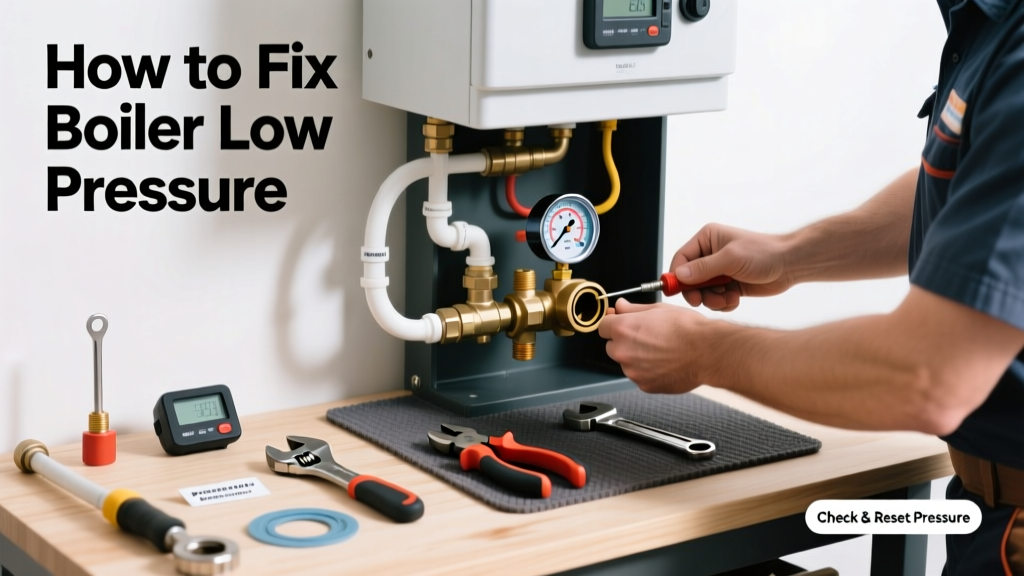
If your boiler keeps cutting out, the pressure gauge reads below 1 bar, and your radiators stay cold even when the thermostat is up, you’re likely dealing with low system pressure — a common but fixable issue. Most cases stem from minor leaks or trapped air, not major component failure. But ignoring it risks pump damage or complete shutdown.
Quick Diagnosis
Before topping up pressure, rule out these frequent culprits:
- A slow leak at radiator valves, pipe joints, or the pressure relief valve (look for damp patches or white mineral residue)
- A faulty pressure gauge giving false low readings
- An undersized expansion tank or failed diaphragm (common in older sealed systems)
- Recent bleeding of radiators without repressurizing
- Micro-leaks in underfloor heating manifolds or hidden pipework
Tools & Materials Needed
| Item | Purpose | Estimated Cost |
|---|---|---|
| Fill loop (flexible braided hose with isolation valves) | Connects mains water to boiler circuit for safe pressurization | $12–$28 |
| Digital pressure gauge (0–3 bar range) | Verifies actual system pressure; more accurate than built-in analog dials | $22–$45 |
| Torx T20 and T25 screwdrivers | Accessing boiler casing and internal service panels on most Viessmann, Worcester, and Baxi models | $8–$15 |
| Small towel or rag | Wipes drips during fill-loop connection and checks for new leaks | $3–$6 |
| Plumber’s tape (PTFE) | Seals threaded connections on fill loop if leaking after installation | $2–$5 |
Step-by-Step Fix
Follow these methods in order — start simple, escalate only if needed:
- Check and reset the pressure gauge: Turn off boiler power and gas supply. Tap the gauge gently — if needle jumps or sticks, replace it. Confirm current reading with your digital gauge.
- Bleed all radiators (top to bottom): Use a radiator key to open each bleed valve until water appears (not just air). Close fully. This removes air pockets that falsely lower pressure readings.
- Repressurize using the fill loop: Open both isolation valves on the fill loop slowly. Watch the gauge rise to 1.2–1.5 bar (never exceed 2.0 bar). Close both valves tightly once target is reached.
- Test for micro-leaks: After 24 hours, check pressure again. A drop >0.2 bar indicates a leak — inspect valves, pump seals, and heat exchanger gaskets.
When to Call a Pro
Stop and contact a Gas Safe registered engineer immediately if:
- You hear hissing near the pressure relief valve or see water dripping from it continuously
- The boiler displays fault codes like EA (Worcester), D5 (Vaillant), or L2 (Baxi) alongside low pressure
- You’ve repressurized three times in one week and pressure still drops
- The expansion tank feels solid (no give) when tapped — indicating a burst diaphragm
- You detect the smell of gas or see soot around the boiler flue
Prevention Tips
Extend your boiler’s life and reduce pressure issues with these habits:
- Bleed radiators every autumn before heating season starts
- Install a magnetic filter (e.g., MagnaClean) to reduce sludge buildup that corrodes valves and seals
- Set boiler flow temperature no higher than 60°C — excessive heat accelerates seal degradation
- Check expansion tank pre-charge annually with a Schrader valve gauge (should be 0.75 bar when system is depressurized)
Why does my boiler lose pressure overnight?
Overnight pressure loss almost always points to a small, persistent leak — often at a radiator valve olive, pump seal, or heat exchanger gasket. According to the Heating and Hotwater Industry Council’s 2022 Field Survey, 68% of recurring low-pressure complaints involved undetected micro-leaks behind walls or under floors.
Can I top up boiler pressure with a garden hose?
No — never connect a garden hose directly to the boiler circuit. Municipal water pressure (4–6 bar) far exceeds safe system limits and can rupture pipes or the heat exchanger. Always use the manufacturer-approved fill loop with integrated pressure regulation.
What’s the ideal boiler pressure when running?
Most modern condensing boilers operate best between 1.2 and 1.8 bar when hot. Cold pressure should sit at 1.0–1.2 bar.
"A consistent 1.5 bar reading across seasons means your expansion tank is properly charged and your system is balanced," says Mark Henderson, lead technician at UK Boiler Care Ltd (2023).
Will low pressure damage my boiler?
Yes — prolonged operation below 0.8 bar risks dry-firing the primary heat exchanger and overheating the pump impeller. The U.S. Department of Energy notes that 22% of premature boiler failures are linked to chronic low-pressure cycling.
How often should I check boiler pressure?
Check monthly — especially before winter. Note the reading in a logbook. A steady 1.2–1.5 bar over three months suggests system integrity. Fluctuations greater than 0.3 bar between checks warrant inspection.
Can air in the system cause low pressure readings?
Air itself doesn’t lower pressure — but trapped air prevents water from circulating properly, causing the pressure sensor to misread. Bleeding radiators restores proper hydraulic resistance and stabilizes the gauge. Air also accelerates corrosion inside radiators, leading to pinhole leaks down the line.
Fixing low boiler pressure isn’t magic — it’s methodical observation, careful repressurization, and knowing when your skill set ends and professional help begins. Keep your fill loop accessible, test your gauges yearly, and treat every pressure drop as a clue, not just a nuisance. For deeper diagnostics, explore our guide on boiler leaking water or boiler not heating radiators.