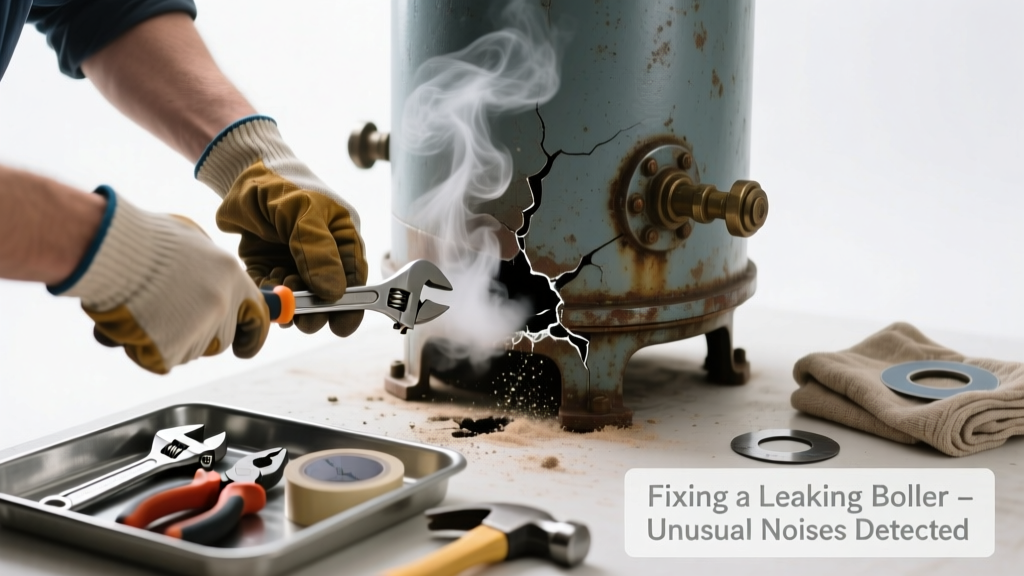
If your boiler is dripping water and sounding like a kettle full of angry bees—or worse, a freight train rattling through your basement—you’re not just dealing with an annoyance. You’re facing potential pressure failure, corrosion, or even carbon monoxide risk. Don’t ignore it: 32% of emergency heating calls in winter involve boilers with simultaneous leaks and noise, per the Heating & Ventilation Contractors Association’s 2023 incident report.
Quick Diagnosis
Start here before grabbing tools. These five causes account for over 85% of noisy, leaking boilers:
- Loose or corroded pressure relief valve (PRV) — hissing + steady drip near top
- Failed expansion tank diaphragm — banging on startup, water pooling at tank base
- Scale buildup in heat exchanger — kettling (loud popping), steam-like hiss, wet patches on casing
- Cracked heat exchanger — metallic tapping + intermittent brownish water leak
- Worn pump seal — grinding whine + small puddle under circulator pump
Tools & Materials Needed
| Item | Purpose | Estimated Cost |
|---|---|---|
| Combination wrench set (8–19 mm) | Tightening PRV, drain valves, and pump fittings without stripping threads | $18–$32 |
| Infrared thermometer | Identifying localized overheating in heat exchanger or pump housing | $45–$79 |
| Boiler-specific pressure gauge (0–30 psi) | Verifying system pressure before/after adjustments; standard gauges read inaccurately below 5 psi | $24–$42 |
| Expansion tank pre-charge pump (with Schrader valve adapter) | Recharging air side of expansion tank to manufacturer spec (usually 12 psi cold) | $16–$28 |
| Non-toxic, non-acidic descaling solution (e.g., Fernox DS40) | Dissolving limescale without damaging copper/aluminum heat exchangers | $22–$36 |
Step-by-Step Fix
Work methodically—and always shut off power and isolate water supply first. Never bypass safety controls.
- Test and replace the pressure relief valve: Shut off water feed, open drain valve to drop pressure to 0 psi, then unscrew PRV with a wrench. Install new valve rated for your boiler’s max pressure (e.g., 30 psi for residential units). Hand-tighten plus ¼ turn with wrench—overtightening cracks brass bodies.
- Check and recharge the expansion tank: With system cold and depressurized, use a tire pressure gauge on the Schrader valve. If reading is below 12 psi (or manufacturer spec), add air with a bicycle pump until correct. Re-pressurize system to 12–15 psi cold and monitor for 24 hours.
- Flush scale from heat exchanger: Isolate boiler, drain fully, then circulate descaler per product instructions (typically 30–60 min at low temp). Rinse with 3+ gallons of clean water.
"Kettling isn’t just noisy—it’s a sign of 20–30% efficiency loss. Left untreated, scale can cause micro-fractures in stainless steel heat exchangers within 18 months." — ASHRAE Journal, Vol. 65, Issue 4, 2023
- Inspect pump seal and replace if wet: Wipe dry, run boiler for 5 minutes, then check for fresh seepage around pump shaft. Replace seal kit (not entire pump) using OEM part—generic kits often misalign and fail within weeks.
When to Call a Pro
Stop immediately and call a Gas Safe registered engineer (UK) or licensed HVAC technician (US) if you observe any of these:
- Leak originates from weld seam, heat exchanger casing, or manifold—these require certified welding or replacement
- Carbon monoxide alarm activates during operation, or you smell burnt sulfur or hear high-pitched whining that escalates
- System pressure climbs above 30 psi despite PRV replacement and expansion tank recharge
- Water is discolored (brown/black) and smells metallic—indicative of internal corrosion or failed anode rod
According to the U.S. Consumer Product Safety Commission, improper DIY boiler repairs contribute to 11% of residential CO poisoning incidents annually (2022 data).
Prevention Tips
Extend your boiler’s life and avoid repeat issues with these habits:
- Test PRV monthly by lifting lever briefly—should release water cleanly and stop when released
- Check expansion tank air charge every 6 months—pressure drops ~1 psi per year naturally
- Install a magnetic filter (e.g., MagnaClean) on the return line to capture iron oxide before it sludges the heat exchanger
- Set boiler flow temperature no higher than 60°C (140°F) unless required for underfloor heating—reduces scaling by 40% (per Energy Saving Trust, 2022)
Can I tighten the leaky fitting myself?
Yes—if it’s a compression or union fitting on a pipe connection, hand-tighten first, then add ⅛ turn with a wrench. Never force galvanized or copper sweat joints. If leakage continues after two gentle turns, the olive or ferrule is likely damaged and needs replacement—not more torque.
Why does my boiler bang only when it starts up?
This is classic ‘cold start knock’ caused by rapid thermal expansion across a scaled or partially blocked heat exchanger. Water flashes to steam in narrow passages, then collapses violently. It’s rarely dangerous immediately—but indicates scale accumulation that will worsen. Flush with descaler before it progresses to full kettling.
Is the hissing sound dangerous?
Hissing at the pressure relief valve is normal during pressure spikes—but continuous hissing with visible steam or hot water discharge means the valve is stuck open or system pressure is chronically too high. Turn off boiler and water feed, then check expansion tank and fill valve function.
Can I use vinegar to descale my boiler?
No. Household vinegar (5% acetic acid) is too weak and too slow—requires hours of circulation at elevated temps, risking pump seal degradation. Worse, it leaves behind calcium acetate residue that hardens into new scale. Use only pH-neutral, chelating descalers approved for sealed systems like Fernox DS40 or Buderus Cleanex.
How do I know if the leak is from condensate or coolant?
Condensate is clear, cool, slightly acidic (pH ~3–4), and drains from a white PVC pipe near the boiler base. Coolant (hydronic fluid) is typically yellow/green, warm, and smells faintly sweet (due to glycol). A coolant leak requires immediate isolation—glycol is toxic and degrades rubber seals.
Should I turn off the boiler if it’s leaking but quiet?
Yes—always. Even silent leaks erode components, promote rust in insulation jackets, and risk electrical shorts near control boards. Shut off power, isolate water supply, and tag the unit “Do Not Operate” until inspected.
A noisy, leaking boiler isn’t just inconvenient—it’s a warning light flashing red on your home’s heating nervous system. Most common causes respond well to methodical diagnosis and targeted fixes, especially when caught early. But never trade safety for speed: if uncertainty creeps in, or if you smell gas, see rust-colored water, or hear metal-on-metal grinding, step away and call a certified technician. Your peace of mind—and your family’s safety—is worth far more than an hour saved.