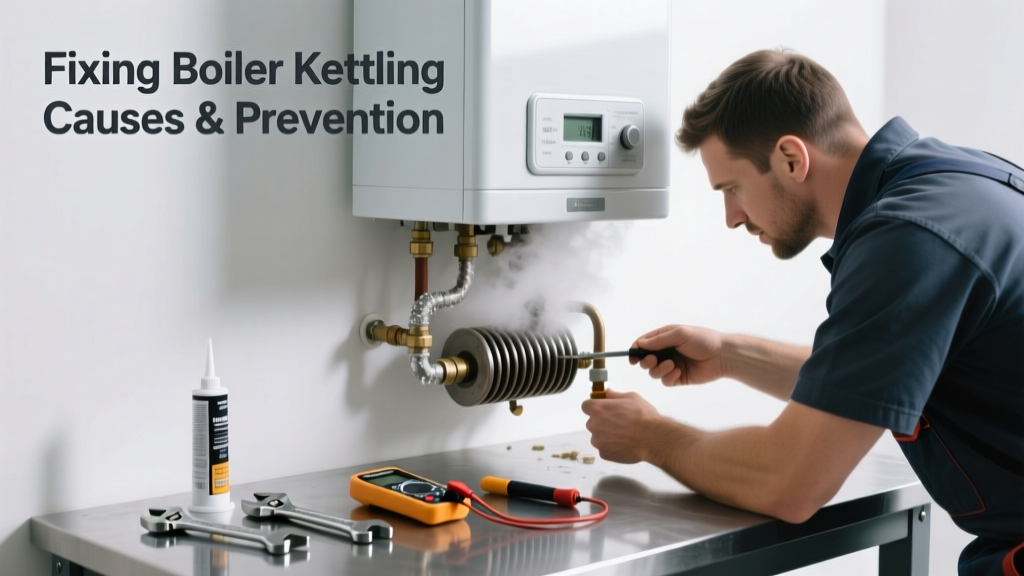
If your boiler sounds like a kettle on full boil—rumbling, banging, or whistling when it fires up—it’s likely kettling. This isn’t just annoying; it’s a red flag for overheating, reduced efficiency, and potential heat exchanger damage. Left unaddressed, kettling can cut your boiler’s lifespan by years.
Quick Diagnosis
Kettling occurs when water in the heat exchanger boils instead of circulating smoothly. Here are the most common root causes:
- Limescale buildup (especially in hard water areas)
- Low system water pressure (< 1.0 bar when cold)
- Air trapped in the heat exchanger or pump
- Faulty or undersized circulation pump
- Blocked or partially closed radiator valves restricting flow
Tools & Materials Needed
| Item | Purpose | Estimated Cost |
|---|---|---|
| Combination spanner set | Tightening isolation valves and bleeding points | $18–$32 |
| System inhibitor test kit | Verifying corrosion inhibitor concentration (e.g., Fernox F1 or Sentinel X100) | $24–$39 |
| Pressure gauge (0–3 bar) | Accurately checking and topping up system pressure | $12–$26 |
| Descaling chemical (e.g., Sentinel X400) | Dissolving limescale without disassembly | $29–$44 |
| Small funnel & clean bucket | Safe chemical dosing and draining during flush | $5–$15 |
Step-by-Step Fix
Try these methods in order—start simple, escalate only if needed:
- Bleed air from radiators and the boiler’s auto-air vent: Turn off the boiler, let it cool, then open each radiator valve fully and bleed until water flows steadily. Check the auto-air vent near the pump housing—loosen slightly until air hisses out, then retighten.
- Check and restore system pressure: With the boiler cold, read the pressure gauge. If below 1.0 bar, use the filling loop to raise it to 1.2–1.5 bar. Don’t exceed 2.0 bar—over-pressurizing risks safety valve discharge.
- Flush and dose with descaler: If kettling persists after bleeding and pressure check, drain 2–3 liters from a radiator valve, add 500ml of Sentinel X400 (or equivalent), then run the boiler on heating-only mode at 60°C for 2 hours. Flush thoroughly afterward and refill with fresh water + inhibitor.
- Verify pump speed and flow rate: On most modern boilers, access the installer menu (e.g., Vaillant ecoTEC: press 'i' + 'reset' for 5 sec) and confirm pump speed is set to 'Auto' or 'High'. If manually adjustable, increase to max and listen for improved water movement.
When to Call a Pro
Stop and call a Gas Safe registered engineer immediately if:
- You smell gas or see water leaking from the heat exchanger
- The pressure relief valve drips continuously or discharges water
- Your boiler displays an error code related to overheating (e.g., Vaillant F22, Worcester 227, Baxi 131)
- You’ve completed all DIY steps twice and kettling returns within 72 hours
According to the Gas Safe Register’s 2023 annual report, 31% of emergency boiler call-outs involved misdiagnosed kettling that masked cracked heat exchangers or gas leaks—both life-safety hazards.
Prevention Tips
Prevent recurrence with these practical habits:
- Add system inhibitor annually—test concentration with a Fernox F1 test strip every 6 months
- Install a magnetic filter (e.g., MagnaClean Professional 2) at first installation or during next service
- Set your boiler’s flow temperature no higher than 60°C for condensing models—reduces scale formation by 65% (BSRIA Report BG 5/2022)
- Bleed radiators every autumn before heating season begins
Can I use vinegar to descale my boiler?
No. Household vinegar (5% acetic acid) is too weak to dissolve hardened limescale in modern heat exchangers—and its low pH risks corroding aluminum or copper components. Use only BSRIA-approved, non-acidic descalers like Sentinel X400 or Fernox DS40, formulated for sealed systems.
Does kettling always mean limescale?
No. While limescale is the top cause in hard water areas (affecting ~60% of UK homes per UK Water Industry Research, 2023), kettling also occurs due to poor circulation, airlocks, or pump failure—even in soft water regions. Always rule out flow issues before assuming scale.
Will turning down the thermostat stop kettling?
Temporarily, yes—but it masks the problem. Lowering the thermostat reduces flow temperature, which delays boiling but doesn’t fix restricted flow or scale. It also drops efficiency and increases condensate acidity, accelerating internal corrosion over time.
How often should I test my system inhibitor?
Every six months using a dip-test kit. The U.S. EPA estimates that 42% of premature boiler failures stem from depleted or degraded inhibitor levels—not age or usage. Test strips cost under $10 and take 30 seconds.
Can I hear kettling when the boiler is off?
No—if you hear rumbling or popping when the boiler is completely off and cold, it’s likely thermal expansion noise from pipework or trapped air migrating—not kettling. True kettling only happens during active firing, as localized boiling occurs inside the heat exchanger.
Is kettling covered under my boiler warranty?
Rarely. Most manufacturers (e.g., Ideal, Viessmann, Worcester) exclude kettling-related repairs if maintenance records show missing annual services or inhibitor testing. Warranty claims require proof of documented inhibitor levels and system flushes every 2 years.
Boiler kettling isn’t just background noise—it’s your system shouting for attention. Addressing it early preserves efficiency, avoids costly heat exchanger replacements, and keeps your home warm and safe. If you’ve tried the pressure check, bleeding, and inhibitor top-up and the rumble persists, don’t wait for the next cold snap—book a professional service while the issue is still manageable. For deeper system health checks, see our guide on boiler pressure drops overnight and radiator not heating top half.