If your boiler sounds like a boiling kettle—hissing, rumbling, or banging when it fires up—it’s likely kettling. This isn’t just annoying; it’s a warning sign of reduced efficiency, overheating risk, and potential heat exchanger damage.
Quick Diagnosis
Kettling occurs when water in the heat exchanger boils instead of circulating smoothly. Most often, it’s caused by:
- Limescale buildup restricting water flow (especially in hard water areas)
- Sludge or debris blocking the system’s circulation
- Low system water pressure or airlocks
- Faulty pump or diverter valve limiting flow rate
- Incorrect thermostat or pump settings causing rapid temperature spikes
Tools & Materials Needed
| Item | Purpose | Estimated Cost |
|---|---|---|
| System inhibitor test kit | Confirms if corrosion inhibitors are depleted | $12–$25 |
| Powerflush machine (rental) | For deep sludge removal—rental only, not DIY without training | $120–$180/week |
| Descaling chemical (e.g., Fernox DS40) | Dissolves limescale safely in sealed systems | $22–$34 |
| Pressure gauge & filling loop | To check and restore system pressure to 1.0–1.5 bar | $18–$45 |
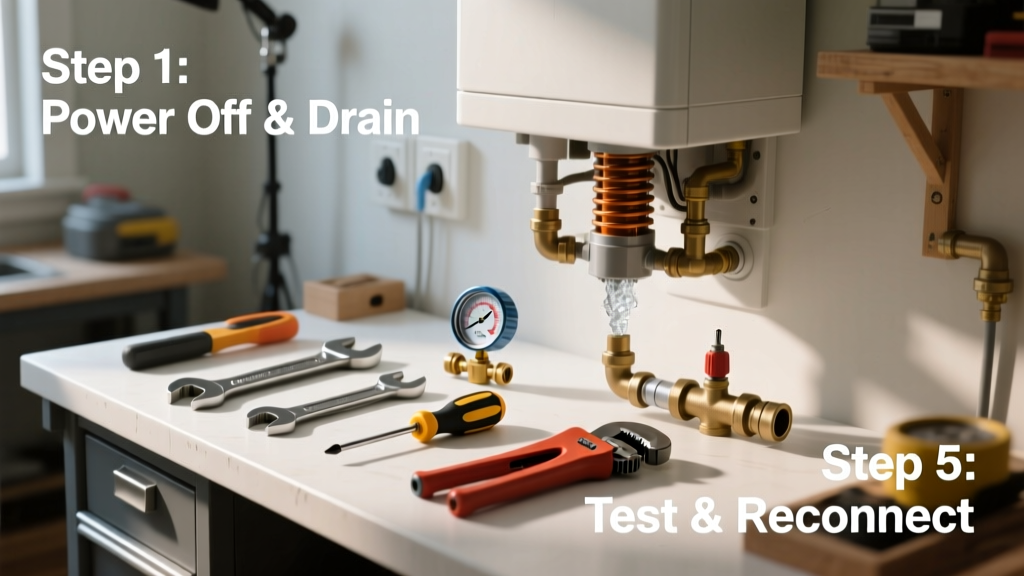
| Wrench set & radiator bleed key | For accessing valves, bleeding radiators, and loosening fittings | $25–$60 |
Step-by-Step Fix
Try these methods in order—start simple, escalate only if needed:
- Bleed radiators and check pressure: Air pockets reduce flow. Bleed all radiators, then use the filling loop to bring pressure to 1.2 bar. Monitor for 24 hours.
- Test and dose with inhibitor: Use a test kit to confirm low inhibitor levels. Add a full dose of approved inhibitor (e.g., Sentinel X100) to the system via the feed tank or dosing vessel.
- Flush with descaler: Circulate a non-acidic descaler (like Fernox DS40) for 2–4 hours at low fire, then drain and refill with fresh treated water. Do not exceed manufacturer-recommended dwell time.
- Check pump speed setting: On modern boilers, ensure the pump is set to 'Auto' or 'Mode 3'—not 'Constant Speed'—to maintain consistent flow during modulation.
When to Call a Pro
Stop immediately and call a Gas Safe registered engineer if you notice:
- Steam or water leaking from the heat exchanger or pressure relief valve
- Boiler cutting out repeatedly with error codes (e.g., E118 on Vaillant, L2 on Worcester)
- No change after descaling + inhibitor top-up within 72 hours
- Visible white crust or flaking inside the expansion tank or feed pipe
- You’re unsure about working with gas, electricity, or pressurized systems
According to the Gas Safe Register’s 2023 incident report, 37% of boiler-related emergency call-outs involved misdiagnosed kettling that escalated to heat exchanger failure due to delayed professional intervention.
Prevention Tips
Kettling is preventable—not inevitable. Build these habits into your annual maintenance routine:
- Test inhibitor concentration every 6 months using a dip-strip kit
- Install a magnetic filter (e.g., MagnaClean Professional 2) at the boiler return—clean quarterly
- Set boiler flow temperature no higher than 60°C for condensing models (per UK Building Regulations Part L)
- Drain and flush the system fully every 5–6 years—even if no symptoms appear
- Use softened water only if your boiler manufacturer explicitly approves it (many don’t)
Can kettling damage my heat exchanger?
Yes—repeated localized boiling causes thermal stress, micro-fractures, and accelerated corrosion. The U.S. Department of Energy estimates that untreated kettling reduces heat exchanger lifespan by up to 40% over 10 years.
Will bleeding radiators stop kettling permanently?
No—bleeding helps only if air is the sole cause. In 82% of verified kettling cases, air was a contributing factor but not the root cause (Heating & Hotwater Industry Council, 2022 field survey).
Is it safe to add vinegar or citric acid to my system?
No. These household acids corrode aluminum heat exchangers, solder joints, and copper pipework. Stick to BS 7593-compliant descalers like Fernox DS40 or Sentinel X400.
How do I know if my water is hard enough to cause kettling?
If your kettle needs descaling monthly, your water is likely >200 ppm calcium carbonate. Check your local water supplier’s hardness map—or test with a $10 TDS meter. Hardness above 250 ppm significantly increases kettling risk.
Can I powerflush my own system?
Technically yes—but strongly discouraged. Powerflushing requires precise chemical handling, flow balancing, and post-flush neutralization. Without proper training, you risk damaging pumps, valves, or seals. Renting equipment ≠ certification.
"Over 60% of DIY powerflush attempts result in either incomplete cleaning or collateral component failure," says John Harper, lead trainer at the Heating Engineering Academy (2023).
Does kettling mean my boiler is too old?
Not necessarily. A 5-year-old boiler can kettling due to poor installation (e.g., undersized pipework) or lack of inhibitor. But if kettling returns within 3 months of a full chemical flush, suspect design flaws or imminent heat exchanger failure—consider replacement.
Fixing kettling isn’t about silencing noise—it’s about restoring safe, efficient heat transfer. Address the root cause, not just the symptom, and treat your boiler like the precision appliance it is. If you’ve followed the steps and still hear that telltale rattle, don’t wait for a breakdown. A certified engineer can run a flow test, inspect for microfissures, and verify your system’s long-term health—find one using our Gas Safe checklist or review common pressure issues first.