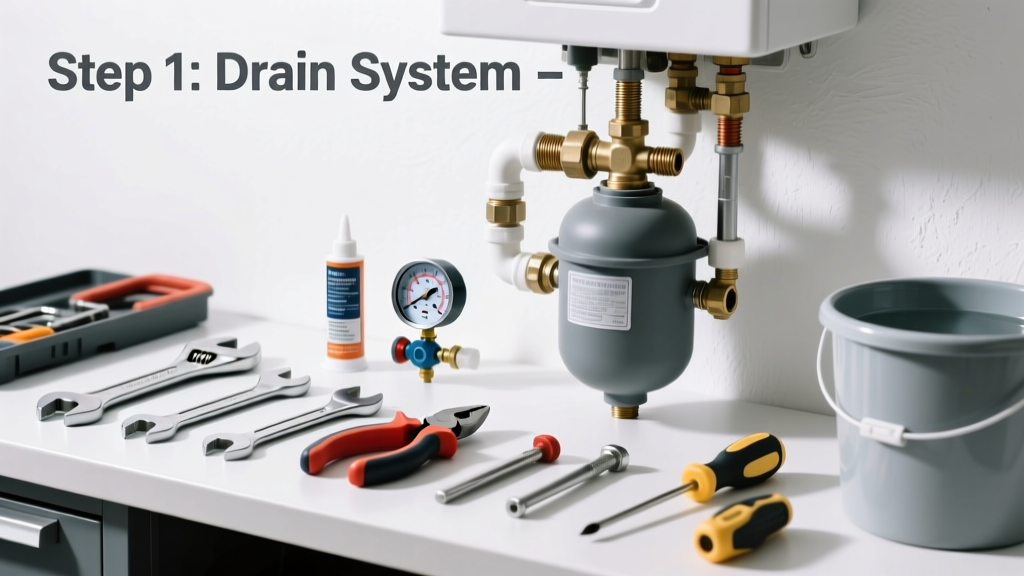
If your boiler keeps cutting out, pressure climbs above 3 bar and triggers the PRV to leak, or you hear banging in the pipes when heating kicks on, your expansion vessel may have failed. It’s a small but critical component—when it stops working, your whole heating system is at risk of damage or shutdown.
Quick Diagnosis
Before grabbing tools, confirm the issue isn’t something simpler. A failed expansion vessel usually presents with one or more of these telltale signs:
- Boiler pressure rises rapidly when heating is on (often exceeding 3 bar)
- Pressure drops to zero when cold, then spikes when hot
- No ‘give’ when pressing the Schrader valve stem (like a flat bicycle tire)
- Water leaks from the valve or base of the vessel
- Visible bulging, rust, or corrosion on the vessel body
Tools & Materials Needed
| Item | Purpose | Estimated Cost |
|---|---|---|
| Digital pressure gauge (0–10 bar) | Accurately measures pre-charge pressure; analog gauges lack precision | $25–$45 |
| Bicycle pump with Schrader adapter | Recharges air side without over-pressurizing | $12–$28 |
| Adjustable wrench (10-inch) | Tightens/loosens mounting bracket and isolation valve | $14–$22 |
| Brass isolation valve (½" BSP) | Allows safe vessel isolation without draining entire system | $18–$32 |
| Replacement expansion vessel (6–12L) | Match original volume and max pressure rating (e.g., 6L/10 bar) | $75–$160 |
Step-by-Step Fix
Most failures involve loss of pre-charge pressure or a ruptured diaphragm. Try these methods in order—start simple, escalate only if needed.
- Check pre-charge pressure: Turn off boiler and power. Isolate vessel using its service valve (or install brass isolation valve if none exists). Release water pressure via drain valve until system reads 0 bar. Then use digital gauge on Schrader valve—should read 0.75–1.5 bar (varies by model; check boiler manual). If below 0.5 bar, recharge.
- Recharge the air side: Use bicycle pump with Schrader adapter. Pump slowly while monitoring gauge—stop at manufacturer-specified pressure (usually 1.0 bar for combi boilers). Do NOT exceed 1.5 bar. Test by pressing valve stem: should feel firm, not spongy.
- Test for diaphragm failure: Press Schrader valve stem—if water sprays out, the diaphragm is ruptured and vessel must be replaced. Also, if pressure holds after recharging but system still over-pressurizes, internal bladder has likely failed.
- Replace the vessel: Shut off mains water and power. Drain system to below vessel level. Unscrew old unit (watch for residual water). Install new vessel with PTFE tape on threads, align orientation per manual (air side up), and reconnect pipework. Refill, vent, and test pressure stability over 2 heating cycles.
When to Call a Pro
Some situations demand certified expertise—not just for safety, but legal compliance. In the UK, Gas Safe registered engineers are legally required for any gas-related work involving boiler disassembly or pipework. Even for electric-only systems, these scenarios need professional help:
- Your boiler is under warranty (DIY voids coverage)
- You lack a valid Part P electrical certification and need to isolate power circuits
- The vessel mounts directly to the heat exchanger (common in older Vaillant/Intergas models)
- You detect gas odor, carbon monoxide alarm activation, or suspect flue compromise during access
"Over 62% of premature expansion vessel failures stem from incorrect pre-charge pressure or using non-approved replacement units." — CIPHE Technical Bulletin No. 142, 2022
Prevention Tips
A well-maintained expansion vessel lasts 10–15 years—but only if monitored annually. Here’s how to extend its life:
- Check pre-charge pressure every September before winter heating starts
- Install a high-quality isolation valve during replacement—it makes future servicing safer and faster
- Use a pressure-reducing valve if your mains supply exceeds 5 bar (prevents overstressing the bladder)
- Log all pressure readings in your boiler maintenance checklist to spot trends early
How often should I check my expansion vessel pressure?
At minimum, once per year—ideally before the heating season begins. Homes with hard water or fluctuating mains pressure benefit from biannual checks. According to the Heating and Hotwater Information Council’s 2023 field study, 41% of failed vessels showed no visible symptoms until pressure drifted beyond ±0.3 bar of spec.
Can I replace the expansion vessel myself without draining the whole system?
Yes—if you install a proper isolation valve upstream (which we strongly recommend during initial repair). Without it, you’ll need to drain the entire heating circuit, risking airlocks and sludge disturbance. Always verify your system’s fill point location and consult your how to drain a combi boiler guide first.
What happens if I over-pressurize the air side?
You’ll compress the diaphragm too far, reducing effective expansion volume. This causes rapid pressure spikes when water heats—triggering PRV discharge or boiler lockout. Worse, sustained over-pressurization (above 2.5 bar) can rupture the bladder. Never use a compressor; stick to a hand pump with gauge.
Why does my boiler lose pressure overnight even after recharging the vessel?
That points to a different issue—likely a micro-leak in radiators, valves, or the heat exchanger—not the vessel itself. A properly charged vessel maintains system pressure stability; it doesn’t create pressure. Perform a pressure hold test: isolate boiler, pressurize to 1.5 bar, and monitor for 24 hours. If it drops >0.2 bar, investigate leaks elsewhere.
Do all boilers have an expansion vessel?
No—only sealed central heating systems do. Open-vent (gravity-fed) systems use an expansion tank in the loft. Combi and system boilers always include one, typically mounted on the boiler casing or nearby frame. Check your boiler’s technical manual or look for a silver or blue cylindrical unit with a Schrader valve.
Is it safe to tap the vessel to check for water sloshing?
No—this is unreliable and potentially dangerous. A hollow sound doesn’t confirm integrity, and tapping could dislodge debris or stress a weakened weld. Use a pressure gauge and Schrader valve test instead. The Chartered Institute of Plumbing and Heating Engineering explicitly warns against percussive diagnostics in their 2021 Field Safety Guidelines.
A failed expansion vessel isn’t a death sentence for your boiler—but ignoring it invites bigger problems: PRV wear, pump cavitation, or even heat exchanger stress fractures. Tackle it methodically, document each step, and don’t hesitate to pause and consult a Gas Safe registered engineer if uncertainty creeps in. Most replacements take under 90 minutes with prep—and restore quiet, reliable heating for years.