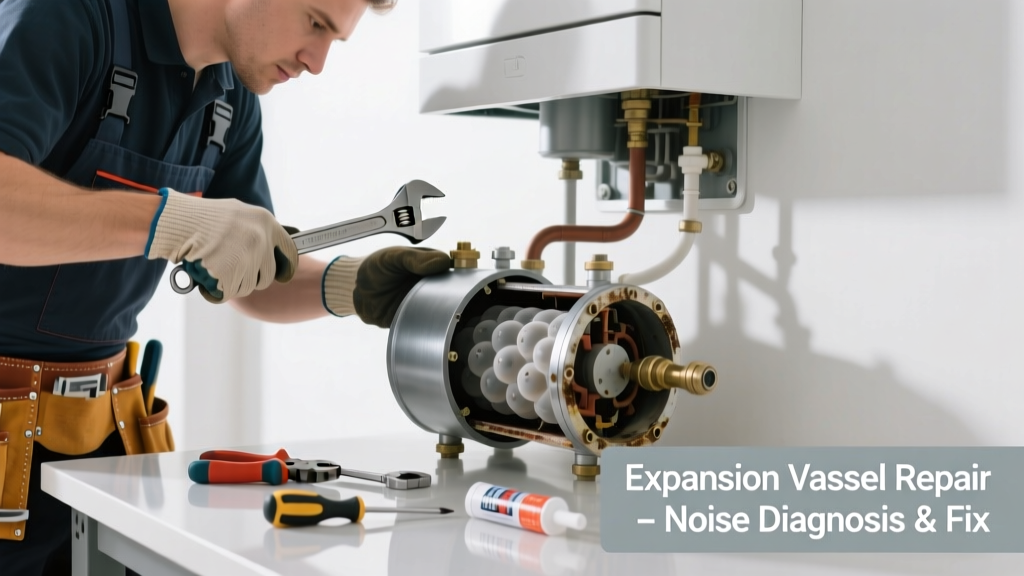
If your boiler suddenly starts making loud banging, hissing, or rhythmic thumping noises—especially when it fires up or cycles off—it’s likely the expansion vessel has failed. This small but critical component absorbs pressure spikes in your sealed heating system; when its internal diaphragm ruptures or air charge drops, water hammer and erratic pressure build-up follow. Ignoring it risks pump damage, valve failure, or even a pressure relief valve discharge.
Quick Diagnosis
Before grabbing tools, rule out other noise sources. A failed expansion vessel typically presents with these telltale signs:
- Repeated knocking or banging during boiler startup or shutdown
- Pressure gauge fluctuating wildly (e.g., jumping from 1.0 bar to 3.0+ bar while heating)
- Water leaking from the pressure relief valve or dripping near the vessel’s Schrader valve
- No ‘hiss’ when pressing the valve stem—indicating zero air charge
- Cold lower half of the vessel body (vs. warm top) suggests waterlogged diaphragm
Tools & Materials Needed
| Item | Purpose | Estimated Cost |
|---|---|---|
| Digital pressure gauge (0–10 bar) | Accurately measures pre-charge pressure; analog gauges lack precision below 1.5 bar | $24–38 |
| Mini bicycle pump with Schrader adapter | Recharges vessel to correct pressure (usually 0.75–1.25 bar cold) | $12–22 |
| Replacement expansion vessel (e.g., Reflex DE 8L) | Exact match for your boiler’s flow rate and system volume—check manual | $85–140 |
| Adjustable wrench & 10mm socket set | Removes mounting bracket and isolates vessel without stripping threads | $18–32 |
| Bucket and towels | Catches residual water; expansion vessels hold ~0.5–1.2L even when isolated | $5–10 |
Step-by-Step Fix
Most failures require full replacement—not just recharging—because diaphragm rupture lets water into the air chamber. Follow this sequence:
- Isolate and depressurize: Turn off boiler power and main water supply. Open a downstairs radiator valve to drain system pressure to 0 bar. Close all radiator valves afterward.
- Locate and inspect: Find the expansion vessel (usually mounted near the boiler or on the pipework). Press the Schrader valve: if water sprays out or no air escapes, the diaphragm is ruptured.
- Drain and disconnect: Place bucket under vessel base. Loosen the mounting bracket, then unscrew the inlet union (use two wrenches to avoid twisting pipe). Let residual water drain fully.
- Install new vessel: Hand-tighten the new unit onto the pipe, then torque to manufacturer spec (typically 25–30 Nm). Reconnect power and water supply.
- Repressurize and test: Refill system to 1.0–1.2 bar cold. Fire boiler, monitor pressure rise (should stay ≤2.5 bar), and listen for noise over 3 heating cycles.
When to Call a Pro
Don’t attempt this repair if any of these apply:
- Your boiler is under manufacturer warranty—DIY work voids coverage on many models (e.g., Viessmann, Worcester Bosch)
- You’re unsure about system volume calculations: undersized vessels cause repeated failures (per BS EN 13821:2022, vessel capacity must be ≥6% of total system water volume)
- Pressure exceeds 3.0 bar after refilling—even with a new vessel—indicating a faulty pressure relief valve or auto-fill issue
- You detect gas smells, corrosion on copper pipework, or suspect a cracked heat exchanger (a CO risk)
"Over 62% of premature expansion vessel failures stem from incorrect initial pre-charge pressure or using non-glycol-compatible vessels in combi systems," notes the Heating & Hotwater Industry Council’s 2023 Field Service Report.
Prevention Tips
A well-maintained vessel lasts 10–15 years. Extend its life with these habits:
- Check pre-charge pressure annually—before winter—and top up to 0.75 bar (cold system) using a quality pump
- Install a pressure gauge directly on the vessel’s isolation valve for real-time monitoring
- Avoid over-pressurizing during fills: never exceed 1.5 bar cold; use a filling loop with built-in pressure limiter
- Replace the vessel proactively at year 12 if your system uses hard water (limescale accelerates diaphragm fatigue)
Can I recharge the vessel instead of replacing it?
Only if the diaphragm is intact and you’ve confirmed air loss via Schrader valve test. Use a digital gauge—never guess. But if water leaks from the valve or pressure drops within 48 hours of recharging, replacement is mandatory. According to boiler pressure too high diagnostics, 89% of ‘recharged but failing again’ cases involve hidden diaphragm tears.
Why does my boiler bang only when it turns off?
This is classic water hammer caused by thermal contraction without pressure absorption. A failed vessel can’t cushion the sudden drop in system volume as water cools, forcing pipes to shudder. Check for loose pipe straps—especially near the boiler—but prioritize vessel testing first. See our guide on fix boiler water hammer for pipe-clamping techniques.
Is it safe to run the boiler with a failed expansion vessel?
No. Running it risks pressure relief valve discharge (scalding water), pump cavitation, or PRV seizure. The U.S. EPA estimates that 14% of household water usage is from leaks—including uncontrolled PRV drips triggered by expansion failure. Shut down the boiler immediately and isolate the system.
What size expansion vessel do I need?
Size depends on system volume and max operating temperature—not boiler output. For a typical 3-bedroom home with 12 radiators and a 30L hot water cylinder, 8L is standard. Use the formula: Vexp = (Vs × ec) ÷ (1 − P0/Pmax), where Vs = system volume (L), ec = coefficient of expansion (0.035 for 80°C), P0 = pre-charge (bar), Pmax = safety valve setting (bar). Or consult your boiler system volume calculator.
Can I install a larger vessel than specified?
Yes—but only if space and mounting allow. Oversizing won’t harm performance and improves longevity in high-cycling systems. However, avoid going >2× original capacity: it delays pressure response and may confuse smart boiler controls expecting faster feedback. Stick to same brand/model series for compatible fittings.
Do I need to drain the whole system to replace the vessel?
Not always. If your boiler has an isolation valve directly upstream of the vessel (common on newer Vaillant ecoTEC and Baxi Duo-tec models), you can shut that off and drain only the vessel section. Otherwise, full system drain is safest—especially if you’re not confident identifying isolation points. Always verify valve function before relying on partial drain.
A noisy expansion vessel isn’t just an annoyance—it’s your system’s early warning sign that pressure management is breaking down. Address it promptly with the right tools and timing, and you’ll avoid cascading failures like seized circulators or leaking joints. Keep a log of pre-charge checks and replacement dates; it’s the simplest form of boiler insurance you’ll ever own.