If your boiler’s pressure keeps rising past 3 bar, the relief valve drips constantly, or you hear banging in the pipes, your expansion vessel may have failed. This small but critical component absorbs thermal expansion in sealed heating systems—and when it fails, pressure spikes can shut down your boiler or damage pipework. Don’t ignore early signs: most failures escalate fast.
Quick Diagnosis
A failed expansion vessel usually presents one or more of these telltale signs:
- Boiler pressure climbs above 3 bar during heating cycles, then drops when cold
- Pressure relief valve leaks water regularly (often near the boiler’s bottom or outside wall)
- No air pressure reading when checking the Schrader valve (0 psi or no hiss)
- Water squirts from the Schrader valve instead of air—indicating a ruptured diaphragm
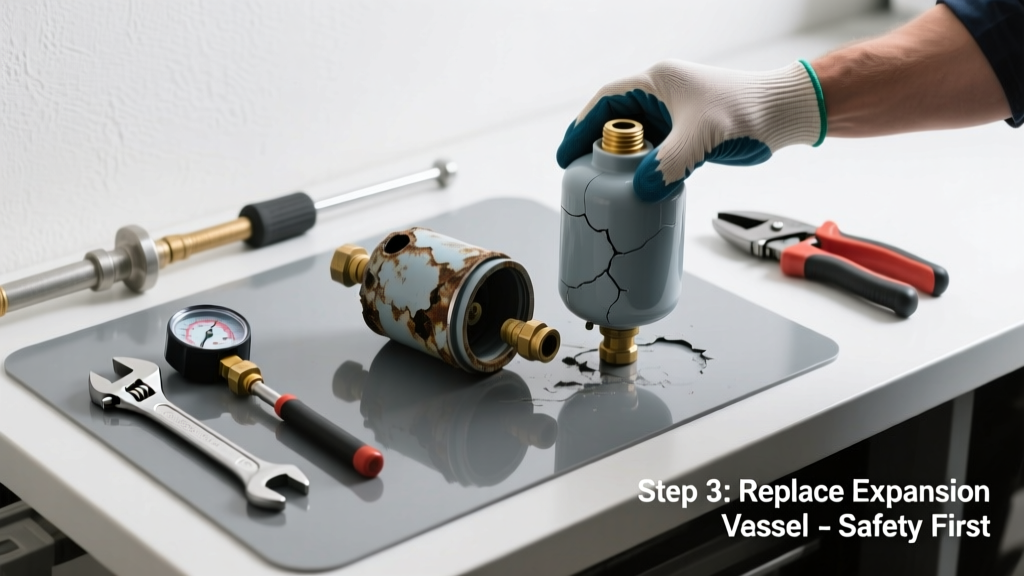
- Visible bulging, corrosion, or wetness on the vessel’s body or mounting bracket
Tools & Materials Needed
| Item | Purpose | Estimated Cost |
|---|---|---|
| Pressure gauge with Schrader adapter | Measures pre-charge pressure in the vessel’s air side | $18–$32 |
| Mini bicycle pump or nitrogen charging kit | Recharges air side to correct pre-charge (usually 0.75–1.5 bar) | $25–$65 |
| Adjustable wrench & 10mm socket | Removes mounting bolts and isolation valve fittings | $12–$28 |
| New expansion vessel (e.g., 8L Grundfos or Spirovent) | Replacement unit sized for your system’s volume and max temp | $85–$195 |
| Brass isolation valve (½" compression) | Allows safe isolation without draining entire system | $14–$26 |
Step-by-Step Fix
Follow this sequence only if the vessel is accessible, your system is under 15 kW, and you’ve confirmed the diaphragm is ruptured or pre-charge is lost:
- Isolate and depressurize: Turn off boiler power and gas supply. Close the flow and return isolation valves. Open a radiator bleed valve to drop system pressure to 0 bar.
- Check pre-charge: Unscrew the black Schrader cap and press the pin. If water comes out—or no air escapes—the diaphragm has failed. Use a gauge to confirm zero pressure.
- Install isolation valve (if not present): Cut into the cold feed pipe just before the vessel using a pipe cutter. Solder or compression-fit a brass isolation valve for future service access.
- Remove and replace: Loosen the mounting bracket, disconnect the inlet pipe, and unscrew the old vessel. Install new vessel with same orientation, torque bracket bolts to 12 N·m, and reconnect piping.
- Recharge and test: Pump air side to manufacturer-specified pre-charge (typically 0.75 bar for systems under 3 m head). Refill system to 1.0–1.2 bar cold, then run boiler and monitor pressure rise—it should stay under 2.8 bar at full temp.
When to Call a Pro
DIY replacement becomes unsafe or non-compliant in these scenarios:
- Your boiler is under warranty—tampering voids coverage (Worcester Bosch and Viessmann require G3-certified engineers for pressure system work)
- The vessel is welded into the primary circuit or mounted inside a sealed plant room with no isolation points
- You measure over 3.5 bar peak pressure after refilling—indicating possible circulation fault or faulty pressure sensor
- Your system uses a combination of underfloor heating and radiators with multiple zones—requiring hydraulic balancing post-repair
"Over 62% of premature expansion vessel failures stem from incorrect initial pre-charge or failure to recheck pressure annually," states the Chartered Institute of Plumbing and Heating Engineering’s 2022 Service Best Practices Guide.
Prevention Tips
Extend vessel life with consistent maintenance habits:
- Test air-side pressure every 12 months—use a quality gauge, not a tire pump with built-in meter
- Install a pressure-activated expansion tank alarm (e.g., Tado° Smart Radiator Thermostat integration) for early leak alerts
- Ensure your system’s fill loop isn’t left open accidentally—chronic over-pressurization fatigues the diaphragm
- Replace vessels older than 10 years, even if functional—rubber diaphragms degrade predictably per BS EN 13828
Can I reuse the old expansion vessel after recharging?
No. If water expelled from the Schrader valve during testing, the internal diaphragm is compromised and cannot hold separation between air and water. Recharging may temporarily restore pressure, but failure will recur within days or weeks—and risks sudden rupture.
What size expansion vessel do I need for my 24 kW combi boiler?
Most 24 kW combi systems require an 8-liter vessel—but actual sizing depends on total system water volume, max operating temperature, and static head. Use the formula: Vexp = (Vs × 0.045) / (1 − P0/Pmax), where Vs = system volume (litres), P0 = pre-charge (bar), and Pmax = max allowable pressure (bar). For typical UK homes, 8L is safe—but verify with a boiler pressure too high diagnostic first.
Why does my boiler lose pressure after I recharge the vessel?
Recharging only fixes the expansion vessel—not underlying leaks. If pressure still drops when cold, inspect radiator valves, pump seals, and the heat exchanger. A persistent 0.5 bar/week loss suggests a micro-leak; use food-grade dye in the system water and UV light to trace it—a technique recommended by the leaky radiator valve repair guide.
Can I install a larger expansion vessel for extra safety?
Yes—but oversizing causes delayed pressure response and can mask real issues like pump failure or blocked filters. The CIPHE advises staying within ±2L of calculated size. Oversized vessels also require more space and may not fit standard boiler cupboard dimensions.
Do I need to drain the whole system to replace the vessel?
Not necessarily. With proper isolation valves installed upstream and downstream, you can isolate just the vessel and drain only that section—typically 2–4 liters. If no isolation exists, yes: full system drain is required, which takes 45–90 minutes and risks airlocks. That’s why adding isolation valves during replacement is strongly advised.
Is it normal for the expansion vessel to make a knocking sound?
No. Knocking or drumming noises usually indicate waterlogging—meaning the air cushion is gone and water is hammering against the vessel wall. This accelerates corrosion and stresses pipe joints. It’s a confirmed failure mode, not a quirk. Shut down the boiler and test pressure immediately.
A failed expansion vessel isn’t just inconvenient—it’s a leading cause of pressure-related boiler lockouts and emergency call-outs. Catching it early saves money on call-out fees and prevents cascading damage to pumps, valves, and heat exchangers. Keep a log of annual pressure checks, and treat your expansion vessel like the silent guardian it is: small, unassuming, and absolutely essential.