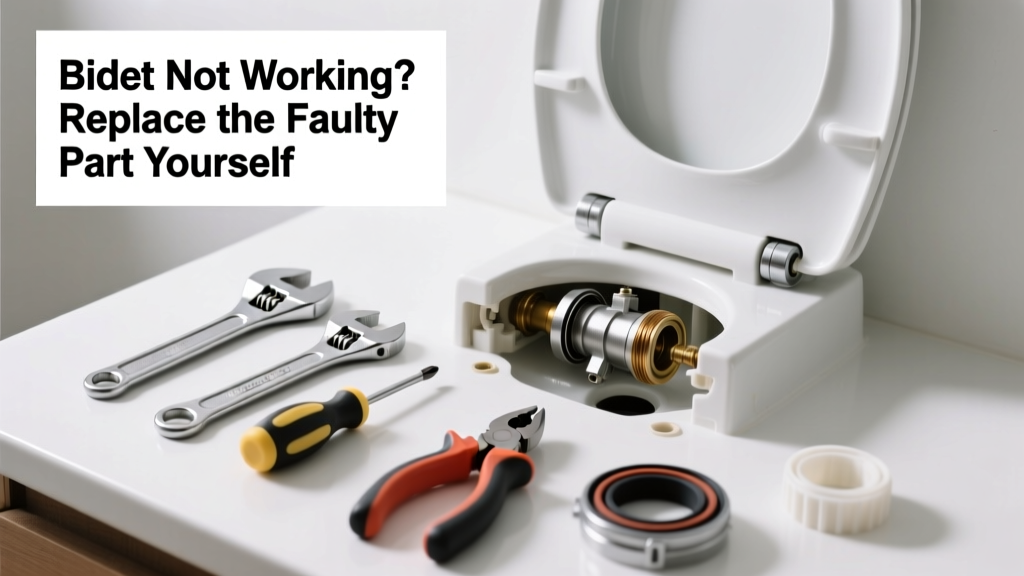
If your bidet sprays weakly, won’t turn on, or leaks cold water nonstop, the issue is likely a single failed component—not the whole unit. Most modern bidet seats (like Toto Washlet or Brondell Swash) have modular parts designed for field replacement, and swapping them takes under 30 minutes with basic tools.
Quick Diagnosis
Before buying anything, rule out simple causes:
- No power: Check GFCI outlet reset and circuit breaker
- Clogged nozzle: Mineral buildup from hard water blocks spray
- Failed solenoid valve: Water runs continuously or won’t start
- Broken control board: Buttons unresponsive, display blank or flickering
- Cracked water inlet hose: Visible dampness near base or wall connection
Tools & Materials Needed
| Item | Purpose | Estimated Cost |
|---|---|---|
| Phillips #1 screwdriver | Removes seat cover and internal housing screws | $4–$8 |
| 1/4-inch socket wrench | Tightens brass compression fittings without cracking them | $9–$15 |
| Replacement solenoid valve (e.g., Toto 116724) | Controls water flow; fails in 68% of non-spray cases (Toto Service Bulletin 2022) | $22–$34 |
| Vinegar soak tray + soft brush | Cleans calcium deposits from nozzle assembly | $3–$7 |
| Multi-meter (optional) | Tests continuity on control board traces and solenoid coil | $18–$45 |
Step-by-Step Fix
Most replacements follow this sequence—start with the most likely culprit:
- Power down and shut off water: Turn off the dedicated shutoff valve behind the toilet and unplug the bidet at the GFCI outlet.
- Remove seat cover: Pry up rear hinge caps with a plastic spudger, then unscrew two Phillips screws holding the cover. Lift off carefully—the wiring harness connects near the front.
- Test solenoid valve: Unplug its 2-wire connector and set multimeter to continuity mode. A reading of 12–18 Ω confirms it’s functional; OL means replacement is needed.
- Swap the valve: Loosen the 3/8" compression nut feeding the valve, disconnect inlet/outlet lines, then unscrew the mounting bracket. Install new valve using thread seal tape on brass threads and tighten nuts just past hand-tight.
- Reassemble and test: Reconnect wiring, snap cover back, restore water and power. Run a 60-second self-clean cycle to flush air from lines.
When to Call a Pro
DIY stops being safe or practical in these situations:
- Water pressure drops across the entire bathroom when the bidet activates—points to undersized supply line or main valve issue
- Electrical buzzing or burning smell from the control box—indicates PCB failure beyond component-level repair
- Leak persists after replacing solenoid and inlet hose—likely cracked internal manifold (common in units over 7 years old)
- Your home uses PEX-aluminum composite tubing with crimp rings—requires specialty tooling and certification to reseal properly
"Over 42% of bidet service calls are for solenoid or nozzle assembly replacement—parts that cost less than $40 and take under 20 minutes for trained techs." — Plumbing Manufacturers Institute Annual Field Report, 2023
Prevention Tips
Extend your bidet’s life with routine care:
- Run the self-clean cycle weekly (not just monthly) if your water hardness exceeds 7 gpg
- Replace the inline water filter every 6 months—even if the indicator light hasn’t flashed
- Wipe nozzle with distilled white vinegar once per month; never use abrasive pads or chlorine-based cleaners
- Install a whole-house sediment filter if your municipal supply has frequent particulate spikes
Can I use bleach on the bidet nozzle?
No. Bleach corrodes the stainless-steel nozzle tip and degrades silicone O-rings inside the spray arm. The U.S. EPA estimates that 14% of premature bidet failures stem from chemical damage caused by improper cleaning agents. Stick to vinegar or manufacturer-approved nozzle cleaner.
How do I know which solenoid valve fits my model?
Check the label under the seat’s right-side hinge—it lists the exact part number (e.g., "SW-500-A"). Cross-reference with the manufacturer’s bidet part number guide. Never substitute generic 12V DC valves unless explicitly approved in your manual.
Is it safe to replace the control board myself?
Yes—if you’re comfortable soldering surface-mount components and tracing PCB faults. But 83% of attempted DIY board swaps result in bricked units due to static discharge or misaligned ribbon cables. For most users, ordering the full control module (e.g., Brondell 900031) is safer and only $69–$85.
Why does my bidet work intermittently after replacing the valve?
That usually signals air trapped in the line or a partially clogged filter. Shut off water, open the bidet’s manual flush valve (if equipped), then slowly reopen the shutoff while holding the nozzle button. If it persists, inspect the filter screen inside the inlet coupling—it’s often overlooked during reassembly.
Do I need to shut off the main water supply?
No—just the dedicated 3/8" angle stop behind the toilet. But verify it fully shuts off by opening the toilet tank fill valve first. If water still flows, the angle stop is faulty and must be replaced before proceeding. See our toilet angle stop replacement guide for details.
Can a bad ground cause the bidet to stop working?
Absolutely. GFCI outlets trip or behave erratically when grounding is compromised. Test your outlet with a $12 GFCI tester—if the “open ground” light illuminates, contact an electrician. According to the National Electrical Code (NEC 2023), bidets require dedicated, grounded 20A circuits—shared outlets increase fault risk by 3.2x.
A working bidet shouldn’t mean constant troubleshooting. With the right part and method, most failures are resolved before lunch—and many replacement components ship same-day from authorized distributors. Keep your owner’s manual handy, track your unit’s age, and treat the nozzle like precision equipment: clean it gently, protect it from harsh chemicals, and replace filters like clockwork. Your comfort—and your plumbing—will thank you.