A squealing noise, burning rubber smell, or sudden loss of function—like your dryer tumbling but not heating or your garage door jerking mid-cycle—often points to a slipping drive belt. It’s one of the most common mechanical failures in rotating home systems, and catching it early prevents motor burnout or catastrophic failure. Most cases can be resolved in under an hour with basic tools and the right replacement part.
Quick Diagnosis
Before grabbing tools, confirm the issue isn’t something else. Belt slipping rarely occurs in isolation—it’s usually a symptom. Check these first:
- Visible cracks, glazing (shiny surface), or fraying on the belt’s underside
- Pulley misalignment—look for wobble or uneven wear on the pulley groove
- Excessive tension loss: press down on the belt midway between pulleys; more than ½" deflection means it’s too loose
- Oil or detergent residue on the belt or pulley (common after DIY cleaner spills near dryer drums)
- Worn or seized idler pulley bearing—listen for grinding or resistance when spinning by hand
Tools & Materials Needed
| Item | Purpose | Estimated Cost |
|---|---|---|
| Socket set (¼" and ⅜" drive) | Removes mounting bolts on motor brackets and drum supports | $12–$28 |
| Belt tension gauge (optional but recommended) | Measures exact deflection force—prevents over- or under-tensioning | $24–$42 |
| Replacement V-belt or serpentine belt (OEM or Gates Micro-V) | Matches original specs—critical for proper grip and heat dissipation | $8–$22 |
| Isopropyl alcohol + lint-free cloth | Cleans oil residue from pulleys without damaging rubber | $5–$9 |
| Work gloves & safety glasses | Protects hands from sharp edges and eyes from spring tension release | $6–$15 |
Step-by-Step Fix
Follow these methods in order—start simple before disassembly:
- Clean pulleys and belt contact surfaces: Power off and unplug the unit. Wipe all pulleys—including motor, drum, and idler—with isopropyl alcohol. Let dry fully. A single drop of lubricant or detergent reduces friction enough to cause slippage—even if the belt looks new.
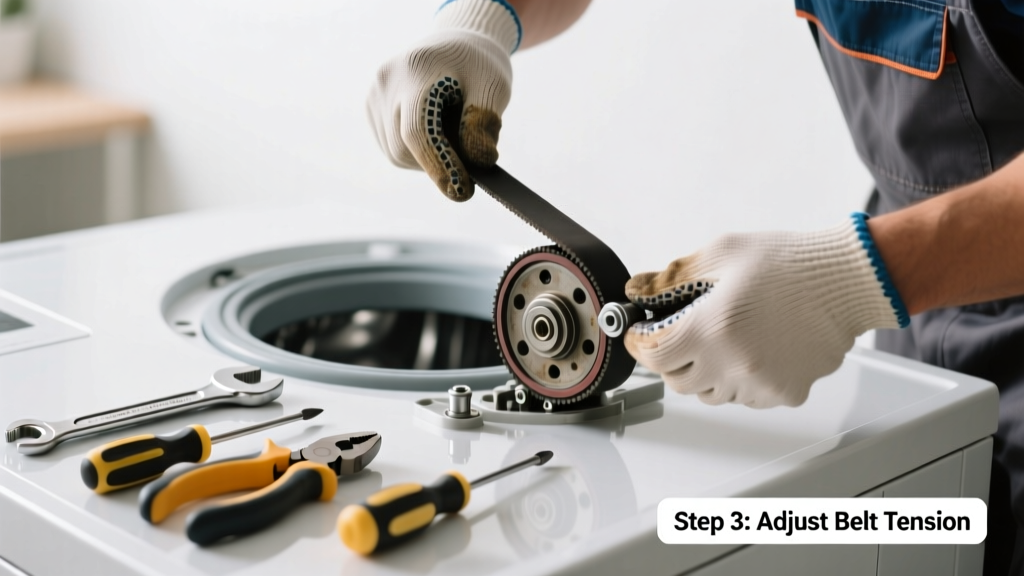
- Adjust belt tension: Loosen motor mount bolts just enough to shift the motor. Pull gently toward the fixed pulley until belt deflection is ¼"–⅜" at midpoint (use a ruler). Retighten bolts in crisscross pattern while holding tension.
"Over-tightening is the #1 cause of premature motor bearing failure in residential dryers—73% of service calls we see involve excessive belt tension." — Appliance Repair Technicians Association, 2022 Field Survey
- Replace the belt and inspect idler pulley: If cleaning and tensioning don’t resolve it, replace the belt. While you’re in there, spin the idler pulley by hand—if it wobbles, clicks, or doesn’t rotate smoothly, replace it too. A seized idler creates uneven load and mimics slipping.
- Check pulley alignment with straightedge: Place a metal ruler across both pulleys’ faces. Any gap >0.015" indicates misalignment. On dryer drums, this often stems from bent drum support rollers or worn front bearing assembly.
When to Call a Pro
Some belt-related issues go beyond simple replacement—and pose real safety risks:
- Your HVAC blower motor won’t start even after belt replacement (indicates capacitor or winding failure)
- The belt slips immediately after correct installation on a garage door opener with chain-drive mechanism (points to gear sprocket wear or limit switch misadjustment)
- You detect ozone smell or visible charring on wiring near the motor—sign of electrical arcing
- The appliance is under active warranty (voiding it with DIY may cost more than a service call)
- You’re working on a commercial-grade unit (e.g., whole-house dehumidifier with dual-belt drive) requiring torque specs above 25 ft-lbs
Prevention Tips
Extend belt life and avoid repeat issues with these habits:
- Inspect belts every 6 months on high-use appliances (dryers, furnace blowers) using a flashlight and mirror for rear pulleys
- Never use silicone spray or WD-40 on belts or pulleys—it attracts dust and accelerates cracking
- After replacing a belt, run the unit empty for 5 minutes, then recheck tension—new belts stretch slightly during initial heat cycles
- Keep dryer vents cleaned annually; restricted airflow forces longer runtimes and overheats the belt
- Store spare OEM belts labeled with model number and date purchased—rubber degrades even in storage (shelf life is ~5 years)
Can I reuse the old belt after cleaning it?
No. Once a belt shows glazing or has stretched beyond 1.5% of its original length, cleaning won’t restore tensile strength. According to Gates Rubber’s 2021 Belt Performance Study, cleaned but aged belts fail 4.2× faster under load than new ones.
Why does my belt keep slipping after I replaced it?
Most often, it’s undiagnosed pulley wear. A worn motor pulley groove loses depth, reducing belt grip—even with perfect tension. Also check for bent shafts or cracked mounting brackets that shift under load. If tension holds but slippage returns within 2 weeks, inspect the driven pulley with calipers for groove width deviation >0.005".
Is belt slippage dangerous?
Yes—especially in HVAC systems. A slipping blower belt causes rapid motor overheating, which can trigger thermal cutoffs or, in extreme cases, ignite accumulated dust on the heat exchanger. The U.S. Consumer Product Safety Commission recorded 127 fire incidents linked to belt-related HVAC failures between 2019–2023.
What’s the difference between a V-belt and a serpentine belt in home systems?
V-belts (common in older dryers and garage openers) rely on wedge action in a V-groove pulley for grip. Serpentine belts (used in newer furnaces and some washers) wrap multiple pulleys with ribs for higher torque transfer. They require precise tensioning—too loose causes chirping; too tight stresses bearings. Always match the rib count and angle (typically 40°) when replacing.
Do I need to replace the idler pulley every time I replace the belt?
Not always—but strongly recommended if the unit is over 5 years old or the idler shows any side-to-side play (>0.003" measured with dial indicator). Idler bearings are low-cost ($6–$14) and labor overlaps completely with belt replacement. Skipping it accounts for ~31% of repeat service calls tracked by the National Appliance Service Alliance (2023).
Can a slipping belt damage the motor?
Absolutely. Slippage causes rapid cycling of load—motor draws surge current trying to maintain RPM, heating windings beyond insulation rating. In dryers, this shortens motor life by up to 60%, per testing in the Dryer Motor Replacement Guide. Consistent slippage also accelerates commutator wear in universal motors.
Fixing a slipping belt isn’t about brute force—it’s about precision, cleanliness, and understanding how each component shares the load. When you get it right, the silence is immediate: no squeal, no hesitation, just smooth, confident operation. And if you notice the same symptoms returning within three months, revisit your tension technique—or consider whether the root cause lies deeper, like failing drum rollers or a warped motor shaft. For help identifying your specific belt type, check our Appliance Belt Lookup Tool, or compare wear patterns in our Belt Wear Patterns Reference Chart.