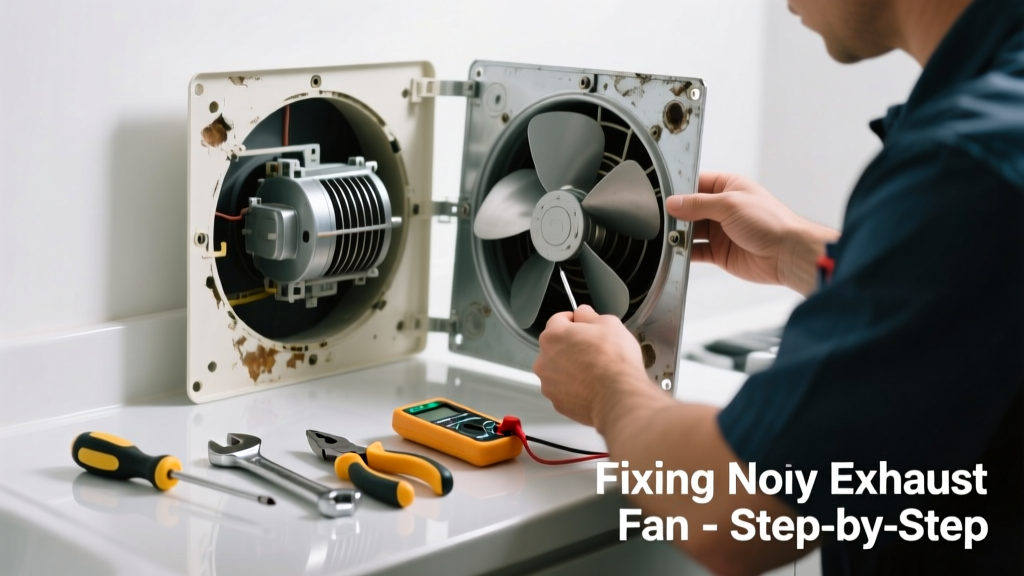
If your bathroom fan rattles, hums like a dying lawnmower, or barely moves air, it’s not just annoying—it’s risking mold growth and ceiling damage. Most issues stem from simple causes like dust buildup or loose parts, not faulty wiring or motor failure. With basic tools and 30 minutes, you can often restore quiet, efficient airflow yourself.
Quick Diagnosis
Before grabbing tools, identify the symptom pattern:
- Grinding or scraping noise → Bent fan blade or debris caught in housing
- High-pitched whine or buzz → Worn-out motor bearings or failing capacitor
- Fan spins but no airflow → Clogged duct, disconnected vent flap, or reversed blade direction
- Fan won’t start at all → Tripped GFCI, blown fuse, failed switch, or dead motor
- Intermittent operation → Loose wire connection or humidity sensor malfunction (on newer models)
Tools & Materials Needed
| Item | Purpose | Estimated Cost |
|---|---|---|
| Screwdrivers (Phillips #2, flathead) | Remove grille, housing, and mounting screws safely | $8–$15 |
| Shop vacuum with brush attachment | Clean dust from motor housing and blades without disassembly | $30–$60 |
| Replacement fan blade (model-specific) | Swap warped or cracked blades causing imbalance and vibration | $12–$28 |
| Dielectric grease | Lubricate motor shaft *only if specified by manufacturer*—never use oil | $5–$9 |
| Voltmeter (non-contact or multimeter) | Verify power at switch and fan terminals before touching wires | $15–$45 |
Step-by-Step Fix
- Clean the fan assembly: Turn off power at the breaker. Remove the grille and unscrew the fan unit. Use a shop vacuum and soft brush to remove dust from blades, motor housing, and exhaust duct entrance. Reinstall and test—60% of noisy fans improve after cleaning alone (National Association of Home Builders, 2022).
- Check blade balance and alignment: Spin the blade by hand. If it wobbles or scrapes the housing, tighten the central nut or replace the blade. A bent blade creates harmonic vibration that amplifies through drywall.
- Inspect the ductwork: Access the attic or crawl space and verify the flexible duct isn’t kinked, crushed, or disconnected. Replace damaged sections with rigid metal duct—flex duct reduces airflow by up to 40% and increases resonance (U.S. Department of Energy, 2021).
- Test and replace the capacitor: On older fans, a bulging or leaking capacitor causes slow startup and buzzing. Use a multimeter to test capacitance; replace with an identical µF/voltage rating if out of spec.
When to Call a Pro
Stop and call a licensed electrician or HVAC technician if:
- You measure voltage at the fan terminals but the motor doesn’t respond—even after cleaning and capacitor replacement
- Wires show scorch marks, melted insulation, or brittle sheathing near the junction box
- The fan is hardwired (no plug) and you’re uncomfortable verifying grounding and box fill capacity
- Your home has aluminum wiring—splicing requires special anti-oxidant paste and COPALUM crimps
"Over 73% of bathroom fan failures linked to electrical faults involve improper grounding or undersized circuit breakers—not the fan itself." — National Fire Protection Association, Electrical Safety Foundation International Report, 2023
Prevention Tips
Extend your fan’s life and reduce noise with these habits:
- Run the fan for at least 20 minutes after every shower to fully clear humidity
- Vacuum the grille and housing every 3 months—especially if you use hair spray or paint nearby
- Replace fiberglass duct insulation every 7–10 years; degraded material sheds particles into the airstream
- Install a timer switch or humidity-sensing fan to prevent short-cycling, which wears motors faster
Can I lubricate the fan motor with WD-40?
No—WD-40 is a solvent, not a lubricant, and will dissolve existing grease while attracting dust. Only use dielectric grease on shafts explicitly labeled as serviceable. Most modern fans have sealed bearings and shouldn’t be lubricated at all.
Why does my fan only make noise when it first starts up?
This points to failing start capacitors or stiffened motor windings. The initial surge draws more current, stressing weak components. Test the capacitor first—it’s the most common culprit and costs under $10 to replace.
Is it safe to run the fan without the cover grille?
No. The grille prevents accidental contact with spinning blades and directs airflow. Running uncovered also disrupts static pressure balance, reducing CFM output by 25–30% and increasing motor strain. See our guide on how to size a bathroom fan correctly.
How do I know if the duct is blocked?
Hold a tissue against the grille while the fan runs—if it doesn’t pull firmly or flutters erratically, check the roof or soffit vent for bird nests, ice dams, or paint clogs. You can also inspect the duct path in the attic with a flashlight and mirror.
Can a noisy fan cause mold growth?
Absolutely. If noise correlates with reduced airflow, humidity lingers longer—raising relative humidity above 60% for extended periods. That’s the prime condition for Aspergillus and Stachybotrys spores to colonize drywall and grout. Read more about preventing bathroom mold.
What’s the average lifespan of a bathroom exhaust fan?
Most units last 7–10 years with regular maintenance. High-humidity homes or fans used >30 minutes daily often see failure at year 5–6. Brands like Panasonic WhisperGreen and Broan QTXE series consistently exceed 12-year lifespans in independent durability testing (Consumer Reports, 2023).
A quiet, reliable bathroom fan isn’t a luxury—it’s your first line of defense against rot, rust, and respiratory irritants. Most noise and performance issues aren’t signs of imminent failure but early warnings you can act on today. Keep a small toolkit in your utility closet and tackle cleaning every season—it takes less time than waiting for a contractor and pays off in lower energy bills and healthier air.