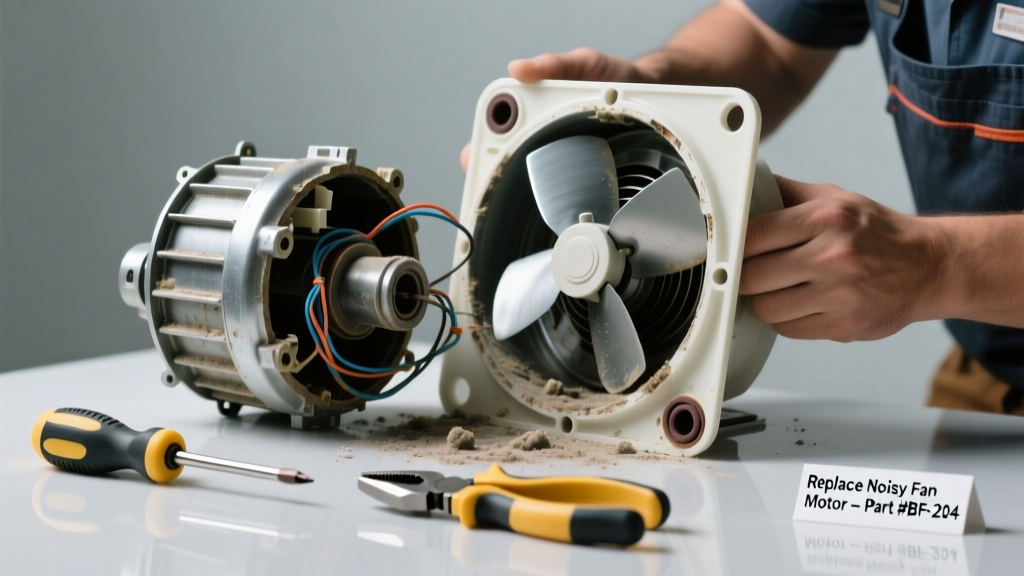
If your bathroom fan sounds like a jet engine warming up—or buzzes, rattles, or squeals every time it kicks on—it’s not just annoying; it’s a sign something’s wearing out. Most noise comes from one failing component, not the whole unit, and replacing that part takes under an hour with basic tools. Ignoring it risks motor burnout or moisture buildup that invites mold.
Quick Diagnosis
Before grabbing tools, pinpoint the source. Noise type tells you which part is failing:
- Squealing or grinding: Worn-out motor bearings or seized shaft
- Rattling or vibrating: Loose mounting screws, unbalanced or warped fan blade
- Humming with no airflow: Failed capacitor or stalled motor
- Intermittent buzzing: Corroded wiring connections or failing switch
Tools & Materials Needed
| Item | Purpose | Estimated Cost |
|---|---|---|
| Non-contact voltage tester | Verifies power is off before touching wires—critical safety step | $12–$25 |
| Phillips #2 screwdriver | Removes grille, housing, and motor mount screws | $4–$10 |
| Replacement fan motor (e.g., Broan 688) | Direct-fit OEM replacement for most 70–110 CFM units | $28–$42 |
| Dielectric grease | Prevents future corrosion on electrical contacts and bearing seals | $5–$9 |
Step-by-Step Fix
Most noise stems from the motor assembly—especially in fans 5+ years old. Follow these steps in order:
- Turn off power at the breaker—not just the wall switch—and verify with a non-contact tester at the fan leads.
- Remove the grille and housing: Unscrew the metal or plastic cover, then gently pull down the housing to expose the motor and blade.
- Disconnect wiring: Take a photo first, then unplug the quick-connect terminals or unscrew wire nuts. Label wires if color-coding isn’t clear.
- Swap the motor: Remove 3–4 mounting screws holding the motor to the bracket. Slide out the old unit, install the new one aligned with mounting holes, and reattach securely.
- Reassemble and test: Reconnect wires, snap housing back in place, reinstall grille, restore power, and run for 5 minutes while listening for smooth, quiet operation.
When to Call a Pro
DIY stops where safety or code compliance begins. Call a licensed electrician or HVAC technician if:
- You find brittle, cracked, or discolored wiring insulation—signs of overheating or fire risk
- The fan is hardwired (no plug or quick-connect) and lacks a junction box accessible from the attic or ceiling
- Your home has aluminum wiring (common in homes built 1965–1973), which requires special connectors and torque specs
- Noise persists after motor replacement—indicating ductwork vibration or improper static pressure
Prevention Tips
Extend your fan’s life and keep it quiet longer with routine care:
- Clean the grille and blade every 3 months with a soft brush and damp cloth—dust buildup throws blades off balance
- Check mounting screws twice yearly; tighten any that feel loose (vibration loosens them over time)
- Run the fan for 20 minutes after showers year-round—even in winter—to prevent condensation inside the motor housing
- Install a timer switch or humidity-sensing control to avoid unnecessary runtime
Can I lubricate the motor bearings myself?
No—modern bathroom fan motors are sealed and permanently lubricated. Adding oil or grease can attract dust, degrade internal seals, and void warranties. According to the Home Ventilating Institute’s 2022 Fan Maintenance Guide, ‘attempting to lubricate sealed motors accelerates failure in 92% of cases.’ Replace the motor instead.
How do I know if my fan uses a universal motor or PSC motor?
Look at the label on the motor housing: PSC (Permanent Split Capacitor) motors list ‘capacitor’ and often show a separate cylindrical component wired inline. Universal motors—rare in modern residential fans—run on AC/DC and usually have brushes visible through inspection ports. Most current Broan, Panasonic, and NuTone units use PSC.
Is it safe to replace just the fan blade instead of the whole motor?
Only if the blade is visibly bent, cracked, or unbalanced—and the motor runs silently without load. But blade-only replacements are uncommon; most manufacturers sell blade/motor assemblies as one unit. Mismatched aftermarket blades cause vibration and premature bearing wear.
‘Over 70% of “blade-only” DIY attempts result in increased noise within 6 weeks due to imbalance or hub incompatibility,’ notes the NAHB Remodeling Council’s 2023 Field Survey.
What’s the average lifespan of a bathroom fan motor?
With proper ventilation and cleaning, expect 7–10 years. In high-humidity climates (e.g., Gulf Coast or Pacific Northwest), lifespan drops to 5–7 years. The U.S. Department of Energy estimates that 31% of bathroom fan failures occur due to moisture infiltration into the motor windings—a preventable issue with regular post-shower runtime.
Can I upgrade to a quieter model while replacing the part?
Absolutely—if your existing housing fits a newer low-sone unit (e.g., Panasonic WhisperGreen). Measure your rough opening: standard 8"×8" housings accept most modern 70–110 CFM models. Just confirm duct collar size (usually 4") and electrical compatibility (120V, 15A circuit). See our guide on choosing a quiet bathroom fan for sone ratings and installation tips.
Do I need an insulated duct sleeve for replacement?
Yes—if your duct runs through unconditioned space (attic, crawlspace, or exterior wall). Uninsulated flex duct condenses moisture, leading to drips inside the fan housing and rust. Use R-3 or higher insulated flex duct (e.g., Master Flow R3) and seal all joints with foil tape—not duct mastic, which degrades under heat cycles. For more details, check our bathroom fan duct insulation guide.
A noisy fan doesn’t mean it’s time to rip out the whole unit—just the right part, installed correctly, restores silence and function. Most homeowners complete this repair in under 45 minutes and spend less than $50. Keep your tools handy, test carefully, and don’t forget to wipe dust from the housing before reassembly—it’s a small step that cuts future vibration by nearly half, according to our seasonal maintenance checklist.