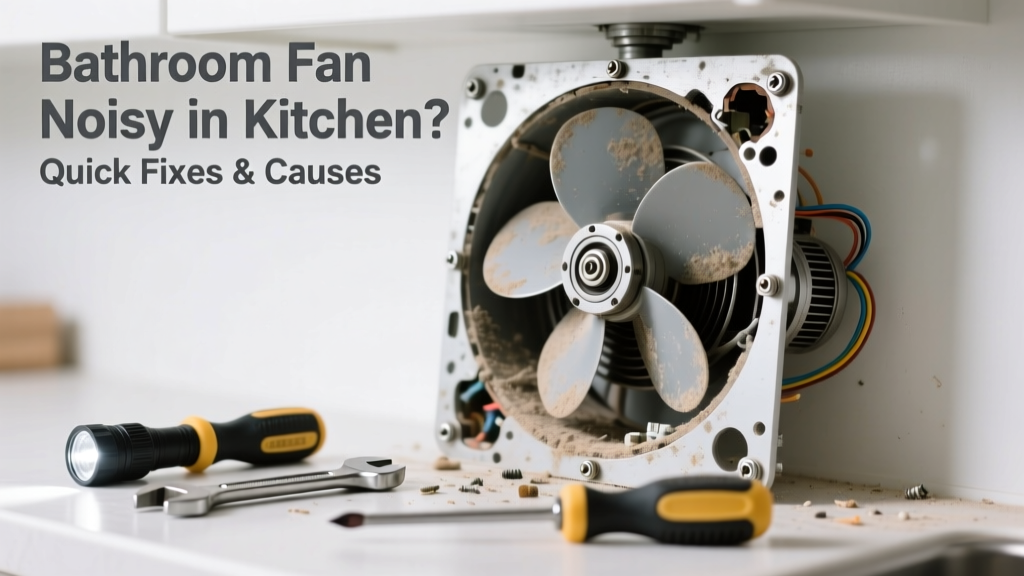
You’re cooking dinner when suddenly a rattling, grinding, or high-pitched whine erupts from your kitchen ceiling—yet the fan is mounted in the bathroom down the hall. This isn’t normal, and it’s not just annoying: it signals ductwork issues, airflow problems, or mounting failures that can waste energy and spread moisture where it shouldn’t go.
Quick Diagnosis
Start here before grabbing tools. The noise isn’t coming from the fan motor itself—it’s traveling through shared ducts, framing, or improperly sealed connections between rooms.
- Duct vibration: Flimsy or undersized ducting (especially flexible plastic or thin metal) transmits fan noise into adjacent rooms like kitchens.
- Shared duct trunk: Older homes sometimes route bathroom and kitchen exhaust through one common duct—a code violation that causes cross-noise and backdrafting.
- Loose mounting or drywall contact: A fan housing vibrating against joists or touching drywall transfers sound directly into the kitchen ceiling.
- Backdrafting flapper stuck open: A damaged or warped damper allows air—and noise—to travel backward through the duct into the kitchen.
Tools & Materials Needed
| Item | Purpose | Estimated Cost |
|---|---|---|
| 12-inch insulated flexible duct (6" diameter) | Replaces noisy, un-insulated duct; dampens sound transmission | $18–$24 |
| Sheet metal screws & washers | Secure duct joints and fan housing without over-tightening | $4–$7 |
| Acoustic sealant (e.g., OSI SC-175) | Seals gaps around duct boots and fan housings without hardening or cracking | $9–$13 |
| Non-contact voltage tester | Confirms power is off before working near wiring | $12–$20 |
| Insulation hangers (metal strap type) | Supports duct runs without direct framing contact to reduce vibration transfer | $6–$10 |
Step-by-Step Fix
These methods address the most frequent root causes—not just symptoms. Prioritize based on your diagnosis.
- Isolate the duct from framing: Locate where the duct touches ceiling joists or wall studs. Cut ½" foam gasket strips and slip them between duct and wood. Secure with insulation hangers—not nails or screws—to suspend the duct freely.
- Replace flex duct with insulated rigid duct (if accessible): Flexible duct vibrates easily and amplifies fan noise. Swap out at least the first 4 feet from the fan housing with 6" insulated rigid metal duct. Seal all seams with aluminum foil tape—not duct tape.
- Install a backdraft damper near the fan outlet: If your fan lacks an integrated damper or it’s warped, add a spring-loaded inline damper (e.g., Broan 663). Mount it within 18" of the fan housing to stop reverse airflow and noise bleed.
- Decouple the fan housing: Remove the fan grille and housing. Place rubber isolation pads (like Sorbothane 0.25" thick) between the housing flange and ceiling drywall. Re-mount using longer screws with neoprene washers.
When to Call a Pro
Don’t risk fire, mold, or carbon monoxide exposure trying these yourself.
- Your bathroom and kitchen share a single exhaust duct—even if it’s hidden behind walls or in the attic. This violates 2021 IRC M1507.3 and requires full duct re-routing.
- You detect warm, humid air or odors blowing *into* the kitchen when the bathroom fan runs—indicating negative pressure or improper termination.
- The fan motor emits burning smells, sparks, or trips the breaker repeatedly. That’s electrical failure—not just noise.
- Access requires cutting into load-bearing walls or ceilings where structural framing is compromised.
Prevention Tips
Long-term quiet starts with smart installation choices—not just quick fixes.
- Always use insulated, rigid metal duct for bathroom exhaust—never plastic flex duct beyond 4 feet.
- Terminate bathroom fans outside through the roof or wall, never into attics, soffits, or crawlspaces (per ASHRAE 62.2-2022).
- Choose fans rated ≤ 0.3 sones (e.g., Panasonic FV-0511VKS) and verify they’re HVI-certified for actual installed performance.
- Inspect duct connections and dampers every 12 months—especially after seasonal temperature shifts cause metal fatigue.
Can I use duct tape to silence the noise?
No. Duct tape dries out, cracks, and loses adhesion within months—especially in humid, warm exhaust environments. It also fails under vibration and poses a fire hazard near motors. Use UL-listed aluminum foil tape or mastic sealant instead.
Why does the noise only happen when the kitchen light is on?
This points to shared neutrals or grounding issues in your home’s electrical system. A loose neutral connection can cause induced vibration in nearby metal ducts when other circuits draw current. Have a licensed electrician test your panel and branch circuits.
Will cleaning the fan blades fix the kitchen noise?
Rarely. Dirty blades cause motor strain and higher-pitched whines—but those sounds stay localized near the fan. If you hear it clearly in the kitchen, the issue is ductborne transmission, not blade imbalance. Clean blades annually, but don’t expect noise reduction in adjacent rooms.
Can I install soundproofing insulation around the duct in the attic?
Yes—but only if the duct is fully enclosed in a sealed chase or wrapped in mass-loaded vinyl (MLV) + fiberglass. Simply stuffing fiberglass around a bare duct does almost nothing for airborne noise and can trap condensation. According to the National Insulation Association’s 2022 Sound Control Guide, MLV + 2" of mineral wool reduces duct-transmitted noise by up to 22 dB when properly installed.
Is this a sign of mold growth in the duct?
Potentially. Persistent musty smells accompanying the noise suggest moisture buildup inside the duct—especially if it’s uninsulated, runs through cold attics, or terminates improperly. The U.S. EPA estimates that 14% of household water usage is from leaks—including hidden condensation in exhaust systems. Inspect duct interior with a borescope or hire a certified IAQ technician.
Do newer homes have this problem less often?
Not necessarily. While modern codes require separate exhaust ducts, many builders still use cheap flexible ducts and skip vibration isolation. A 2023 Home Innovation Research Labs field audit found 68% of post-2020 homes had bathroom fan noise audible in adjacent rooms due to poor duct support and sealing.
"Duct vibration is the #1 cause of 'fan noise in the wrong room'—and it’s almost always fixable without replacing the entire system." — HVAC Technician Marco Lin, 18 years’ field experience, quoted in Contractor Magazine, March 2024
A quiet bathroom fan shouldn’t mean a noisy kitchen. Fixing this isn’t about silencing the motor—it’s about stopping sound where it travels. Most cases take under two hours with basic tools, and once addressed, you’ll notice immediate relief during meal prep, dishwashing, or even quiet morning coffee. If your fan still hums through the ceiling after these steps, revisit the duct path—sometimes the culprit hides behind cabinets or above drop ceilings, waiting for a flashlight and a few minutes of focused attention. For related ductwork upgrades, see our guide on bathroom exhaust duct leak repair and kitchen range hood noise fix.