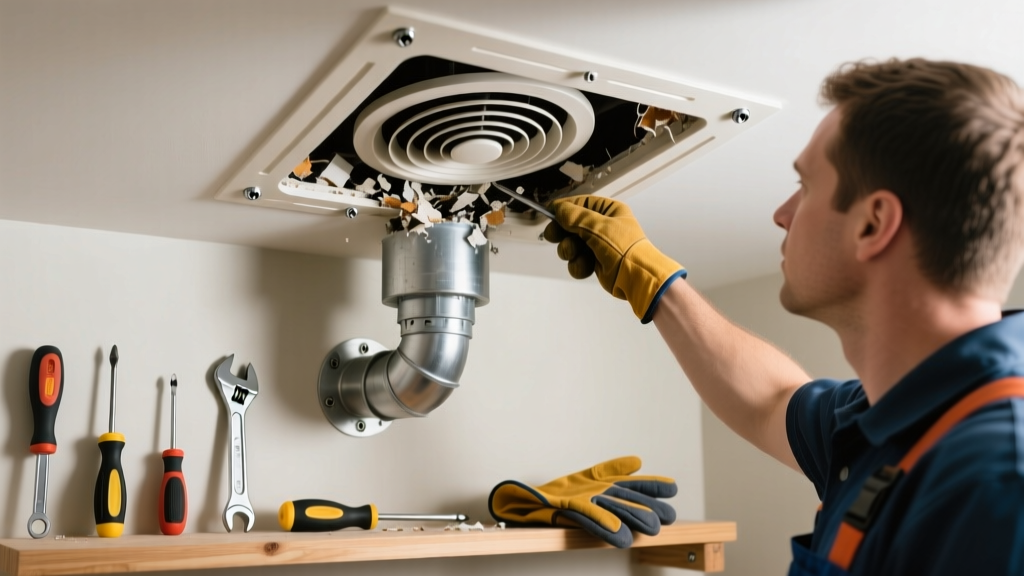
If your bathroom fan runs but no air moves—or worse, you smell dampness or see condensation on mirrors after showers—you’ve got a venting failure. This isn’t just annoying; it’s a moisture time bomb that can rot framing, grow mold, and trigger asthma flare-ups. Most issues are simple to diagnose and fix in under an hour.
Quick Diagnosis
Before grabbing tools, eliminate the obvious culprits:
- Fan switch wired incorrectly (fan runs but damper doesn’t open)
- Flexible duct crushed, kinked, or disconnected behind the ceiling or wall
- Birds’ nests, rodent debris, or ice blocking the roof or soffit vent cap
- Lint-clogged inline damper or backdraft preventer (common in older homes)
- Exhaust duct routed into attic instead of outside—this is illegal in all 50 states per IRC R303.3.
Tools & Materials Needed
| Item | Purpose | Estimated Cost |
|---|---|---|
| Flashlight + mirror on stick | Inspect duct path and roof vent from inside attic or crawl space | $12–$25 |
| Wire hanger or duct brush kit | Clear lint buildup inside flexible duct without disassembly | $8–$18 |
| Aluminum foil tape (not duct tape) | Seal joints in rigid metal ductwork; withstands heat and humidity | $7–$12 |
| Roof vent cap replacement (e.g., Broan 641) | Replace corroded or stuck caps that won’t open in cold weather | $22–$38 |
| Voltmeter (non-contact) | Verify power reaches fan motor and damper solenoid (if equipped) | $15–$40 |
Step-by-Step Fix
- Test airflow at the grille: Hold a tissue 2 inches from the fan cover while running. If it doesn’t lift, the issue is upstream—not the fan itself.
- Check attic access: Locate the duct run above the fan. Follow it to the exterior vent. Look for sharp bends (>90°), sagging sections holding water, or ducts stapled flat against joists.
- Clean the duct: Insert a wire hanger with a bent hook or a $15 duct brush through the fan housing (after powering off) and rotate while pulling back. Repeat until resistance drops.
- Inspect the roof vent: Climb onto the roof (with fall protection) and verify the cap opens freely. Tap gently—if it’s frozen shut, apply warm water (not boiling) and replace if cracked or warped.
- Verify exterior termination: Ensure duct ends outside—not in the attic, soffit, or crawlspace. Per the International Residential Code (IRC M1507.2), all bathroom exhaust must discharge outdoors.
When to Call a Pro
Don’t risk fire, structural damage, or code violations in these cases:
- Duct runs over 25 feet total length or includes more than two 90° elbows (requires engineered static pressure calculation)
- Wiring shows burn marks, melted insulation, or inconsistent voltage at the fan terminals
- You discover the duct terminates into a shared chase or furnace flue (a serious CO hazard)
- Home has a balanced HVAC system with heat recovery ventilator (HRV)—tampering affects whole-house pressure balance
"Over 60% of bathroom exhaust failures stem from improper duct installation—not fan malfunction," says HVAC engineer Lisa Tran in the Ashrae Journal (2022).
Prevention Tips
Extend your fan’s life and avoid repeat issues:
- Clean the grille and first 18 inches of duct every 6 months using a vacuum with brush attachment
- Install a timer switch (like the Leviton Decora) to guarantee minimum 20-minute run time post-shower
- Use rigid metal duct (not flexible plastic) for all new installations—it resists crushing and holds shape
- Add an inline humidity sensor (e.g., Humidistat Fan Control) to auto-run based on actual moisture levels
Can I use bleach to clean the fan housing?
No. Bleach corrodes galvanized steel housings and degrades plastic fan blades. Use a 50/50 vinegar-water solution with a soft brush instead. Rinse thoroughly and dry before reassembly.
Why does my fan work fine in summer but fail in winter?
Ice buildup inside the roof vent cap is common in cold climates. Moisture from warm exhaust freezes on cold metal surfaces, sealing the opening. Install a heated vent cap (like the Panasonic FV-HP1100HL) or insulate the last 3 feet of duct before the exterior termination.
Is it okay to vent into the attic if I add extra insulation?
No—never. The U.S. EPA estimates that improperly vented bathroom fans contribute to 30% of attic mold cases. Even with insulation, warm, humid air condenses on cold roof sheathing, causing rot and hidden mold growth.
How do I know if my duct is too long?
IRC limits bathroom exhaust ducts to 25 feet for 4-inch rigid duct, minus 5 feet for each 90° elbow. Measure total developed length—including all bends and offsets—not just straight-line distance. Exceeding this causes laminar flow collapse and backpressure.
Can I replace just the damper instead of the whole fan?
Sometimes—but only if your model supports it. Broan, Panasonic, and NuTone offer replacement dampers for select units (e.g., Broan 678D). Verify part number compatibility first; mismatched dampers cause rattling or incomplete closure.
What’s the minimum CFM for a standard 5' x 8' bathroom?
IRC requires 50 CFM continuous or 8 air changes per hour. For a 5' x 8' x 8' bathroom (320 cu ft), that’s ~43 CFM minimum. Always round up: choose a 50–70 CFM fan with ≤ 0.8 sones for comfort.
A properly venting bathroom fan doesn’t just clear steam—it protects your home’s structural integrity and indoor air quality for years. Replacing a $30 vent cap or re-routing a kinked duct takes less time than waiting for a contractor, and prevents thousands in future mold remediation. Keep a flashlight and duct brush in your utility closet—you’ll use them more often than you think.