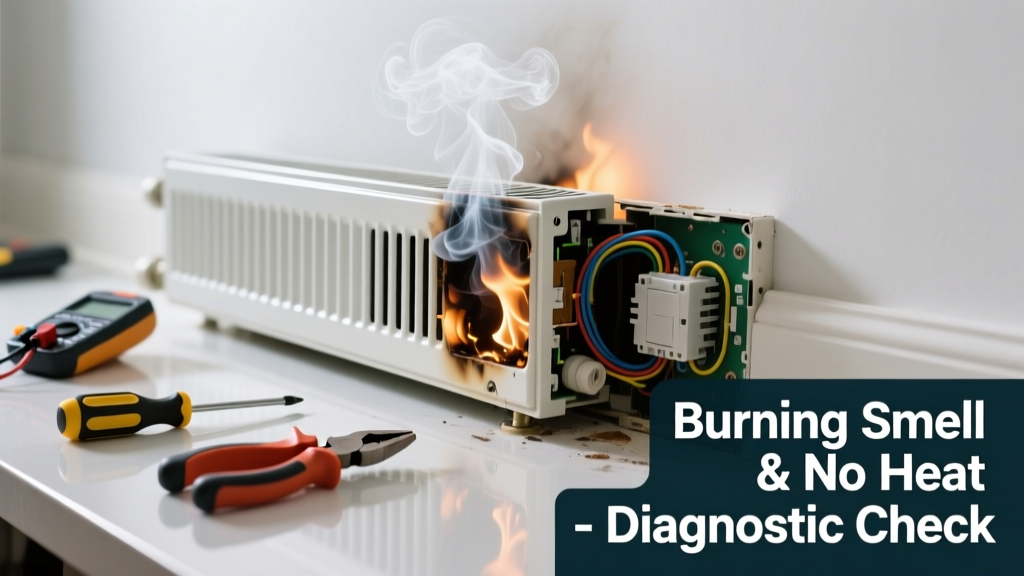
If your baseboard heater emits a sharp, acrid burning smell—and fails to warm the room—it’s not just annoying; it’s a red flag. That odor often signals overheating, dust ignition, or electrical failure, and ignoring it risks fire or component damage. Don’t turn it back on until you’ve ruled out serious causes.
Quick Diagnosis
Start here before grabbing tools. Most burning-smell + no-heat issues trace to one of these:
- Dust and debris baked onto heating elements (most common—especially after summer dormancy)
- Faulty thermostat or wall-mounted control unit
- Tripped or failing circuit breaker or internal thermal cutoff switch
- Loose or corroded wiring connections inside the unit
- Failed heating element (open circuit or shorted coil)
Tools & Materials Needed
| Item | Purpose | Estimated Cost |
|---|---|---|
| Non-contact voltage tester | Verifies power is off before opening the unit—critical for safety | $18–$25 |
| Phillips and flat-head screwdrivers | Removes cover panels and terminal screws | $8–$12 |
| Soft-bristle brush + vacuum with crevice tool | Cleans dust from fins and elements without bending them | $0 (if owned) or $25–$40 |
| Multimeter (with continuity setting) | Tests thermostat, element, and wiring for continuity and resistance | $30–$65 |
| Replacement thermostat (if needed) | Matches model number; most common replacement part | $22–$38 |
Step-by-Step Fix
Work methodically—and always cut power at the breaker first. Verify with your voltage tester.
- Clean thoroughly: Remove the front cover, then use the brush and vacuum to clear dust from fins, element coils, and the base tray. Pay special attention to corners where lint accumulates. According to the U.S. EPA, dust buildup on electric heaters can raise surface temps by up to 75°F, increasing fire risk and triggering thermal cutoffs.
- Test the thermostat: Bypass it temporarily by connecting the two line wires directly (only if comfortable with live wiring—otherwise skip to step 3). If the heater works, replace the thermostat. Most baseboard thermostats fail open-circuit, cutting power silently.
- Check the heating element: With power OFF, set multimeter to ohms. Touch probes to each terminal. A functional 240V element reads 10–25Ω. Infinite resistance = dead element. Replace only with an exact OEM match—mismatched wattage risks tripping breakers or underheating.
- Inspect wiring and terminals: Look for discoloration, melting insulation, or loose screws. Tighten any loose lugs and replace cracked or brittle wire sections. Corrosion on aluminum wiring requires professional remediation—do not DIY.
When to Call a Pro
Stop immediately and call a licensed electrician if you find any of these:
- Burn marks, melted plastic, or charring inside the unit
- Aluminum wiring (common in homes built 1965–1973) showing corrosion or overheating signs
- Breaker trips repeatedly—even after cleaning and resetting
- Smell persists after full cleaning and 48 hours of non-use
- You’re uncomfortable testing live circuits or interpreting multimeter readings
According to the National Fire Protection Association’s Fire Analysis and Research Division (2022), space heaters—including baseboards—are involved in an estimated 1,700 home fires annually, 40% linked to improper maintenance or aging components.
Prevention Tips
Extend your heater’s life and avoid repeat issues with these habits:
- Vacuum baseboard units twice yearly—spring and fall—before seasonal use
- Keep furniture, curtains, and rugs at least 12 inches away from the front and sides
- Label your breaker panel clearly so you can isolate baseboard circuits quickly
- Replace mechanical thermostats every 8–10 years—even if they “still work”
- Install a whole-home carbon monoxide detector (not required for electric heaters, but critical if gas appliances share the same HVAC ductwork)
Can I spray cleaner inside the heater?
No. Never use liquid cleaners, aerosols, or solvents near heating elements or wiring. Moisture and residue create short-circuit risks and leave flammable film. Stick to dry brushing and vacuuming. For stubborn grime, lightly dampen a microfiber cloth—wring it out completely—and wipe only non-electrical surfaces like the metal housing.
Why does it smell only when I first turn it on?
A brief (under 5-minute), dusty-burning odor at startup is normal after long disuse—it’s just accumulated dust igniting. But if it lingers, intensifies, or returns daily, it signals incomplete cleaning or an underlying fault. The baseboard heater maintenance schedule recommends deep cleaning before first use each season.
Is the burning smell dangerous if the heater still heats?
Yes—potentially. Even with heat output, persistent burning odors suggest insulation breakdown, arcing, or overheated wiring. These conditions escalate quickly. Turn it off, unplug or shut off the breaker, and inspect. If uncertain, consult a pro. Don’t rely on “it still works” as proof of safety.
Can I replace the heating element myself?
Yes—if you’re experienced with 240V circuits and have matched the exact model, voltage, wattage, and physical dimensions. But miswiring a 240V element can cause immediate breaker trips, ground faults, or fire. Always verify compatibility using the manufacturer’s parts list—not just visual similarity. See our how to replace baseboard heater element guide for wiring diagrams and torque specs.
What’s the average lifespan of a baseboard heater?
Most quality units last 15–25 years with proper care. However, thermostats and thermal cutoffs often fail earlier—around year 8–12. If yours is over 20 years old and exhibits multiple symptoms (slow response, uneven heating, repeated smells), replacement may be more reliable than repair. Compare cost: a new 240V 1500W unit runs $85–$140, while labor for diagnosis and parts often exceeds $200.
Should I install a GFCI breaker for my baseboard circuit?
No—GFCI breakers are not recommended or required for 240V baseboard circuits per NEC 2023 Article 210.8. They’re designed for 120V receptacles in wet locations. Installing one on a baseboard circuit will cause nuisance tripping due to normal leakage current across heating elements. Use a standard double-pole thermal-magnetic breaker sized to the heater’s amperage (e.g., 15A for 1500W @ 240V).
Fixing a burning-smelling, non-functional baseboard heater isn’t just about restoring warmth—it’s about preventing hazards before they escalate. Most cases resolve with careful cleaning and simple part swaps, but never sacrifice safety for speed. When in doubt, power down and call a licensed electrician. And next time you vacuum, add those baseboards to your checklist—they’ll thank you in quiet, consistent heat all winter.