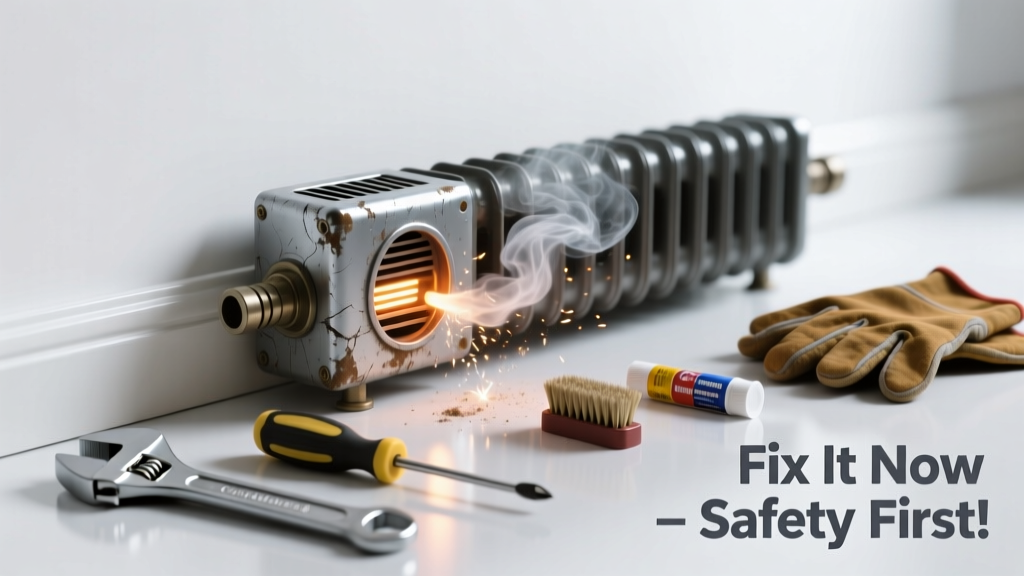
If your baseboard heater suddenly emits a sharp burning odor and starts making loud pops, buzzes, or rattles, don’t ignore it — this is your system warning you of dust buildup, electrical stress, or failing components. These symptoms often appear together because overheating triggers both thermal expansion noise and insulation off-gassing. Acting quickly prevents damage and reduces fire risk.
Quick Diagnosis
Start by ruling out obvious causes before touching wires or disassembling:
- Dust and pet hair baked onto heating elements (most common cause of burning smell)
- Loose or warped metal fins vibrating against the housing (causes buzzing or rattling)
- Electrical arcing inside the unit (sharp ozone + crackling sound)
- Faulty thermostat sending erratic voltage (intermittent heat + humming)
- Water intrusion from leaks or high humidity causing corrosion (musty-burning mix)
Tools & Materials Needed
| Item | Purpose | Estimated Cost |
|---|---|---|
| Non-contact voltage tester | Confirms power is fully off before servicing — critical safety step | $18–$35 |
| Soft-bristle brush & vacuum with crevice tool | Removes dust/debris from fins without bending them | $12–$25 |
| Isopropyl alcohol (90%+) and lint-free cloths | Cleans residue and oxidation from terminals and contacts | $8–$15 |
| Needle-nose pliers with insulated grips | Adjusts bent fins or tightens loose terminal screws safely | $14–$28 |
| Replacement thermal cutoff switch (if needed) | Factory-specified safety device that fails open when overheated | $12–$22 |
Step-by-Step Fix
- Power down completely: Turn off the circuit breaker (not just the wall switch), then verify no voltage at the heater’s wiring using a non-contact tester.
- Vacuum and brush the fins: Pull the cover off (usually two screws), then use the crevice tool to suction dust from between fins — follow with gentle brushing top-to-bottom. Don’t force bent fins back; replace if cracked.
- Inspect and clean electrical connections: Check wire nuts, terminal screws, and the thermal cutoff switch for discoloration or corrosion. Wipe terminals with isopropyl-soaked cloth; tighten only finger-tight plus ¼ turn with insulated pliers.
- Test operation with caution: Restore power and run heater on low for 15 minutes. Listen for changes in noise and sniff near the front grille — any persistent burning smell means internal damage exists.
When to Call a Pro
Stop and call a licensed HVAC technician or electrician if you observe any of these:
- Blackened or melted plastic housing or wiring insulation
- Arcing sparks visible behind the cover or at the wall outlet
- Thermostat reads 120V at the heater but unit doesn’t heat — indicates internal open circuit
- Smell persists after 48 hours of cleaning and low-heat testing
- You’re uncomfortable handling line-voltage wiring (120V or 240V)
According to the U.S. Fire Administration’s Home Fire Causes Report (2022), space heaters — including baseboard units — account for 12% of home heating fires, with improper maintenance cited in over 60% of those incidents.
Prevention Tips
- Vacuum baseboard heaters twice yearly — spring and fall — before heavy use begins
- Keep furniture, rugs, and curtains at least 12 inches away from the front and sides
- Install a whole-house humidifier set to 35–45% RH to reduce static-related dust attraction
- Replace mechanical thermostats with digital models that offer precise temperature control and built-in diagnostics
Can I spray compressed air into my baseboard heater?
No — compressed air can force dust deeper into the element coils or damage delicate thermal sensors. Use vacuum suction and soft brushes only. Compressed air also risks blowing debris into adjacent wall cavities where it may later ignite.
Why does the burning smell only happen when the heater first turns on?
This is usually dust baking off the hot fins — normal for the first few minutes each season. But if it lasts longer than 5–7 minutes or returns daily, it signals accumulated debris or failing insulation on internal wiring. See our guide on how to clean electric baseboard heaters.
Is it safe to run the heater if it’s buzzing but not smelling?
Buzzing alone may indicate loose mounting brackets or a failing transformer in a 24V-controlled unit. However, if buzzing coincides with flickering lights or warm outlets nearby, stop use immediately — it could signal an overloaded circuit or failing breaker. Read more about circuit breaker tripping when heater turns on.
What’s the white powder I see near the heater’s terminals?
That’s likely aluminum oxide — a conductive corrosion byproduct formed when moisture meets bare aluminum bus bars. It increases resistance, creates hot spots, and contributes to burning smells. Clean with isopropyl alcohol and inspect for pitting; replace corroded sections if depth exceeds 0.5mm.
Can I replace the thermal cutoff switch myself?
Yes — if you match the exact amperage, voltage, and trip temperature (e.g., 130°F/54°C, 15A, 240V). But never bypass it or substitute with a higher-temp model. Doing so voids UL listing and creates serious fire risk. Replacement kits are available for most common models like Cadet, Fahrenheat, and Marley.
How long should a baseboard heater last before needing replacement?
Well-maintained units typically last 15–25 years. The National Association of Home Builders’ 2023 Remodeling Impact Report notes that baseboard heaters installed before 2005 have a 42% higher failure rate during cold snaps due to outdated thermal cutoff designs and thinner gauge wiring. If yours is older, consider upgrading to a modern low-noise model with integrated GFCI protection.
Most burning smells and odd noises aren’t signs of imminent failure — they’re early warnings your heater needs attention. With careful cleaning, tight connections, and seasonal checks, you’ll extend its life and keep your home safe and quiet. And if you’ve tackled this repair successfully, you’ve just added a valuable skill to your home maintenance toolkit — one that pays off every winter.