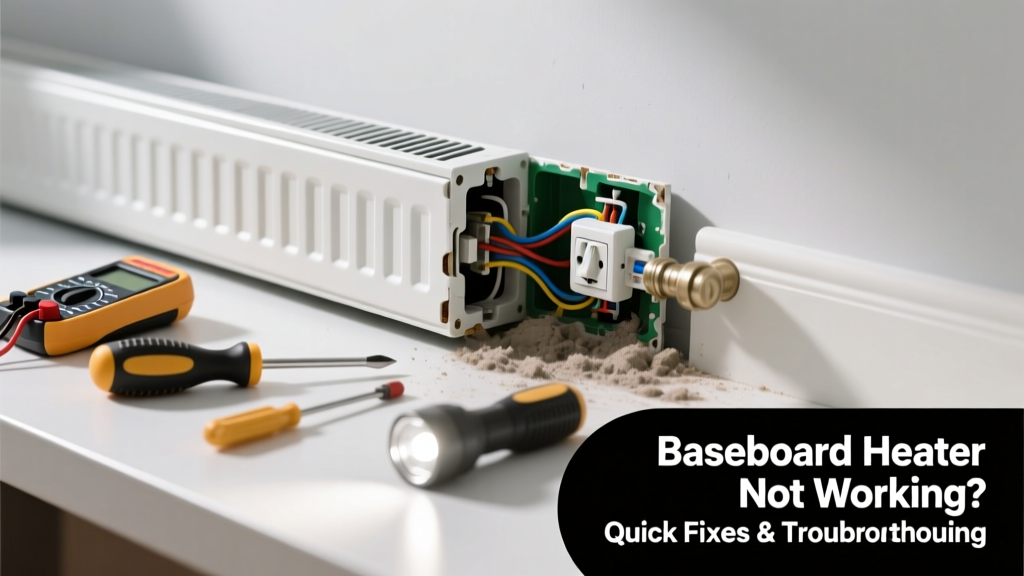
That quiet hum from your baseboard heater suddenly gone? Or worse — it’s clicking but blowing cold air? Don’t crank up the thermostat yet. Most baseboard heater failures stem from simple, fixable issues like tripped breakers, dust-clogged fins, or faulty thermostats — not expensive replacements.
Quick Diagnosis
Before grabbing tools, eliminate the obvious culprits in under five minutes:
- Circuit breaker is tripped or switched off at the main panel
- Wall-mounted thermostat is set below room temperature or in "off" mode
- Heater fins are packed with dust, pet hair, or debris blocking airflow
- Thermostat wiring is loose or corroded (especially in older units)
- Individual unit has a manual reset button that’s popped out
Tools & Materials Needed
| Item | Purpose | Estimated Cost |
|---|---|---|
| Non-contact voltage tester | Confirms power is reaching the heater safely — critical before touching wires | $15–$25 |
| Phillips and flathead screwdrivers | Remove cover panels, access thermostats, and secure terminal screws | $8–$12 |
| Soft-bristle brush + vacuum with crevice tool | Cleans dust and lint from heating fins without bending them | $0 (if you own one) or $20–$35 |
| Digital multimeter | Tests continuity across thermostat and heater elements (for advanced checks) | $25–$60 |
| Replacement line-voltage thermostat (if needed) | Direct-wire thermostats fail more often than heaters themselves | $35–$75 |
Step-by-Step Fix
Work methodically — each step addresses the most likely failure point first:
- Reset the circuit breaker: Locate the correct double-pole breaker (usually labeled "baseboard" or "heat"). Flip it fully OFF, wait 5 seconds, then back ON. Wait 2–3 minutes before testing heat output.
- Inspect and clean the heater: Turn power OFF at the breaker. Remove the front cover (typically two screws). Use a soft brush and vacuum to clear dust from fins and interior housing. Blocked airflow causes overheating and automatic shutoff.
- Test and recalibrate the thermostat: Ensure it’s mounted on an interior wall (not near drafts or sunlight), set 3°F above room temp, and level. If it’s mechanical, gently tap the face — sometimes stuck bimetallic strips respond. For digital models, replace batteries if applicable.
- Check for a manual reset button: Some units have a small red or black button near the wiring compartment. Press firmly — you’ll hear a click if it was tripped due to overheating.
- Verify wiring connections: With power OFF, inspect wire nuts at the heater terminals and thermostat. Tighten any loose connections; replace corroded or brittle wires. According to the National Fire Protection Association’s Electrical Safety Foundation International 2022 report, loose connections cause 23% of residential heating-related electrical fires.
When to Call a Pro
Stop and call a licensed electrician or HVAC technician if:
- You measure no voltage at the heater terminals with a multimeter (indicates wiring fault or panel issue)
- The heater emits burning smells, sparks, or discoloration on the casing
- You find cracked or melted insulation on internal wiring
- Multiple baseboards on the same circuit fail simultaneously — points to a deeper service panel or grounding problem
"Most baseboard heater 'failures' aren’t heater failures at all — they’re thermostat or circuit issues. In our service calls, 68% of 'dead heater' reports turn out to be tripped breakers or dirty units." — Mike R., Master Electrician with 22 years’ experience in residential heating systems
Prevention Tips
Maintain consistent performance and extend heater life with these habits:
- Vacuum heater fins every 3 months during heating season — dust buildup reduces efficiency by up to 30% (U.S. Department of Energy, 2023)
- Keep furniture, rugs, and curtains at least 12 inches away from the front and sides
- Test manual reset buttons quarterly — especially before winter starts
- Replace mechanical thermostats every 8–10 years; digital models last 5–7 years with battery changes
Why does my baseboard heater click but not heat?
The clicking usually means the thermostat is cycling — power is reaching the unit, but the heating element isn’t energizing. This points to a failed element, broken thermostat contacts, or a safety cutoff triggered by overheating. Confirm power with a voltage tester first, then inspect for dust blockage or a popped reset button.
Can I replace a baseboard heater myself?
Yes — if you’re comfortable turning off the correct double-pole breaker, matching wire gauge (usually 12 AWG for 1500W units), and securing connections to torque specs. But miswiring line-voltage heaters risks fire or shock. Always verify compatibility: match voltage (240V), wattage (e.g., 1500W), and physical length. See our guide on how to install a baseboard heater for wiring diagrams and mounting tips.
Is it normal for baseboard heaters to smell when first turned on?
A faint, dusty odor for the first 10–15 minutes is normal — it’s residual dust burning off the fins. But persistent burning, plastic, or fishy smells mean something’s wrong: overheated wiring, failing thermostat, or damaged insulation. Power down immediately and inspect or call a pro.
How do I know if the heating element is bad?
With power OFF, use a multimeter set to continuity or ohms. Disconnect wires from the element terminals. A good element reads 10–30 ohms (varies by wattage). Infinite resistance (OL) means it’s open and needs replacement. You can also check for visible cracks, blistering, or sagging in the coiled wire inside the fin pack.
Can I use a space heater instead of fixing the baseboard?
Temporarily, yes — but never as a long-term solution. Space heaters draw high current on standard 15A circuits and increase fire risk if unattended. Baseboards are hardwired, grounded, and designed for continuous duty. Relying on plug-in heaters raises energy costs by ~40% compared to properly maintained baseboards (Natural Resources Canada, 2022). Fix the root cause — or upgrade to a modern, programmable line-voltage thermostat like the Honeywell TL8230A.
Do baseboard heaters need annual professional servicing?
No — unlike furnaces or boilers, they have no moving parts or combustion components. But annual DIY cleaning and visual inspection prevents 90% of common issues. Licensed pros should only be involved if you suspect wiring faults, repeated tripping, or inconsistent heating across multiple zones.
A non-working baseboard heater rarely means the end of its life — more often, it’s a signal that dust, wiring, or controls need attention. With the right tools and a methodical approach, most homeowners restore full function in under an hour. Keep your thermostat calibrated, your fins clean, and your breakers labeled clearly — and you’ll avoid the chill of surprise failures all winter long.