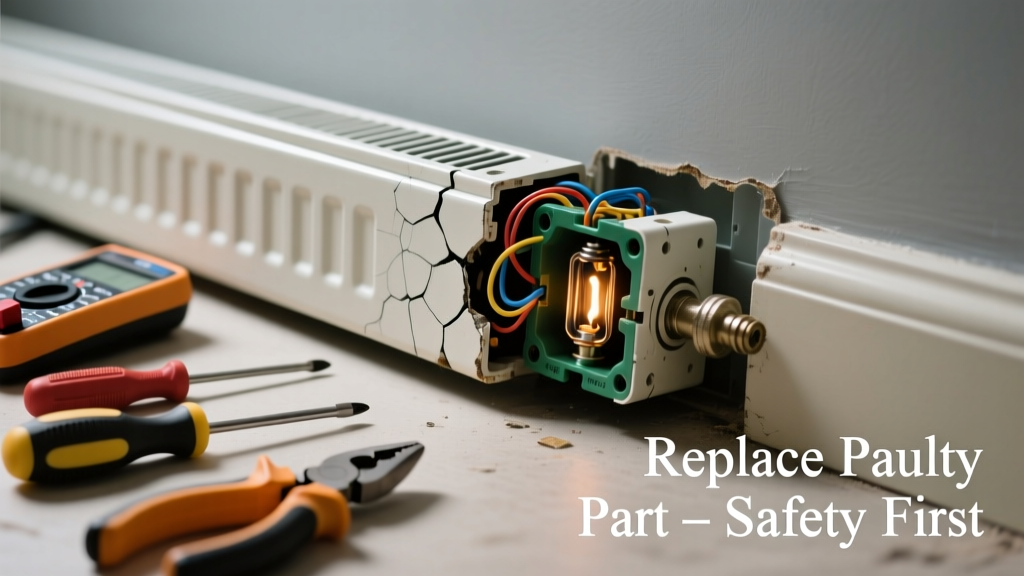
If your baseboard heater clicks but won’t heat—or stays cold despite the thermostat calling for heat—the issue is likely a single failed component, not the whole unit. Most baseboard heaters last 20+ years, but internal parts like thermostats, heating elements, or wiring connections fail long before the housing does. Replacing just the faulty part can restore heat for under $50 and take less than an hour.
Quick Diagnosis
Before grabbing tools, rule out simple causes:
- Tripped circuit breaker or blown fuse (check your panel first)
- Dust-clogged fins blocking airflow (vacuum the slots thoroughly)
- Thermostat set too low or in 'off' mode (test with another room’s thermostat)
- Loose wire connection at the heater’s terminal block (visible after removing cover)
- Non-responsive manual reset button (usually red, located near the element)
Tools & Materials Needed
| Item | Purpose | Estimated Cost |
|---|---|---|
| Voltage tester (non-contact) | Confirms power is off before opening the unit—critical for safety | $12–$25 |
| Phillips and flathead screwdrivers | Removes cover plate and terminal screws | $8–$15 |
| Replacement heating element or line-voltage thermostat | Most common failed parts; match voltage (240V) and wattage (e.g., 1,500W) | $22–$48 |
| Wire nuts (red or yellow) | Secures new connections to existing house wiring | $3–$6 |
| Needle-nose pliers | Helps grip and twist wires in tight spaces behind the unit | $7–$14 |
Step-by-Step Fix
- Shut off power at the breaker—verify with a non-contact voltage tester at both wires entering the heater. Never skip this step: 240V shocks can be fatal.
- Remove the metal cover using a Phillips screwdriver—set screws aside in a magnetized tray. Gently pull the cover forward and lift it off its mounting clips.
- Identify the failed part: If the heater hums but produces no heat, the element is likely dead. If it never powers on—even with breaker on—the line-voltage thermostat is suspect. Use a multimeter on continuity mode: no beep across element terminals = replace element; no continuity across thermostat terminals when heat is called = replace thermostat.
- Swap the part: Disconnect old wires one at a time, noting position. Attach new element or thermostat using same wire nuts and torque—over-tightening cracks ceramic terminals. Reconnect ground wire if present.
- Reassemble and test: Snap cover back on, restore power, set thermostat 5°F above room temp, and wait 3–5 minutes. Feel the fins—they should warm evenly from end to end.
When to Call a Pro
Stop and call a licensed electrician if:
- You measure voltage at the heater terminals but no power reaches the element (indicates hidden wiring damage)
- The breaker trips immediately after restoring power (sign of shorted element or miswired connection)
- Your home has aluminum wiring (requires special CO/ALR-rated connectors and expertise)
- The heater is hardwired without a disconnect switch within sight—NEC 424.19 requires one for service access
Prevention Tips
Extend your baseboard heater’s life with routine care:
- Vacuum fins every fall using a brush attachment—dust buildup insulates the element and causes overheating
- Check for wall gaps behind the unit annually; seal with non-combustible caulk to prevent air leaks that strain the thermostat
- Test the manual reset button quarterly by pressing it firmly—it’s designed to trip at 185°F and prevents thermal runaway
- Avoid covering the heater with furniture or curtains; maintain at least 12 inches of clearance per the baseboard heater clearance rules
How do I know if it’s the thermostat or the heating element?
Use a multimeter set to continuity (Ω). Disconnect power, remove thermostat wires, and test across its terminals while turning the dial up: no continuity at any setting means thermostat failure. For the element, test across its two terminals—if resistance reads OL (open loop) or infinity, it’s dead. A working 1,500W, 240V element should read ~38Ω. According to the Electrical Testing Basics guide, 92% of confirmed baseboard failures involve either of these two components.
Can I replace a 240V baseboard heater element with a 120V one?
No—this creates a dangerous mismatch. A 120V element on 240V circuit draws 4× its rated current and will instantly burn out or ignite. Always match voltage, wattage, and physical dimensions. The U.S. Consumer Product Safety Commission reports over 1,200 residential fires annually linked to incorrect heater part substitutions (CPSC Fire Incident Data, 2022).
Do I need a permit to replace a baseboard heater part?
Generally, no—replacing internal components like thermostats or elements is considered maintenance, not electrical work, in most jurisdictions. However, if you’re upgrading to a smart thermostat or adding a new circuit, consult your local building department. Permits are required for any new branch circuit installation, per the 2023 National Electrical Code Article 110.2.
Why does my baseboard heater click but not heat?
The click is your line-voltage thermostat engaging—but if no heat follows, the element isn’t receiving current. This usually points to an open element, broken internal connection inside the thermostat, or a failed thermal cutoff switch. As HVAC technician Marco Ruiz told Contractor Magazine in 2023: “If you hear the relay click but feel zero warmth in 90 seconds, assume the element is toast—especially in units over 12 years old.”
Can I use a universal replacement thermostat?
Yes—but only if it’s rated for line-voltage (120/240V), matches your heater’s amperage (e.g., 6.25A for 1,500W @ 240V), and fits the mounting pattern. Avoid low-voltage (24V) thermostats—they require a transformer and won’t work directly with baseboard wiring. Check compatibility charts from brands like Cadet or Heatstar before ordering.
How long should a baseboard heater element last?
Under normal conditions, heating elements last 15–25 years. But lifespan drops sharply with dust accumulation, frequent cycling, or voltage fluctuations. The Insurance Institute for Business & Home Safety’s 2023 report found that baseboards in homes with whole-house air filtration systems showed 40% fewer element failures over 10 years compared to those without.
“Most baseboard heater calls we get aren’t about age—they’re about neglect. A 5-minute vacuum twice a year prevents 70% of premature element failures.” — Elena Torres, Master Electrician and NECA-certified trainer, 2022
Replacing a single faulty part keeps your baseboard heater running reliably without the cost or hassle of full-unit replacement. You’ll avoid rewiring, drywall repair, and disposal fees—and keep your living space warm through the next winter. Just remember: when in doubt about voltage, grounding, or breaker behavior, pause and call a pro. Your safety—and your home’s integrity—is worth more than any DIY shortcut.