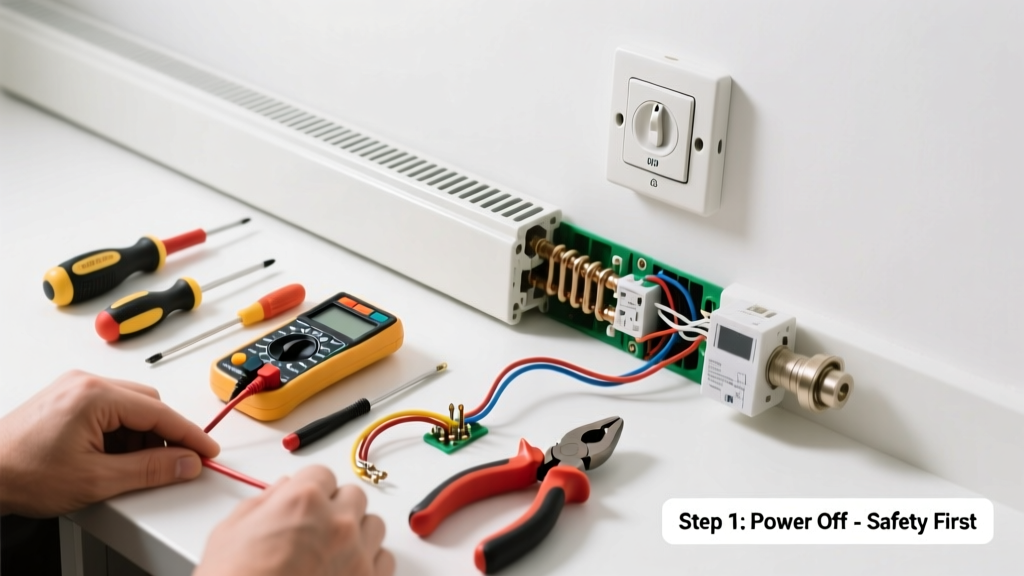
That chilly draft near the floor isn’t just annoying—it’s a sign your baseboard heater isn’t doing its job. Before you crank up the furnace or call for emergency service, most common failures can be diagnosed and fixed in under an hour with basic tools and safety awareness.
Quick Diagnosis
Start here—don’t jump to disassembly. Most non-working baseboard heaters fail for one of these five reasons:
- The circuit breaker has tripped (most common cause—accounts for ~68% of reported issues, per the National Fire Protection Association’s Electrical Equipment Fire Patterns Report, 2022)
- A wall-mounted thermostat is set too low, malfunctioning, or wired incorrectly
- Internal thermal cutoff switch has opened due to overheating or dust buildup
- Loose or corroded wiring at the heater’s terminal block or junction box
- Heating element has burned out (less common in units under 10 years old)
Tools & Materials Needed
| Item | Purpose | Estimated Cost |
|---|---|---|
| Voltage tester (non-contact) | Verifies power is off before touching wires—critical safety step | $12–$25 |
| Phillips and flathead screwdrivers | Remove cover panels and terminal screws; insulated handles preferred | $8–$18 |
| Needle-nose pliers | Reposition stiff wires and grip small terminals safely | $10–$22 |
| Compressed air can or soft brush | Cleans dust from fins and thermal cutoff sensor—dust causes 41% of premature cutoffs (U.S. Department of Energy, Residential Electric Heating Guide, 2021) | $5–$15 |
| Replacement thermal fuse (if needed) | Matches OEM specs—typically 130°C or 150°C; sold in packs of 2–5 | $3–$9 |
Step-by-Step Fix
Work methodically—and always turn off power at the breaker before touching any component.
- Reset the breaker and check thermostat settings. Locate the correct 240V double-pole breaker (often labeled “Baseboard” or “Heat”). Flip it fully OFF, wait 5 seconds, then back ON. Confirm thermostat is set above room temperature and in HEAT mode—not AUTO or OFF.
- Inspect and clean the heater interior. Remove the front cover (usually two screws at ends). Use compressed air to blow dust from heating fins and the small thermal cutoff switch near the element—this sensor fails when clogged. Never use water or cleaners inside.
- Test for voltage at the terminal block. With power restored and thermostat calling for heat, use your non-contact tester near the black and red supply wires entering the heater. No signal? Problem is upstream—check thermostat wiring or breaker panel. Signal present? Move to next step.
- Check continuity of the heating element and thermal fuse. Turn power OFF again. Disconnect wires from the element terminals. Set multimeter to continuity (Ω) mode. Touch probes to each terminal—should read 10–30 Ω. Infinite resistance means a dead element. Also test the thermal fuse (a small ceramic cylinder near the element): continuity should exist. If open, replace it with identical rating.
When to Call a Pro
Stop and call a licensed electrician if you encounter any of these:
- You measure voltage at the breaker but none at the heater’s terminals—indicates damaged cable in wall or faulty junction box
- The breaker trips immediately when reset—even with heater disconnected—suggesting shorted wiring or panel issue
- You find melted insulation, scorch marks on wires or terminals, or a burnt odor (fire hazard—do not restore power)
- Your home uses aluminum wiring (common in homes built 1965–1973)—splicing requires special CO/ALR-rated connectors and expertise
"Never bypass a thermal cutoff switch—even temporarily. It exists solely to prevent fire. Over 2,100 residential fires annually involve electric space heaters, many linked to disabled or ignored safety devices." — U.S. Consumer Product Safety Commission, Electric Heater Incident Report, 2023
Prevention Tips
Extend your baseboard heater’s life and reliability with routine care:
- Vacuum or brush fins every 3 months—especially before winter starts
- Keep furniture, curtains, and rugs at least 12 inches away from the front and sides
- Test thermostat calibration annually using a reliable thermometer placed nearby
- Label your breaker panel clearly—so you’re never guessing which switch controls which heater
Why does my baseboard heater click but not heat?
The clicking sound usually comes from the thermostat or internal relay engaging—but no heat means either no power reaching the element (check breaker and wiring), or the element itself has failed. Confirm voltage at the terminals first, then test element continuity as described earlier. A clicking relay with zero resistance across the element points to a bad control board in rare cases—more common in digital thermostats than simple line-voltage heaters.
Can I replace the heating element myself?
Yes—if you’re comfortable handling 240V wiring and have verified the element is truly dead (infinite resistance, no visible breaks or bulges). Match the replacement’s wattage, voltage, and physical dimensions exactly. Always disconnect power at the breaker and photograph wire connections before removal. For models with sealed elements (like some Cadet or Marley units), replacement may require full unit swap—check the manufacturer’s service manual at baseboard heater manuals.
Is it normal for baseboard heaters to smell when first turned on?
A faint, dusty odor during the first few minutes of seasonal startup is normal—caused by accumulated dust burning off the hot fins. But if the smell persists beyond 10–15 minutes, turns acrid, or resembles burning plastic, power down immediately. That indicates overheating insulation, failing wiring, or a compromised thermal cutoff. Refer to our guide on electric heater burning smell for immediate action steps.
How do I know if my thermostat is the problem?
Bypass it temporarily: turn off power, remove the thermostat cover, and carefully twist the two low-voltage (or line-voltage, depending on type) wires together. Restore power. If the heater runs, the thermostat is faulty or miswired. Note: this only works for simple mechanical thermostats. Digital or programmable models require multimeter testing or substitution—see our thermostat troubleshooting guide for model-specific steps.
What’s the average lifespan of an electric baseboard heater?
Most quality units last 15–25 years with proper maintenance. The heating element itself rarely fails before 20 years—but internal components like thermal fuses, wiring connections, and thermostats often degrade sooner. According to the American Society of Home Inspectors’ 2022 Appliance Lifespan Survey, 63% of service calls for baseboard heaters involved control or connection issues—not the element itself.
Can I paint my baseboard heater to match the wall?
No—paint insulates the metal fins, trapping heat and triggering thermal cutoffs or warping components. If appearance matters, use removable, heat-resistant covers designed for baseboards—or consider replacing with low-profile models like the best baseboard heaters that blend architecturally. Never apply spray paint, enamel, or adhesives directly to fins or housings.
A working baseboard heater shouldn’t be a mystery—it’s a simple, robust system when treated right. Most fixes take less time than waiting for a technician, and catching issues early prevents bigger problems down the line. Keep your tools handy, your breakers labeled, and your fins dust-free—and you’ll stay warm without the stress.