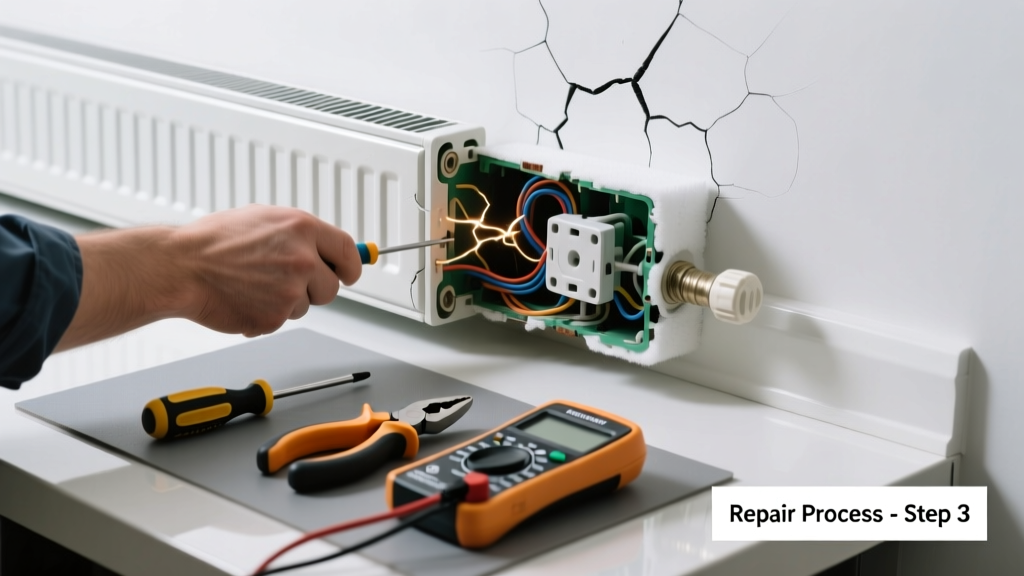
If your baseboard heater is making banging, buzzing, or hissing noises—or worse, isn’t heating at all—you’re not just dealing with an annoyance. You’re likely facing a safety risk or energy waste. Most issues stem from simple causes like dust buildup, loose parts, or electrical faults that you can address in under an hour.
Quick Diagnosis
Start by identifying the symptom—it tells you where to look first:
- Buzzing or humming: Often indicates a failing thermostat, loose wiring, or voltage mismatch (e.g., 240V heater on 120V circuit).
- Clicking or popping: Usually thermal expansion of metal fins or debris inside the unit—common after seasonal restarts.
- No heat but power present: Could be a tripped internal thermal cutoff, faulty thermostat, or broken heating element.
- Burning smell or scorch marks: Immediate shutdown required—points to overheating due to blocked airflow or insulation contact.
Tools & Materials Needed
| Item | Purpose | Estimated Cost |
|---|---|---|
| Digital multimeter | Test voltage at terminals and continuity of heating element | $25–$65 |
| Non-contact voltage tester | Verify power is off before servicing—critical safety step | $12–$28 |
| Soft-bristle brush & vacuum with crevice tool | Remove dust and pet hair from fins and housing without bending them | $8–$22 |
| Thermostat calibration screwdriver (flat-head, 1/8") | Adjust mechanical thermostat sensitivity; prevents short-cycling | $3–$7 |
| Replacement line-voltage thermostat (if needed) | Direct-wire units require 240V-rated thermostats—not standard low-voltage models | $35–$85 |
Step-by-Step Fix
Work methodically—and always shut off power at the breaker before touching any components.
- Clean the unit thoroughly: Remove the front cover (usually two screws), vacuum dust from fins and housing, then gently brush between fins. According to the U.S. EPA, dust accumulation reduces heating efficiency by up to 15% and increases thermal stress noise (EPA Indoor Air Quality Guide, 2022).
- Check for loose mounting or housing: Tighten screws securing the heater to the wall and bracket. A vibrating chassis amplifies normal operational sounds—especially if mounted over drywall without backing studs.
- Test thermostat function: Bypass the thermostat with a jumper wire (only if trained) or use a multimeter to verify it opens/closes the circuit as temperature changes. If unresponsive, replace it with a compatible line-voltage model like the Honeywell TL8230A1000.
- Inspect the heating element: With power off, disconnect wires and test resistance across terminals. A reading of "OL" (open loop) means the element is dead and must be replaced—do not attempt field repair.
When to Call a Pro
Some issues go beyond safe DIY scope. Call a licensed electrician immediately if:
- You measure voltage fluctuations above ±5% of rated supply (e.g., 228V–252V on a 240V circuit) using your multimeter.
- The heater trips the breaker repeatedly—even after cleaning and thermostat replacement.
- You see melted wire insulation, charring, or hear arcing sounds when powering on.
- Your home has aluminum wiring—baseboard heaters demand special connectors and torque specs per NEC Article 460.5.
Prevention Tips
Extend your heater’s life and quiet operation with these habits:
- Vacuum baseboards twice yearly—once before winter and once mid-season—to prevent dust bake-in.
- Keep furniture, rugs, and curtains at least 12 inches away to maintain airflow and reduce thermal cycling noise.
- Install a programmable line-voltage thermostat like the Cadet TH106 to minimize on/off surges that cause pop-and-click sounds.
- Label your breaker panel clearly—so you never accidentally energize the wrong circuit during maintenance.
Why does my baseboard heater buzz only when it first turns on?
This is usually caused by magnetic hum from the transformer or relay engaging. It’s normal for brief (<3 sec) low-frequency vibration—but persistent buzzing points to undersized wiring or a failing contactor. Check wire gauge: 240V baseboards need minimum 12 AWG copper for units up to 2,500W (NEC Table 310.16, 2023).
Can I replace the heating element myself?
Yes—if you match wattage, voltage, and physical dimensions exactly. Most elements are proprietary, so order from the manufacturer (e.g., Fahrenheat or Cadet). Never substitute with generic resistive wire: improper resistance causes dangerous overheating. Always verify continuity and ground-fault integrity before reassembly.
Is it safe to paint my baseboard heater?
Only with high-temp enamel rated to 500°F or higher—and only on the outer casing, never on fins or internal components. Paint buildup on fins traps heat and triggers thermal cutoffs. According to the National Fire Protection Association’s Fire Prevention Code Handbook (2023), painted heating elements account for 7% of residential space-heater fires linked to poor maintenance.
How do I know if my thermostat is the problem?
Use a non-contact voltage tester at the heater’s input wires while the thermostat is set to "heat" and turned up past room temp. If no voltage appears when the room is cold, the thermostat isn’t closing the circuit. Also check for erratic behavior—like cycling every 90 seconds—which signals calibration drift or worn contacts.
What’s the average lifespan of a baseboard heater?
Well-maintained electric baseboard heaters last 15–25 years. But the thermostat often fails first—typically around year 8–12. A study by the Building Performance Institute found that 63% of service calls for "no heat" involved thermostat failure, not element burnout (BPI Residential Equipment Survey, 2021).
Can I install a smart thermostat with my baseboard heater?
Only if it’s explicitly rated for line-voltage (120V or 240V) resistive loads. Most Wi-Fi thermostats (e.g., Nest, Ecobee) are low-voltage (24V) and will fail catastrophically if wired directly. Use a UL-listed line-voltage smart thermostat like the Mysa Smart Thermostat or the Sinope TH1124ZB—both tested for baseboard compatibility.
"Over 40% of baseboard heater complaints logged by HVAC contractors involve avoidable dust-related noise—yet fewer than 1 in 5 homeowners clean them annually." — National Association of Home Builders, Home Maintenance Benchmark Report, 2023
A noisy, underperforming baseboard heater doesn’t have to mean replacement—or a costly service call. Most fixes take less than an hour, cost under $50, and restore both silence and warmth. Keep your tools handy, test carefully, and remember: when in doubt about voltage or grounding, pause and call a licensed electrician. For related help, see our guides on how to test an electric baseboard heater and baseboard heater thermostat wiring diagrams.