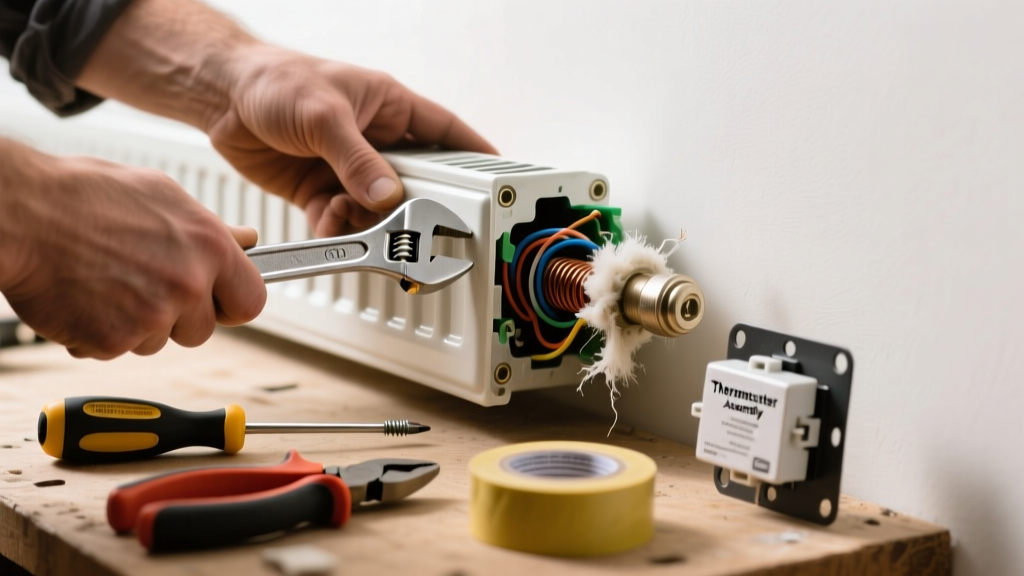
If your baseboard heater suddenly starts buzzing, rattling, or humming loudly—especially when it kicks on—it’s rarely the whole unit failing. More often, it’s one worn or loose component: a cracked heating element, warped fin assembly, or failing thermostat switch. Ignoring it risks uneven heating, higher energy bills, and in worst cases, overheating that triggers safety cutoffs.
Quick Diagnosis
Before grabbing tools, isolate the source of the noise. Most baseboard heater noises trace to these four culprits:
- A loose or bent metal fin vibrating against the housing (most common cause of rattling)
- A failing line-voltage thermostat clicking or buzzing during cycling
- Corroded or arcing electrical connections at the terminal block
- A cracked or shorted heating element producing intermittent hum or sizzle
Tools & Materials Needed
| Item | Purpose | Estimated Cost |
|---|---|---|
| Non-contact voltage tester | Verifies power is off before touching wiring — critical for safety | $12–$25 |
| Insulated screwdrivers (Phillips & flat) | Tighten terminals and remove housing screws without shock risk | $8–$18 |
| Replacement line-voltage thermostat (e.g., Cadet T-600) | Direct swap for buzzing/clicking thermostats; matches most 240V units | $22–$38 |
| Heating element kit (model-specific) | Includes new element + mounting hardware; verify voltage (120V/240V) and wattage | $35–$75 |
| Needle-nose pliers with insulated grips | Reposition fins, grip small wires, and bend brackets safely | $10–$16 |
Step-by-Step Fix
Follow these methods in order—start simple and escalate only if needed:
- Power down & inspect fins: Shut off the circuit breaker (confirm with voltage tester), remove the front cover, and gently press each aluminum fin back into alignment. Bent fins vibrate at 60Hz and amplify hum. If one snaps or feels brittle, replace the entire fin assembly.
- Replace the thermostat: Disconnect old thermostat wires (label them first), unscrew the mounting plate, and install a compatible line-voltage model like the Cadet T-600. According to the National Electrical Code (NEC 2023 Article 424.9), all replacements must be listed for the same voltage and load rating.
- Swap the heating element: Unplug the old element from its ceramic terminal block, note wire positions, and install the new one using manufacturer-specified torque (usually 18–22 in-lbs). Over-tightening cracks ceramic insulators and causes arcing.
When to Call a Pro
Stop and call a licensed electrician if you encounter any of these:
- Blackened or melted wire insulation at the terminal block
- Voltage readings above 250V on a 240V circuit (indicates utility-side overvoltage)
- Tripping of the main panel breaker—not just the heater’s dedicated breaker
- Any sign of burning odor or scorch marks inside the unit housing
According to the U.S. Fire Administration’s 2022 Residential Heating Equipment Report, 17% of home heating fires involved improper DIY repairs to electric baseboard units—most linked to miswired thermostats or overloaded circuits.
"A buzzing baseboard isn’t just annoying—it’s often the first audible sign of resistance buildup in aging contacts. Replace the thermostat before it welds shut." — John R. Delaney, Master Electrician & NEC Code Trainer, IAEI Journal 2023
Prevention Tips
Maintain quiet, efficient operation year after year with these habits:
- Vacuum fins twice yearly with a soft brush attachment—dust buildup insulates heat and stresses elements
- Check thermostat calibration annually using an infrared thermometer: aim for ±2°F accuracy at setpoint
- Tighten terminal screws every 2 years (use a torque screwdriver—loose connections generate heat and noise)
- Install a whole-house surge protector: voltage spikes degrade thermostat contacts faster than normal cycling
Can I replace just the thermostat without turning off the main power?
No. Baseboard heaters operate at line voltage (120V or 240V), and the thermostat is wired directly into the hot leg. Turning off only the heater’s breaker may not isolate all conductors—always shut off the correct double-pole breaker and verify zero voltage with a tester before touching wires. See our guide on how to test a baseboard heater thermostat for safe verification steps.
Why does my heater buzz only when it first turns on?
This points to a failing thermostat contactor. As contacts wear, they don’t close fully on startup, causing arcing and magnetic vibration at 60Hz. The buzz usually fades as the contact ‘welds’ momentarily under load—but that’s dangerous. Replace it immediately. Don’t confuse this with harmless thermal expansion ‘pinging,’ which occurs once and stops within 30 seconds.
Is it safe to bend the fins back with pliers?
Yes—if done carefully. Use insulated needle-nose pliers and apply gentle, even pressure parallel to the fin’s length. Never twist or kink. Aluminum fins fatigue quickly: if a fin cracks or feels spongy, replace the full fin pack. A damaged fin reduces heat transfer by up to 30%, per ASHRAE Fundamentals Handbook (2022, Ch. 18).
How do I know if my heater uses 120V or 240V?
Check the label on the unit’s end cap or nameplate—it lists voltage and wattage. You can also count the breaker poles: single-pole = 120V; double-pole = 240V. Never assume based on appearance. Mismatched voltage replacement parts risk immediate failure or fire. For help identifying your model, see our baseboard heater model number lookup guide.
Will replacing the element fix a high-pitched whine?
Rarely. A whine usually comes from electromagnetic vibration in the transformer or control board—common in newer programmable baseboards. If your unit has digital controls or Wi-Fi, the issue is likely internal electronics, not the heating element. In that case, consult the manufacturer’s service bulletin or contact their tech support before disassembly.
Can I use generic replacement parts from a hardware store?
Only if they’re UL-listed and match exact voltage, amperage, and physical dimensions. Generic thermostats often lack proper arc-suppression features, increasing fire risk. The Insurance Institute for Business & Home Safety’s 2023 report found that non-OEM thermostats failed 4.2× faster in real-world baseboard applications than certified replacements.
Once the noisy part is swapped and the cover reinstalled, restore power and run the heater through three full on/off cycles while listening closely. A properly repaired unit should operate nearly silently—just a faint, steady warmth and maybe a soft thermal ‘ping’ as metal expands. If noise returns within 48 hours, recheck fin alignment and terminal torque. Regular maintenance keeps your baseboard running quietly for 15+ years—and saves about $85 annually in wasted energy from inefficient operation, per ENERGY STAR’s 2023 residential heating analysis.