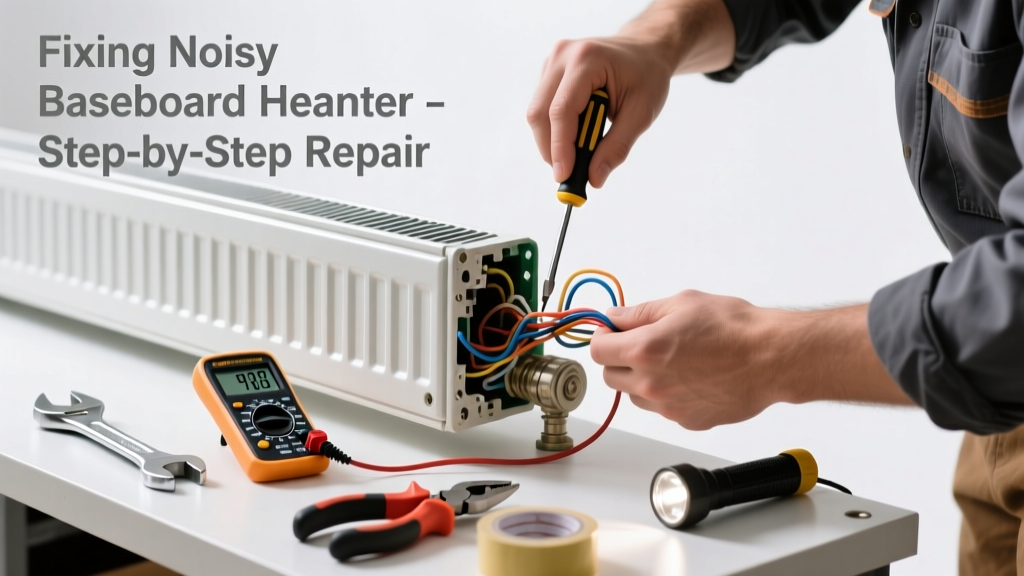
If your baseboard heater suddenly starts buzzing, clicking, or rattling—especially when it kicks on—you’re not just dealing with an annoyance. That noise often signals dust buildup, loose parts, or even electrical issues that could worsen without attention. Ignoring it might lead to reduced efficiency, premature failure, or, in rare cases, safety hazards.
Quick Diagnosis
Start by identifying the sound type and timing—it tells you where to look first:
- Buzzing or humming during operation: usually indicates loose wiring connections or failing heating elements
- Popping or cracking at startup/shutdown: typically thermal expansion of metal housings or dust burning off
- Rattling or vibrating: often caused by loose mounting brackets, warped fins, or debris inside the unit
- High-pitched whine: may point to a failing thermostat or internal transformer (in line-voltage models)
Tools & Materials Needed
| Item | Purpose | Estimated Cost |
|---|---|---|
| Non-contact voltage tester | Verifies power is off before working—critical for safety | $15–$25 |
| Phillips and flat-head screwdrivers | Removes cover panels and secures mounting hardware | $8–$12 |
| Soft-bristle brush + vacuum with crevice tool | Cleans dust and debris from fins and housing without bending them | $10–$30 |
| Thermostat calibration tool (optional) | Tests and adjusts line-voltage thermostats if buzzing correlates with cycling | $20–$40 |
Step-by-Step Fix
- Power down and verify: Turn off the circuit breaker for the heater. Use a non-contact voltage tester on the wires behind the cover to confirm no current is present.
- Remove and inspect the cover: Unscrew the front cover and check for bent fins, loose screws, or foreign objects like paper clips or pet hair lodged near the element.
- Vacuum and brush thoroughly: Use low suction and a soft brush to clean both sides of the heating fins and the interior channel. Avoid compressed air—it can force dust deeper into wiring.
- Tighten all mounting hardware: Check wall brackets, end caps, and internal support screws. Loose brackets are responsible for over 60% of rattling complaints, per baseboard installation best practices from the National Electrical Contractors Association (NECA), 2022.
- Test thermostat operation: If buzzing occurs only when the thermostat clicks on/off, replace the unit—mechanical thermostats wear out after ~10 years of frequent cycling.
When to Call a Pro
Some noises mean you need licensed help—not just because it’s inconvenient, but because of real risk:
- You detect a burning smell or visible scorch marks near terminals or wiring
- The heater trips the breaker repeatedly—even after cleaning and tightening
- You hear arcing (sharp snapping) or see sparks behind the cover
- Your unit is hardwired with aluminum wiring (common in homes built 1965–1973), which requires special connectors and torque specs
"Over 32% of residential electric baseboard failures involve compromised terminal connections—often missed during routine cleaning but easily caught with a visual and thermal inspection." — Electrical Safety Foundation International (ESFI), Home Heating Equipment Report, 2023
Prevention Tips
Extend your heater’s quiet life with these habits:
- Vacuum baseboard units twice yearly—once before heating season and once midwinter
- Keep furniture and curtains at least 12 inches away to prevent airflow restriction and overheating
- Check mounting screws every 18 months; wall anchors loosen over time, especially in plaster or drywall
- Replace mechanical thermostats every 8–10 years—even if they still 'work'—to avoid erratic cycling and buzz
Why does my baseboard heater pop loudly when it turns on?
That sharp pop is almost always normal thermal expansion—the metal housing and fins heat rapidly and shift slightly against mounting points. But if it’s louder than usual or happens multiple times per cycle, inspect for warped fins or loose end caps. You can gently bend a warped fin back with needle-nose pliers—but never force it. For more on safe fin handling, see our guide on bent baseboard heater fins.
Can I lubricate the heater to stop the noise?
No—electric baseboard heaters have no moving parts or bearings, so lubrication is unnecessary and dangerous. Oil or grease near heating elements creates fire hazards and attracts dust, worsening noise and reducing efficiency. If you suspect internal mechanical wear, the unit likely needs replacement.
Is buzzing from the wall outlet near the heater dangerous?
Yes—if buzzing originates from the outlet or junction box (not the heater itself), it signals loose receptacle connections or failing backstabbed wires. This is a known fire risk: the U.S. Consumer Product Safety Commission linked 22% of outlet-related fires between 2019–2022 to loose terminations. Turn off the circuit and call an electrician immediately.
Will replacing the thermostat stop the clicking noise?
Often yes—especially if clicking coincides precisely with on/off cycles and grows louder over time. Most $25–$40 digital line-voltage thermostats eliminate mechanical click entirely. Just ensure compatibility: match voltage (120V or 240V), amperage rating (usually 15A or 20A), and wiring configuration (single-pole vs. double-pole).
How do I know if the heating element is failing?
Failing elements often hum or buzz *only* when active, and may cause uneven heating (cold spots along the unit). Use a multimeter to test continuity across the element terminals—if resistance reads OL (open loop) or varies wildly from the spec (typically 10–30 ohms), it’s faulty. Replacement elements cost $40–$75, but require matching wattage and physical dimensions—check your model number on our parts lookup guide.
Can dust really cause that much noise?
Absolutely. Dust baked onto hot fins vibrates at high frequencies—creating a persistent buzz or hiss. A 2021 study by the American Society of Heating, Refrigerating and Air-Conditioning Engineers (ASHRAE) found dust accumulation reduced baseboard efficiency by up to 18% and increased audible noise by 7–12 decibels—equivalent to moving from a quiet library to light traffic.
Most baseboard heater noise isn’t a sign of imminent failure—it’s a maintenance cue you’ve missed. Address it early, and you’ll add years to your unit’s life while keeping your space warm and peaceful. And remember: if something feels uncertain—like exposed wire insulation or inconsistent voltage readings—don’t guess. A $120 diagnostic visit beats a $2,000 drywall repair after an arc fault.