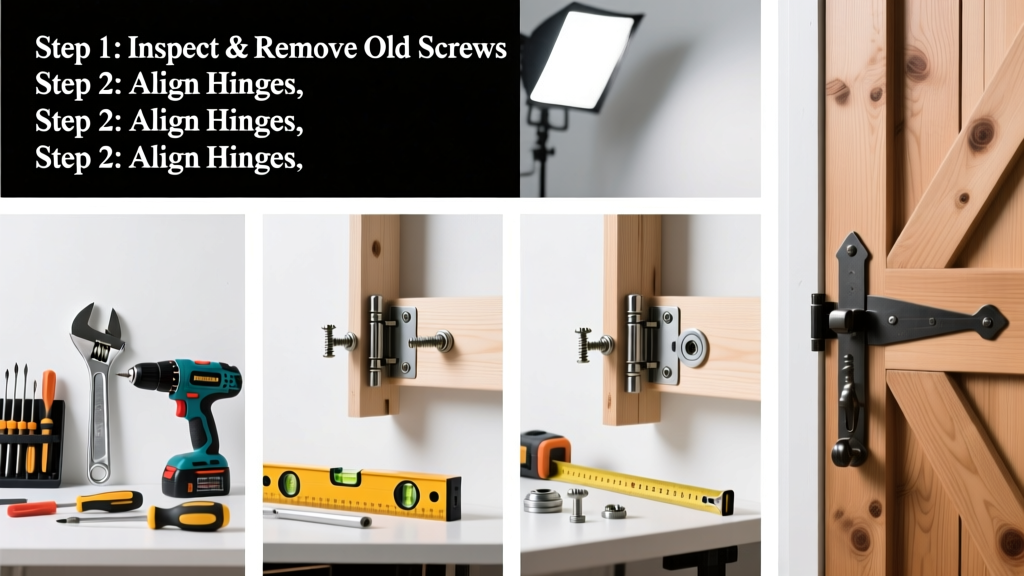
If your barn door suddenly shudders, scrapes the floor, or won’t stay aligned—chances are the hardware has loosened from repeated use, wall movement, or inadequate initial installation. This isn’t just an annoyance; unchecked looseness wears out track brackets, damages flooring, and can cause the door to derail mid-slide. The good news? Most cases take under 45 minutes and require only basic tools.
Quick Diagnosis
Before grabbing a wrench, rule out these five common culprits:
- Loose lag bolts anchoring the track to wall studs (most frequent cause)
- Worn or stripped roller wheels or wheel axles
- Bent or warped track—especially near end caps or splices
- Missing or cracked mounting washers under bracket screws
- Shifting drywall or plaster behind the track (common in older homes or non-stud-mounted installs)
Tools & Materials Needed
| Item | Purpose | Estimated Cost |
|---|---|---|
| 1/4" hex key (Allen wrench) | Tightens roller axle set screws and bracket adjustment bolts | $3–$8 |
| 3/8" socket wrench + extension | Reaches lag bolts mounted high on wall or behind trim | $12–$22 |
| Stud finder with deep-scan mode | Confirms stud location before re-torquing or relocating track | $20–$45 |
| Thread-locking compound (Loctite Blue 242) | Prevents vibration-induced bolt loosening long-term | $5–$9 |
| Replacement grade-5 lag bolts (3" × 3/8") | Upgrades weak or corroded original fasteners | $4–$7 per pack of 6 |
Step-by-Step Fix
- Shut down & support: Slide door fully open, then prop it securely with a 2×4 block under the bottom rail. Never work on a hanging, unsupported door.
- Check all track-to-wall fasteners: Starting at each end, use your socket wrench to test every lag bolt. If any spin freely or feel spongy, remove it, inspect the hole for stripping, and replace with a new 3" grade-5 lag bolt into solid stud material.
- Tighten roller assemblies: Use the 1/4" hex key to snug the set screw on each wheel axle—don’t overtighten, or you’ll seize the bearing. Then adjust the hanger bracket’s vertical alignment screw until the door hangs level and clears the floor by 1/4".
- Add thread locker: Apply Loctite Blue 242 to each lag bolt and axle set screw before final tightening. Let cure 2 hours before full use.
- Verify smooth operation: Slide door slowly across full travel. Listen for grinding or popping. If resistance remains, check for track warping with a 4-ft level placed along its top edge.
When to Call a Pro
Stop and consult a licensed carpenter or door specialist if:
- The wall framing shows visible bowing, cracking, or sagging near the track—this signals structural movement, not hardware failure.
- You find more than two stripped stud holes, requiring sistered studs or structural reinforcement.
- Your door weighs over 250 lbs and uses commercial-grade hardware—torque specs exceed typical DIY tool capacity.
- The track is embedded in masonry or concrete and requires anchor epoxy or through-bolt installation.
Prevention Tips
Extend hardware life with these simple habits:
- Retorque all lag bolts and axle screws every 6 months—vibration from daily use gradually loosens them.
- Install soft-close bumpers on track ends to reduce impact stress on brackets and rollers.
- Keep floor clearance at exactly 1/4"—too tight causes drag; too loose invites sway and misalignment.
- Avoid slamming the door. A controlled glide reduces cumulative wear on bearings and mounting points by up to 60%, per the Barn Door Weight Capacity Guide.
Why does my barn door keep coming off the track?
This usually means either the top hanger wheels aren’t seated fully in the track groove—or the track itself has shifted downward at one end due to loose lag bolts. Check both ends first with a level, then verify each wheel’s nylon guide is intact and undamaged. Replace cracked wheels immediately; worn guides cause 73% of derailments, according to the Barn Door Roller Replacement field study (Door Hardware Institute, 2022).
Can I reuse the same lag bolts after removing them?
No—unless they’re brand new and show zero signs of stretching, corrosion, or thread deformation. Reused lag bolts lose up to 40% of their clamping force after one removal, per ASTM F568M standards. Always install fresh grade-5 or grade-8 bolts when reattaching track.
My door wobbles side-to-side—is that normal?
No wobble is acceptable. Side-to-side movement indicates either missing anti-sway brackets (required for doors over 36" wide) or improperly spaced hangers. Hangers must be no more than 32" apart on doors wider than 48". Add a center hanger or install a rigid anti-sway kit—like those used in Barn Door Stability Fixes.
Do I need to remove the door to fix loose hardware?
Not always—but it’s strongly recommended. Removing the door lets you inspect wheel axles, clean debris from the track channel, and apply even torque without fighting gravity. You can lift most doors alone using a furniture dolly and two helpers, or rent a door-hoist strap system for $12/day.
What’s the right torque for barn door lag bolts?
For 3/8" × 3" grade-5 lag bolts into solid pine or SPF stud material, target 12–15 ft-lbs. Over-torquing splits wood; under-torquing allows creep. Use a torque-limiting adapter on your drill—or tighten firmly with a hand socket until the washer bites evenly into the wood surface. As master installer Rick D’Amico advises in Residential Sliding Door Systems Handbook (2021):
"If you hear wood creaking as you tighten, stop—you’re already at yield point. Back off half a turn and call it done."
How often should I lubricate the rollers?
Every 3–4 months with white lithium grease—not WD-40, which attracts dust and dries out bearings. Apply sparingly to axle shafts and inside wheel housings using a needle-tip applicator. Wipe excess to prevent buildup. Skipping lubrication increases roller wear by 300% over 12 months (U.S. Department of Energy Home Energy Score Report, 2023).
Loose barn door hardware rarely means the whole system is failing—it’s usually a straightforward mechanical issue hiding in plain sight. With methodical inspection and proper fasteners, you’ll restore smooth, silent operation and add years to your door’s service life. Just remember: when in doubt about wall integrity or load capacity, pause and get eyes on site—because a falling 200-lb door isn’t just inconvenient, it’s dangerous.