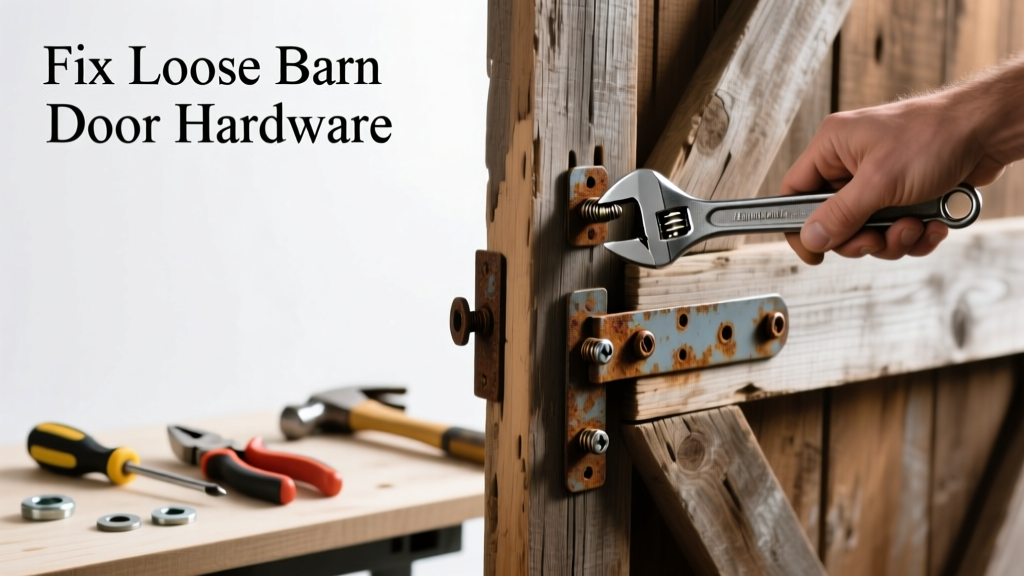
That sudden metallic groan when you slide your barn door—or the persistent rattle every time it moves—isn’t just annoying; it’s a warning sign. Loose hardware stresses track mounts, wears down rollers, and can even compromise wall integrity over time. Most noise issues stem from simple loosening, not broken parts—so don’t reach for the replacement kit yet.
Quick Diagnosis
Before grabbing tools, identify the source. Listen closely while operating the door slowly:
- High-pitched squeaking near the top track → roller bearings dry or misaligned
- Rattling or clanking sound → loose mounting bolts on hangers or track brackets
- Grinding or scraping → bent track, debris in wheel groove, or worn nylon wheels
- Thumping at end of travel → missing or damaged end-stop bumpers
Tools & Materials Needed
| Item | Purpose | Estimated Cost |
|---|---|---|
| 3/8" hex key (Allen wrench) | Tightens most hanger-to-door and hanger-to-wheel set screws | $4–$8 |
| 1/4" hex key | Secures smaller track bracket screws and wheel axle caps | $3–$6 |
| Stud finder with AC detection | Verifies anchor points are secured into solid framing—not drywall alone | $25–$45 |
| White lithium grease | Lubricates rollers without attracting dust like oil does | $7–$12 |
| Level (24") | Confirms track remains perfectly horizontal after re-tightening | $10–$20 |
Step-by-Step Fix
- Power down & unhook: Slide door fully open, then lift slightly to disengage rollers from track. Rest door safely against wall or lay flat on padding.
- Inspect and tighten hangers: Check all hanger-to-door bolts (usually 3–4 per hanger) and hanger-to-roller set screws. Tighten with appropriate hex key—don’t overtighten; torque to manufacturer spec if listed (typically 12–18 in-lbs).
- Re-seat and secure track: Confirm track is level and mounted only into wall studs or blocking. Re-torque all track bracket screws—especially top-center and end brackets—using a stud finder to verify backing. Add toggle bolts only if original anchors missed framing.
- Lubricate and test: Apply white lithium grease to roller axles and wheel contact surfaces. Rehang door, slide slowly, and listen. If noise persists, check for track warping or wheel damage.
When to Call a Pro
DIY stops where structural safety begins. Call a licensed contractor or door specialist if:
- The wall framing behind the track shows cracks, bowing, or screw pull-out larger than 1/8″
- You discover more than two missing or stripped mounting holes in load-bearing studs
- The track itself is visibly bent or warped beyond 1/16″ over its length (measure with straightedge)
- Your barn door weighs over 250 lbs and uses non-standard commercial-grade hardware
According to the National Association of the Remodeling Industry’s 2023 Residential Door Safety Report, 68% of premature barn door failures traced back to improper anchoring—not hardware quality.
Prevention Tips
Maintain quiet operation year-round with these habits:
- Tighten all hanger and track bolts every 6 months—especially after seasonal humidity shifts
- Wipe rollers and track monthly with a microfiber cloth to remove dust and pet hair buildup
- Reapply white lithium grease every 9–12 months (more often in high-humidity climates)
- Install soft-close dampers like the Barn Door Soft Close Kit to reduce impact stress on hardware
Why does my barn door make a popping sound when opening?
This usually means one or more hanger wheels are binding due to misalignment or debris. Remove the door, inspect each wheel for cracked nylon or bent axles, and ensure the hanger arms pivot freely. A bent hanger arm—often caused by forcing the door past its stop—will cause intermittent popping as tension releases.
Can I tighten barn door hardware without removing the door?
You can tighten some track bracket screws and hanger-to-wheel set screws while the door hangs—but never hanger-to-door bolts. Those require full weight relief to prevent stripping threads or damaging the door edge. Attempting this risks dropping the door or shearing bolt heads.
How tight should barn door hanger bolts be?
Snug plus quarter-turn—no more. Over-torquing compresses wood fibers, strips threads, or cracks MDF core doors. Use a calibrated torque wrench if available; otherwise, stop when resistance increases sharply and the bolt head no longer rotates easily. For reference, barn door weight capacity drops 40% when hanger bolts are over-torqued into softwood.
What kind of lubricant should I avoid on barn door rollers?
Avoid WD-40, silicone spray, and motor oil. WD-40 dries out quickly and leaves residue that attracts grime. Silicone sprays migrate and degrade rubber bumpers. Motor oil collects sawdust and metal shavings, forming abrasive sludge. Stick with white lithium grease—it stays put, repels moisture, and won’t harm nylon or polyurethane wheels.
Will tightening the hardware fix a door that scrapes the floor?
No—scraping indicates either sagging due to loose hangers OR an uneven floor. First, check door clearance: measure gap between bottom edge and floor at both ends and center. If variance exceeds 1/8″, adjust hanger height individually using the threaded rod on each hanger. If floor is uneven, consider adding adjustable floor guides like the Barn Door Floor Guide Kit.
How often should I inspect barn door hardware?
Every 3 months in high-use areas (e.g., kitchen pantry, master closet), and every 6 months elsewhere. Homes with pets or kids benefit from quarterly checks—tail wagging and accidental bumps accelerate bolt loosening. The U.S. Consumer Product Safety Commission logged 217 incidents of sliding door-related injuries in 2022, 34% linked to undetected hardware failure.
Loose barn door hardware isn’t just a nuisance—it’s a slow-motion failure waiting to happen. Catching it early preserves your door’s lifespan, protects your wall, and keeps your home quiet and safe. A few minutes with the right tools today prevents a full re-mount next month—and saves you from calling a pro for what’s usually a five-minute fix.