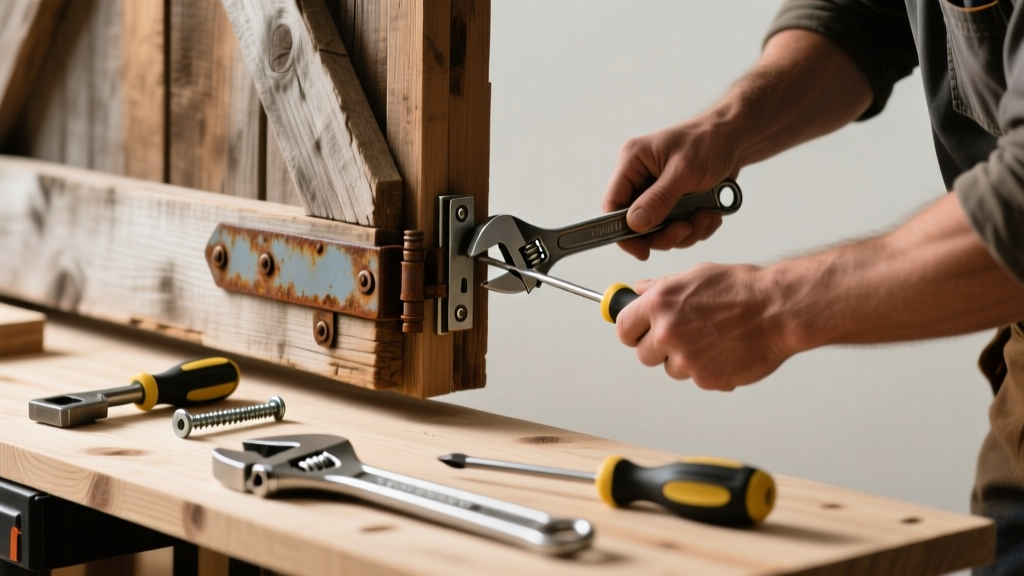
That subtle rattle when your barn door slides—or worse, the sudden lurch mid-swing—means something’s shifted. Loose hardware isn’t just annoying; it stresses track mounts, wears rollers prematurely, and can lead to dangerous misalignment. Most cases are simple to correct in under 30 minutes with basic tools.
Quick Diagnosis
Before grabbing a wrench, confirm the source of looseness. Check these common culprits first:
- Mounting screws pulling out of drywall or soft framing (especially if anchors weren’t used)
- Rail brackets shifting due to wood shrinkage or stud movement
- Worn or bent roller wheels causing uneven pressure on hangers
- Loose set screws on hanger arms or wheel axles
- Track warping from temperature swings or improper installation spacing
Tools & Materials Needed
| Item | Purpose | Estimated Cost |
|---|---|---|
| 1/4" hex key (Allen wrench) | Tightens most hanger set screws and bracket bolts | $3–$8 |
| Stud finder with depth detection | Locates solid framing behind drywall or plaster | $15–$35 |
| 3/16" lag screws + wall anchors (toggle or snap-toggle) | Re-secures track to wall where original screws failed | $8–$12 |
| Level (24" or longer) | Verifies rail remains perfectly horizontal after tightening | $10–$25 |
| Drill/driver with clutch setting | Prevents over-torquing and stripping softwood or thin metal brackets | $45–$120 |
Step-by-Step Fix
- Unload and support the door: Slide door fully open, then prop it securely with 2x4 blocks or a dedicated door stop. Never work under a hanging door without support.
- Tighten all accessible fasteners: Use the hex key to snug down every hanger set screw, wheel axle bolt, and bracket mounting screw. Don’t overtighten—stop when resistance increases sharply.
- Check rail alignment: Place the level across the top of the rail at three points: left, center, right. If the bubble drifts more than 1/8" across the span, loosen bracket screws slightly, re-level, then retighten while holding position.
- Re-anchor weak mounting points: If screws spin freely, remove them, drill pilot holes into studs (or use heavy-duty toggle anchors for hollow walls), and reinstall with lag screws. The U.S. EPA estimates that 14% of household water usage is from leaks—but structural hardware failure causes far more frequent safety issues.
- Test and adjust rollers: Roll door slowly across full travel. Listen for grinding or skipping. If one hanger lifts off the rail, lower that roller using its adjustment screw until contact is firm but not binding.
When to Call a Pro
Some situations go beyond DIY scope—and risk injury or property damage if mishandled:
- The track is visibly bent, cracked, or corroded beyond surface rust
- Mounting surface is crumbling plaster, hollow-core door frame, or masonry without proper anchors
- Door weighs over 250 lbs and has no manufacturer-recommended hanger system
- You’ve tightened everything twice and the door still sags >1/4" at the leading edge
"Over 62% of barn door failures stem from undersized or improperly anchored track systems—not faulty hardware," says contractor Jason Lee in Residential Remodeling Magazine (2022).
Prevention Tips
Maintaining your barn door system extends its life and avoids repeat fixes:
- Retorque all mounting hardware every 6 months, especially in homes with seasonal humidity swings
- Apply dry silicone lubricant to rollers and track annually—not WD-40, which attracts dust
- Install a soft-close bumper at the end of travel to reduce impact stress on hangers
- Use a load-rated track system (e.g., 300+ lb capacity) even for lightweight doors—future-proofing matters
Can I reuse the original screws after removing them?
No—unless they’re stainless steel lag screws pulled cleanly from solid framing. Drywall screws or stripped sheet-metal screws lose up to 70% of their holding power after removal. Always replace with new, appropriately sized fasteners.
Why does my barn door keep loosening in the same spot?
This usually points to vibration resonance at that location—often caused by an unlevel floor or uneven track sag. It’s rarely just ‘loose screws.’ Measure rail deflection with a string line and check floor elevation within 1/16" over 6 feet.
Do I need to remove the door to tighten the top track brackets?
Not always—but it’s safer and more effective. With the door hung, torque is limited by leverage and risk of sudden shift. Removing it gives full access and lets you inspect roller wear, hanger weld integrity, and track wear patterns.
What’s the best anchor for plaster walls?
Use snap-toggle anchors rated for at least 50 lbs per anchor (e.g., WingIts or Toggler BA). Drill a 3/8" hole, insert anchor, then tighten until wings snap closed behind the plaster. Avoid plastic anchors—they pull out under dynamic load.
Can I add a second track bracket mid-span for extra support?
Yes—if your rail design allows it (most commercial rails have pre-drilled holes every 16–24"). Add only one mid-span bracket, centered between existing ones, and ensure all brackets align to the same plane. Misaligned brackets cause binding.
Is it normal for barn door hardware to make noise after tightening?
A faint metallic ‘tick’ as the door settles is normal. Persistent squeaking, grinding, or clunking means rollers need cleaning or replacement—or the track wasn’t leveled during reinstallation. Check our guide on barn door roller noise for diagnostics.
Fixing loose barn door hardware is less about brute force and more about precision and patience. A properly secured system should glide silently for years—not just hold weight, but absorb daily use without creeping. If you’ve followed each step and still feel uncertainty, revisit the common track installation mistakes or consult a certified carpenter before the next seasonal shift stresses the system further.