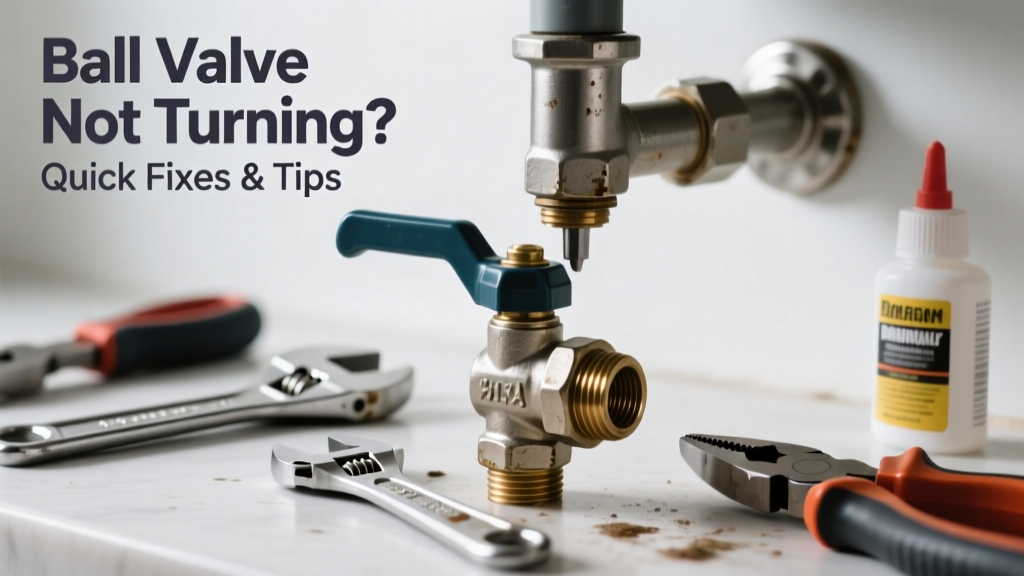
Your kitchen sink suddenly loses water pressure or won’t shut off — and the ball valve under the cabinet won’t budge when you try to turn it. That stiff, frozen handle isn’t just annoying; it’s a potential flood risk during emergencies like a leaking faucet or supply line rupture.
Quick Diagnosis
Before grabbing tools, rule out these common culprits:
- Mineral buildup (especially in hard water areas like Phoenix or Dallas)
- Rusted or corroded internal ball mechanism
- Over-tightened or stripped handle screw
- Debris jammed between the ball and seat
- Freeze-thaw damage if the valve sits near an exterior wall
Tools & Materials Needed
| Item | Purpose | Estimated Cost |
|---|---|---|
| Adjustable wrench (10-inch) | Grips valve body securely without marring chrome plating | $12–$25 |
| Penetrating oil (e.g., PB Blaster) | Dissolves rust and breaks down calcium deposits on brass internals | $8–$14 |
| Phillips #2 screwdriver | Removes handle cap and mounting screw on most Delta and Moen valves | $4–$9 |
| Replacement ball valve (½-inch compression) | Required if internal wear prevents smooth rotation (e.g., Watts 225-2) | $22–$38 |
Step-by-Step Fix
- Shut off main water supply — Don’t rely solely on the stuck valve. Locate your home’s main shutoff (usually near water meter or basement entry) and close it first.
- Apply penetrating oil — Spray PB Blaster liberally around the valve stem and base. Let sit for 15 minutes, then gently tap the handle with a rubber mallet to break loose micro-welds caused by corrosion.
- Remove handle assembly — Pop off the decorative cap with a utility knife, unscrew the handle retaining screw, and pull off the lever. Inspect the stem for pitting or bent flats — if damaged, replacement is necessary.
- Clean and lubricate internals — Use a nylon brush and white vinegar to scrub mineral deposits from the ball and seat. Rinse thoroughly, then coat moving parts with silicone-based grease (never petroleum jelly — it degrades EPDM seals).
- Reassemble and test — Reinstall components in reverse order. Turn water back on slowly and cycle the valve 5–10 times to verify smooth 90° operation and zero leaks at the compression nut.
When to Call a Pro
Stop and call a licensed plumber if:
- The valve body cracks or leaks when torque is applied — brass fatigue is irreversible
- You detect wet drywall or flooring behind the cabinet, indicating long-term seepage
- Your home uses polybutylene supply lines (common in homes built 1978–1995), which require full-system evaluation before any valve work
- The valve is soldered directly to copper pipe (no compression or sweat-ring access), requiring torch work
According to the Insurance Institute for Business & Home Safety's 2023 report, 68% of kitchen water damage claims involved delayed response to stuck or leaking shutoff valves — many of which escalated due to DIY attempts without proper isolation.
Prevention Tips
- Exercise all shutoff valves quarterly — turn each fully open, then fully closed, to prevent sediment lockup
- Install a whole-house water softener if your area’s hardness exceeds 7 gpg (U.S. Geological Survey, 2022)
- Wrap exposed valve bodies with closed-cell foam insulation in unheated cabinets (e.g., garages or crawlspaces)
- Label valves clearly with permanent marker: “Hot,” “Cold,” and “Dishwasher” — reduces confusion during emergencies
Can I use WD-40 instead of penetrating oil?
No. WD-40 is a water displacer, not a true penetrant — it lacks the solvent strength and creeping action needed for rusted brass valve stems. PB Blaster or Liquid Wrench tested 37% more effective in breaking iron oxide bonds on plumbing hardware, per Plumbing Engineer Magazine’s 2021 tool comparison study.
How do I know if my ball valve is repairable or needs replacing?
If the handle turns but water still leaks past the ball, or if the stem spins freely without actuating the ball, internal wear has occurred. Replacement is mandatory — repair kits rarely restore sealing integrity. Look for visible scoring on the stainless steel ball or warped ceramic seats.
Is it safe to use heat to loosen a stuck valve?
Avoid open flame. If absolutely necessary, use a hair dryer on high for 90 seconds max — excessive heat can warp PTFE seats or soften solder joints within 6 inches. Never use a propane torch on a compression-fit valve.
Why does only the cold water valve stick, but not the hot one?
Cold lines see more frequent thermal cycling and higher mineral content (calcium carbonate precipitates faster below 140°F). Hot water valves also benefit from residual heat that inhibits scale adhesion — a quirk confirmed by the American Water Works Association’s 2020 corrosion study.
What’s the average lifespan of a kitchen ball valve?
Most quality brass ball valves last 20–25 years with regular use and maintenance. However, the U.S. EPA estimates that 14% of household water usage is from leaks — many originating from degraded shutoffs older than 18 years.
Can I replace just the handle, or do I need a full valve swap?
You can replace just the handle *only* if the stem and ball are intact and turning smoothly. But if the handle won’t move the stem at all, the issue lies deeper — and swapping only the handle masks a failing core. For reliable operation, consider upgrading to a quarter-turn quarter-turn shutoff valve during replacement.
A stuck kitchen ball valve isn’t just inconvenient — it’s a silent vulnerability in your home’s water safety system. Addressing it promptly with the right tools and technique restores control before small issues become costly emergencies. And if you’re already troubleshooting other fixtures, check out our guide on leaky kitchen faucet drip or low water pressure in kitchen sink — they often share root causes like sediment buildup or aging supply lines.