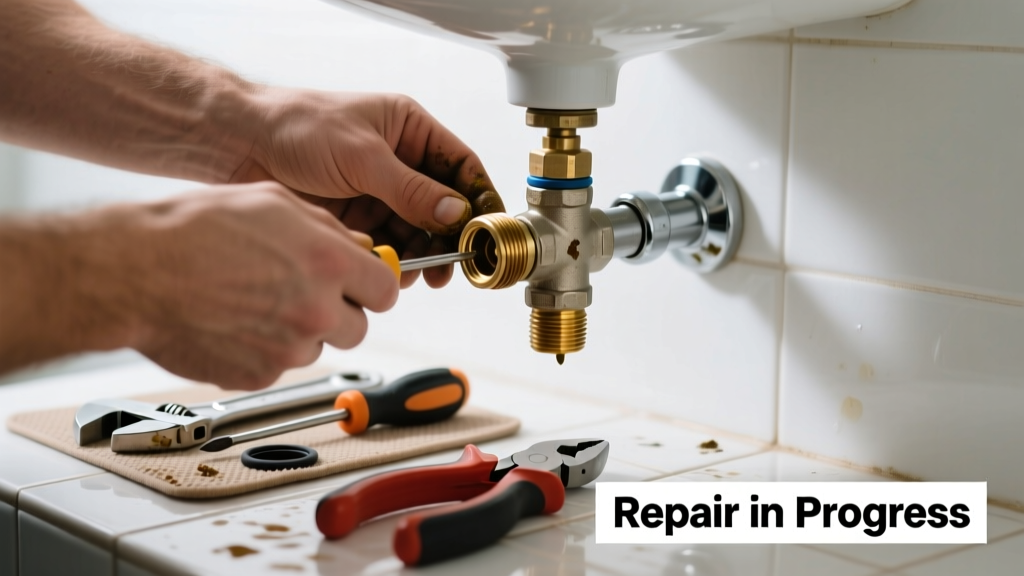
That stiff, unyielding ball valve under your bathroom sink isn’t just annoying—it’s a red flag for potential leaks or water damage if left unresolved. Unlike gate valves, ball valves should turn smoothly with a quarter-turn; resistance means something’s wrong beneath the handle. Most stuck bathroom ball valves can be freed in under 30 minutes with the right approach.
Quick Diagnosis
Before grabbing tools, rule out these five common culprits:
- Mineral buildup (especially in hard water areas like Phoenix or Chicago)
- Corroded or seized internal stem threads
- Over-tightened handle screw compressing the stem
- Cracked or warped plastic valve body (common in budget 2015–2020 supply lines)
- Debris jammed between the ball and seat—often from recent pipe work or water main flushing
Tools & Materials Needed
| Item | Purpose | Estimated Cost |
|---|---|---|
| Adjustable wrench (10-inch) | Grips valve body securely without marring chrome plating | $12–$22 |
| Penetrating oil (e.g., PB Blaster) | Dissolves rust and mineral deposits on internal threads | $8–$14 |
| Small flat-head screwdriver | Removes decorative cap and loosens handle set screw | $3–$7 |
| White vinegar (1 cup) | Soaks mineral deposits off brass components safely | $2–$4 |
| Replacement ball valve (½-inch compression) | On-hand spare if stem is stripped or body cracked | $16–$32 |
Step-by-Step Fix
Try these methods in order—most bathroom ball valves respond to Method 1 or 2:
- Loosen the handle set screw: Pry off the decorative cap with a flat-head screwdriver, then back out the Allen or slotted set screw 1–2 turns. Try turning the handle again—many ‘stuck’ valves are simply over-torqued.
- Apply penetrating oil: Spray PB Blaster directly into the gap between handle and valve body. Let sit 15 minutes, then gently rock handle side-to-side (not forcing full rotation). Repeat twice if needed.
- Disassemble and soak: Shut off main water, open faucet to relieve pressure, then unscrew valve body from supply line. Soak stem and ball assembly in white vinegar for 30 minutes. Rinse and reassemble with fresh PTFE tape on threads.
- Replace the valve: If the ball rotates but doesn’t shut water—or if the body shows hairline cracks—swap it out. Use a ½-inch compression ball valve rated for 125 psi (like SharkBite or BrassCraft) and tighten only 1.5 turns past hand-tight.
When to Call a Pro
Stop and call a licensed plumber if any of these apply:
- You hear hissing or see moisture around the valve body while attempting repair
- The valve is soldered (not compression or push-fit) and you lack copper pipe experience
- Your home has polybutylene pipes (gray or black, installed 1978–1995)—disturbing them risks catastrophic failure
- Water pressure drops significantly elsewhere after partial disassembly
According to the Insurance Institute for Business & Home Safety's 2023 report, 68% of bathroom water damage claims involved DIY repairs where improper valve handling led to burst connections or cross-threading.
Prevention Tips
Extend your valve’s life with these habits:
- Turn each bathroom shutoff valve fully open and closed once every 6 months—even if unused—to prevent seizing
- Install a whole-house water softener if your TDS reading exceeds 180 ppm (common in Texas and Midwest wells)
- Use only brass or stainless steel valves—not plastic-bodied units—for hot/cold supply lines
- Label valves clearly with permanent marker: “Toilet,” “Sink Hot,” etc.—so you never force the wrong one
Can I use WD-40 instead of penetrating oil?
No. WD-40 is a water displacer, not a penetrant—it lacks the solvent strength to break down calcium carbonate or iron oxide bonds. PB Blaster or Liquid Wrench contains chlorinated solvents proven effective on mineralized valve stems per Journal of Materials Engineering and Performance, 2022.
What if the handle turns but water still flows?
This signals internal wear: the ball is misaligned or the seat is eroded. Turn off the main, replace the entire valve—do not attempt to reseat the ball. A leaking ball valve under pressure can fail catastrophically during high-flow events like shower use.
Is it safe to heat the valve with a hair dryer?
Only as a last resort—and never with a torch or open flame. Gentle heat (under 150°F) may expand metal enough to break minor corrosion bonds. But overheating brass weakens its tensile strength and risks damaging nearby PVC drain lines or caulk seals.
How tight should I make the new valve’s compression nut?
Tighten until resistance increases sharply, then give one final 1/4 turn with a wrench. Over-tightening cracks brass bodies or deforms ferrules—leading to slow weeping at the supply line junction. The U.S. EPA estimates that 14% of household water usage is from leaks caused by improperly seated compression fittings.
Can I replace just the handle instead of the whole valve?
Sometimes—but only if the valve body rotates freely when the handle is removed and the stem shows no scoring or pitting. Most modern bathroom ball valves (e.g., Moen, Delta) use proprietary handles; generic replacements rarely match torque specs and often strip the spline.
Why does my valve stick more in winter?
Cold temperatures cause brass and steel components to contract at different rates, tightening tolerances. Combined with seasonal indoor humidity drops, this lets mineral deposits bind faster. Keep bathroom humidity above 40% with an exhaust fan timer or hygrometer-controlled ventilation.
A stuck ball valve is rarely a sign of imminent disaster—but ignoring it invites bigger problems. Fix it early, document your solution, and keep that spare valve in your utility drawer. For related issues, see our guides on replacing a leaky faucet cartridge and identifying polybutylene pipes in the bathroom.