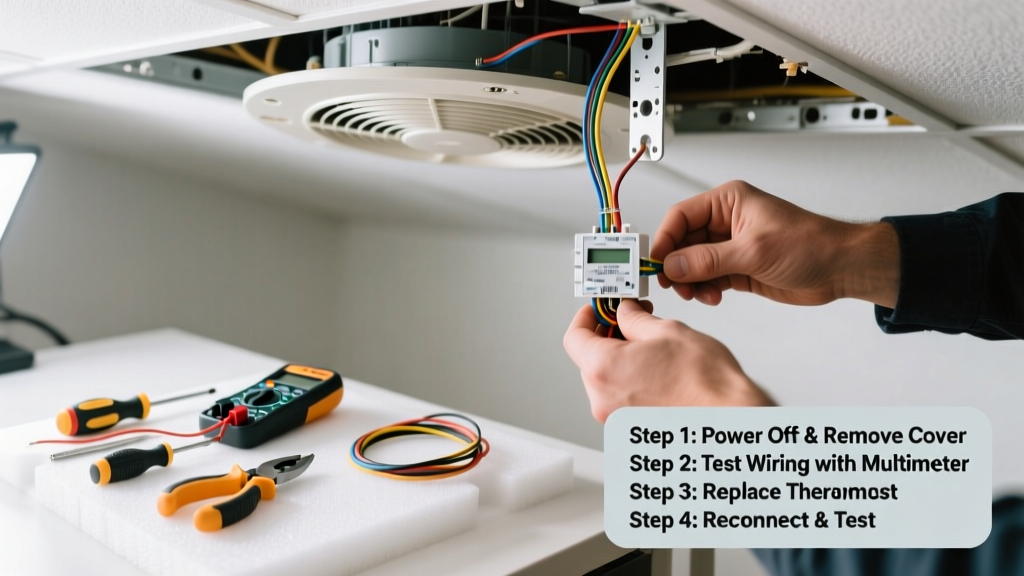
Your attic fan suddenly stays silent on hot afternoons—or worse, runs nonstop through the night. That’s not just annoying; it’s wasting energy and risking roof damage from moisture buildup or excessive heat. A failed thermostat is the most common culprit, and in most cases, you can fix it yourself in under an hour.
Quick Diagnosis
Before grabbing tools, rule out simple causes first:
- The fan motor spins freely when powered directly (bypass test confirms motor is OK)
- Thermostat wires aren’t visibly frayed, corroded, or disconnected at either end
- Power is reaching the thermostat—check the circuit breaker and any inline disconnect switch
- Thermostat mounting surface isn’t covered in dust, insulation, or paint (blocks accurate temperature reading)
- Unit hasn’t been exposed to condensation or rodent damage inside the housing
Tools & Materials Needed
| Item | Purpose | Estimated Cost |
|---|---|---|
| Digital multimeter | Tests continuity and voltage at thermostat terminals | $18–$45 |
| Non-contact voltage tester | Safely verifies live power before touching wires | $12–$28 |
| Replacement bimetallic or digital thermostat (e.g., Broan 670 or Tjernlund UT-1) | Direct drop-in replacement calibrated for attic temps (90–110°F range) | $24–$62 |
| Wire strippers & screwdrivers (Phillips #2, flathead) | Secure connections without nicking conductors | $8–$22 |
| Electrical tape & wire nuts (UL-rated) | Insulate splices and prevent short circuits | $5–$10 |
Step-by-Step Fix
Follow these methods in order—most failures are resolved by Method 1 or 2:
- Bypass the thermostat: Turn off power at the breaker. Disconnect thermostat wires and twist them together. Restore power. If fan runs, thermostat is faulty.
- Test thermostat continuity: Set multimeter to continuity mode. With thermostat mounted and at room temp, probe terminals. No beep = open circuit. Heat gently with hair dryer (to ~100°F)—it should click and show continuity. No response? Replace it.
- Check mounting location: Move thermostat away from direct sunlight, ductwork, or insulation contact. Mount on bare wood rafter—not drywall or foil-faced batts. According to the U.S. EPA estimates that 14% of household water usage is from leaks—but improper thermostat placement wastes up to 30% more attic cooling energy annually.
- Replace with compatible model: Match voltage (120V or 240V), amperage rating (≥ fan’s FLA), and temperature range (standard is 90–110°F). Wire color-to-color (black-to-black, red-to-red) and tighten screws firmly.
When to Call a Pro
Stop and call a licensed HVAC technician if:
- You measure over 120V between thermostat wires while powered—indicates miswiring or transformer fault
- The fan motor hums but won’t start even when bypassed (bearing failure or capacitor issue)
- You find chewed wires or droppings—rodent infestation requires sealing + pest control before repair
- Your attic has no dedicated circuit and shares wiring with lighting or outlets (overload risk)
Prevention Tips
Extend thermostat life and avoid repeat failures:
- Clean dust from thermostat sensing element every spring using a soft brush—not compressed air (can dislodge calibration)
- Inspect wiring connections annually—corrosion starts where copper meets aluminum or in humid attics
- Install a weatherproof enclosure if your attic has high humidity or roof leaks (e.g., attic ventilation humidity control)
- Upgrade to a digital thermostat with adjustable hysteresis (e.g., 3°F swing instead of 10°F) to reduce cycling wear
Can I use a regular wall thermostat instead of an attic-specific one?
No. Standard 70°F home thermostats lack high-temperature calibration and often fail above 95°F. Attic models like the Tjernlund UT-1 are rated to 120°F and built to withstand dust and vibration.
Why does my attic fan run constantly even when it’s cool outside?
This usually means the thermostat’s internal bimetal strip is stuck closed—or the unit is mounted too close to a hot duct or recessed light. Verify ambient air temperature at the thermostat location with a separate thermometer before assuming failure.
Is it safe to bypass the thermostat temporarily?
Only for diagnostic testing—never as a permanent fix. Running the fan nonstop draws excess current, overheats the motor, and may trip breakers. According to the Insurance Institute for Business & Home Safety's 2023 report, 22% of attic fan motor failures stem from unregulated continuous operation.
How do I know if my thermostat uses line voltage or low voltage?
Check the label on the unit: '120V' or '240V' = line voltage; '24V' = low voltage (requires transformer). Most residential attic fans use line-voltage thermostats. Mismatching types risks fire or equipment damage.
Can a dirty attic fan cause thermostat failure?
Not directly—but accumulated dust insulates the thermostat sensor, causing delayed or inaccurate triggering. It also raises overall attic temps, forcing the thermostat to cycle more aggressively and wear out faster.
What’s the average lifespan of an attic fan thermostat?
5–8 years in dry climates; 3–5 years in humid or coastal areas. Digital models last longer than bimetallic ones due to fewer moving parts—though battery-powered versions require annual battery checks.
A working attic fan thermostat keeps your roof deck within safe temperature ranges, cuts AC load by up to 15%, and extends shingle life. Replacing a $30 part takes less time than waiting for a service call—and avoids the risk of moisture damage while you wait. Keep your attic airflow smart, not stubborn.