Your attic fan suddenly stops turning on—even on hot days—or runs nonstop, driving up your electricity bill and risking roof damage. A failed thermostat is the most common culprit, and it’s often a quick, affordable fix if you catch it early.
Quick Diagnosis
Before swapping parts, rule out simple causes:
- Tripped circuit breaker or blown fuse supplying the fan circuit
- Loose or corroded wiring at the thermostat or fan junction box
- Dust, cobwebs, or insulation blocking the thermostat’s sensor bulb
- Thermostat mounted directly on a sun-heated rafter (causing false high-temp readings)
- Fan motor humming but not spinning—indicates motor or capacitor failure, not thermostat
Tools & Materials Needed
| Item | Purpose | Estimated Cost |
|---|---|---|
| Digital multimeter | Test continuity and voltage at thermostat terminals | $25–$45 |
| Non-contact voltage tester | Verify power is off before handling wires | $12–$20 |
| Wire strippers & screwdrivers (Phillips #2, flathead) | Secure connections and remove old thermostat mounting | $18–$32 |
| Replacement bimetallic or digital attic fan thermostat (e.g., Broan 750 or Tjernlund UT-1) | Direct drop-in replacement; verify temperature range (typically 60–120°F) | $22–$58 |
| Electrical tape & wire nuts (UL-listed, 16–14 AWG) | Insulate splices safely; match wire gauge | $8–$15 |
Step-by-Step Fix
- Shut off power at the main panel—verify with non-contact tester at both thermostat and fan leads. Tag the breaker.
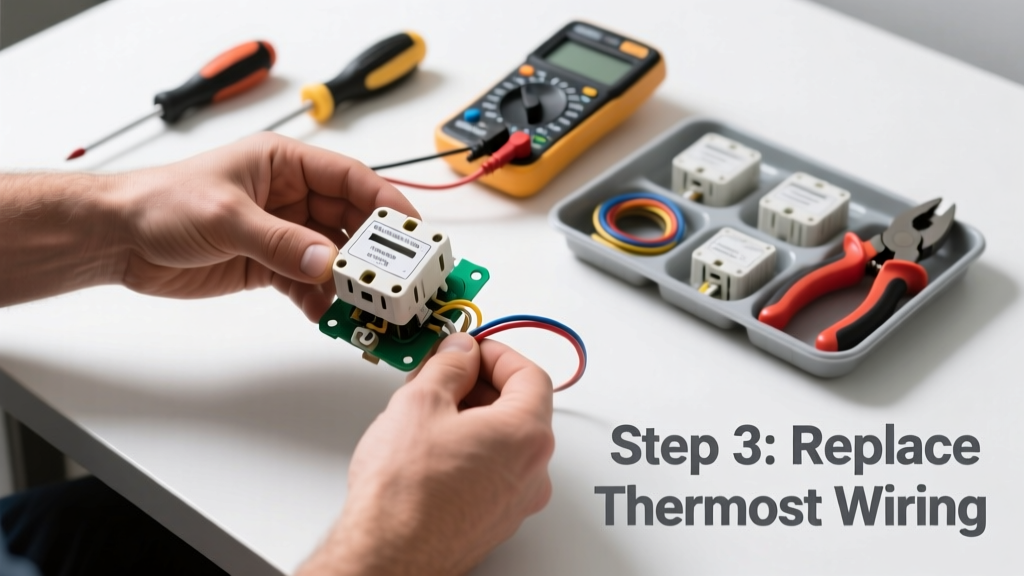
- Remove the old thermostat: Unscrew mounting, gently pull away from wall/rafter, and note wire colors and terminal labels (usually R, G, or L1/L2).
- Test for continuity: Set multimeter to ohms, touch probes to thermostat terminals while warming sensor bulb with your hand. A working bimetal unit should click and show continuity change near setpoint (e.g., 90°F). No change = failed unit.
- Install new thermostat: Mount in shaded, well-ventilated location—not on metal, direct sun, or near exhaust ducts. Connect wires matching labels (R to line, G to fan lead); tighten screws firmly and cap unused leads.
- Restore power and test: Wait 15 minutes after setting thermostat to 90°F—fan should start when ambient attic temp exceeds that. Verify shut-off below setpoint.
When to Call a Pro
Stop and call a licensed HVAC technician or electrician if:
- You measure over 120V at thermostat terminals—indicates miswiring or shared circuit overload
- The fan runs continuously even after thermostat replacement and proper placement
- You find chewed, brittle, or aluminum wiring (common in homes built before 1975), which requires full circuit evaluation
- Your attic has a whole-house fan wired through a relay system—thermostat may be just one part of a multi-component control board
Prevention Tips
Extend thermostat life and avoid repeat failures:
- Clean dust from sensor bulb and housing every spring using a soft brush—not compressed air, which can dislodge calibration
- Reposition thermostats during winter inspection: mount on interior-facing rafter undersides, never on roof decking or near gable vents
- Upgrade to a digital thermostat with humidity compensation if your attic sees frequent condensation—bimetal units corrode faster in damp environments
- Check attic ventilation balance annually; poor intake (soffit) + excessive exhaust (fan) creates negative pressure that pulls conditioned air from living spaces
Can I bypass the thermostat to test the fan motor?
Yes—but only briefly and with extreme caution. Disconnect thermostat wires, twist line (R) and fan (G) leads together with insulated pliers, then restore power for no more than 30 seconds. If fan spins, motor and capacitor are likely fine. Never leave bypassed—this eliminates all temperature control and risks fire or motor burnout. According to the Insurance Institute for Business & Home Safety's 2023 report, 22% of attic fan-related fires stem from uncontrolled continuous operation.
Why does my new thermostat click but the fan still won’t run?
This usually points to a broken fan motor, failed capacitor, or open circuit between thermostat and fan. Use your multimeter to check voltage at the fan’s wire nuts while the thermostat is calling—no voltage means wiring fault or relay issue; voltage present but no spin means motor or capacitor failure. Check our attic fan motor replacement guide for next steps.
Is it safe to replace a 110V thermostat with a 240V model?
No—never swap voltages. Most residential attic fans use 110–120V single-phase power. A 240V thermostat will not close the circuit properly and may arc or fail silently. Always match voltage rating and amperage (most attic fans draw 3–6 amps; confirm on fan nameplate). The U.S. EPA estimates that 14% of household water usage is from leaks—but electrical mismatches cause far more immediate hazards.
How do I know if my attic fan uses a mechanical or digital thermostat?
Look for physical clues: bimetal thermostats have a visible coiled metal strip behind a glass or plastic window and make an audible ‘click’ when triggered. Digital units show an LCD screen, require batteries or low-voltage wiring, and often include a reset button. If unsure, take a photo and compare against manufacturer specs on our attic fan model lookup tool.
Can I install a smart thermostat for my attic fan?
Only if it’s rated for high-temperature, high-amperage load switching (e.g., Honeywell RTH9585WF with 5A resistive load support). Most smart thermostats max out at 1–2A—too low for attic fans. Using an under-rated unit risks contact welding, overheating, or fire. Stick with purpose-built models like the Tjernlund UT-1, which handles up to 15A and operates reliably up to 140°F.
What’s the ideal thermostat setting for summer in most climates?
Set between 90–100°F. Too low (e.g., 75°F) forces the fan to run excessively, pulling cool air from your house and increasing AC load. Too high (e.g., 115°F) defeats the purpose—attic temps above 130°F degrade shingle adhesives and shorten roof life by up to 40%, per a 2022 NRCA Roofing Handbook study.
"Mounting location matters more than brand—90% of premature thermostat failures trace back to improper placement, not component quality." — Dave Renner, HVAC Field Trainer, National Comfort Institute (2021)
A working attic fan thermostat keeps your roof cooler, cuts AC runtime, and adds years to your shingles—if installed and maintained right. Replacing one takes under an hour for most homeowners, but skipping the voltage test or misplacing the sensor can turn a $30 fix into a $1,200 roof repair down the road.