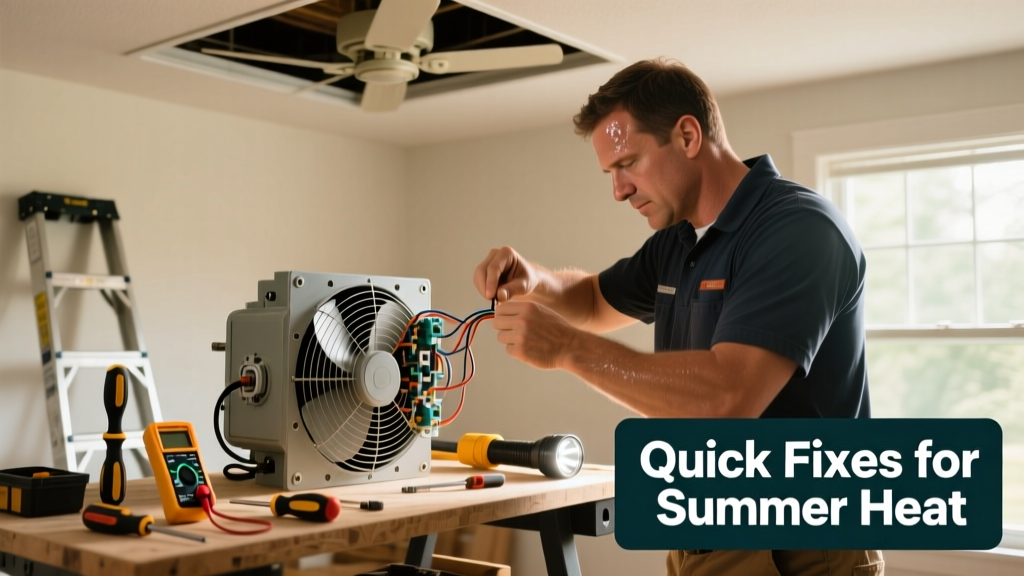
Your attic fan kicks on during summer afternoons to pull hot air out—but today it’s silent. That’s not just inconvenient; it’s a red flag. Without proper ventilation, attic temperatures can soar past 150°F, baking your roof deck, degrading shingles, and forcing your AC to work 20–30% harder (U.S. Department of Energy, 2022).
Quick Diagnosis
Before grabbing tools, rule out the obvious:
- No power at the fan unit (check breaker, switch, and thermostat setting)
- Tripped thermal overload protector (common after extended runtime or dust buildup)
- Stuck or seized motor shaft (try spinning the blades by hand)
- Faulty thermostat or humidistat (especially if fan only fails on mild days)
- Broken capacitor (bulging, leaking, or burnt-smelling)
Tools & Materials Needed
| Item | Purpose | Estimated Cost |
|---|---|---|
| Non-contact voltage tester | Verifies live wires safely before touching terminals | $12–$25 |
| Capacitor tester or multimeter | Confirms capacitor health (start/run types vary by fan model) | $20–$65 |
| Replacement capacitor (µF/voltage matched) | Most common failed part—check label on old unit for specs | $8–$18 |
| Wire brush & compressed air | Removes dust/debris from motor housing and blades | $5–$12 |
| Insulated screwdrivers (VDE-rated) | Safely handles 120V/240V connections in tight attic spaces | $15–$30 |
Step-by-Step Fix
- Power down & verify: Turn off the circuit breaker, then confirm no voltage at the fan’s junction box using your non-contact tester.
- Inspect physically: Remove the fan cover. Look for rodent nests, bent blades, or cracked housing. Try turning the blade manually—if it grinds or won’t spin freely, the motor bearings may be seized.
- Test the capacitor: Disconnect wires, discharge the capacitor with an insulated screwdriver across terminals, then test capacitance. A reading more than ±6% off its labeled µF value means replacement is needed.
- Check thermostat function: Bypass the thermostat by connecting the fan’s hot lead directly to line voltage (with power ON, briefly). If fan runs, the thermostat is faulty—replace with a model rated for attic temps (e.g., Broan 750, up to 150°F).
- Clean & lubricate (if applicable): Wipe motor windings with a dry cloth; use only manufacturer-approved lubricant on sleeve bearings—never oil sealed ball bearings.
When to Call a Pro
Stop and call a licensed electrician or HVAC technician if you encounter any of these:
- Visible scorch marks, melted wire insulation, or burning odor at the motor or wiring
- 240V hardwired fans (common in larger whole-house units) — improper handling risks arc flash
- Fan mounted on trusses with structural modifications required for replacement
- Repeated capacitor failures within 6 months — indicates voltage instability or motor winding failure
According to the National Fire Protection Association’s Electrical Safety Foundation International Report (2023), 32% of residential electrical fires linked to attic equipment stem from DIY repairs without proper grounding verification or load testing.
"If your attic fan hums but won’t start, don’t keep resetting the breaker—it’s likely a locked rotor condition. That heat buildup can ignite nearby insulation in under 90 seconds." — Dave R., Master Electrician, 28 years’ attic ventilation specialization
Prevention Tips
- Inspect fan operation monthly from May through September—listen for grinding or inconsistent startup
- Vacuum dust from motor vents and blade surfaces every spring using a shop vac with brush attachment
- Replace capacitors proactively every 5–7 years—even if functional—since electrolyte dries out over time
- Ensure intake soffit vents are unobstructed (use a mirror + flashlight to check for insulation blocking airflow)
Why does my attic fan click but not turn on?
The clicking sound usually means the starter relay or contactor is engaging, but the motor isn’t receiving full voltage—or the capacitor can’t provide the initial torque boost. Test the capacitor first; if it’s good, check for loose connections at the relay coil or burnt contacts inside the control box.
Can I replace just the motor instead of the whole fan?
Yes—if your unit uses a standardized 1/3 or 1/2 HP shaded-pole or PSC motor with matching mounting flange, shaft length, and RPM rating. But most modern fans integrate motors with housings and thermostats; swapping just the motor often voids UL listing and creates airflow mismatch. We recommend full-unit replacement for fans older than 10 years—see average attic fan replacement cost breakdowns here.
Is it safe to run an attic fan with a cracked housing?
No. Cracks compromise weather sealing and allow rain, pests, or insulation fibers into the motor. Even small hairline fractures let moisture wick along wiring, accelerating corrosion. Replace the housing or entire unit—don’t tape or seal it. For temporary mitigation, shut off power and cover the opening with rigid foam board until replacement arrives.
How do I know if my attic fan thermostat is bad?
Set it to “ON” manually (bypassing auto mode), then raise ambient temperature near the sensor with a hair dryer (keep >6 inches away). If the fan doesn’t activate within 90 seconds, the thermostat is likely faulty. Also check for corrosion on its terminals—multimeter continuity testing steps here.
What’s the difference between a gable-mounted and roof-mounted attic fan?
Gable fans mount in wall openings and draw air horizontally; they’re easier to service and less prone to roof leaks. Roof-mounted units sit on shingles and exhaust vertically—they require flashing and roofing expertise to install correctly. Gable fans typically move 1,200–2,400 CFM; roof units range 800–1,600 CFM but create stronger negative pressure. Choose based on your home’s existing vent layout—not just aesthetics.
Should I install a timer or smart controller for my attic fan?
A timer helps avoid overnight operation when outdoor temps drop below attic temps—preventing unnecessary cooling loss. Smart controllers like the Tjernlund UCB-2 add humidity sensing and remote monitoring, cutting runtime by up to 40% (Home Energy Magazine, 2021). Just ensure compatibility with your fan’s voltage and amperage rating before installing.
A working attic fan isn’t just about comfort—it’s a frontline defense against winter ice dams, summer shingle curl, and mold growth in insulation. Most issues take under an hour to diagnose and fix with basic tools. But don’t ignore warning signs like slow starts or odd smells: those are early indicators of bigger problems hiding behind the insulation. Stay proactive, keep a log of maintenance dates, and treat your attic ventilation like the critical system it is.