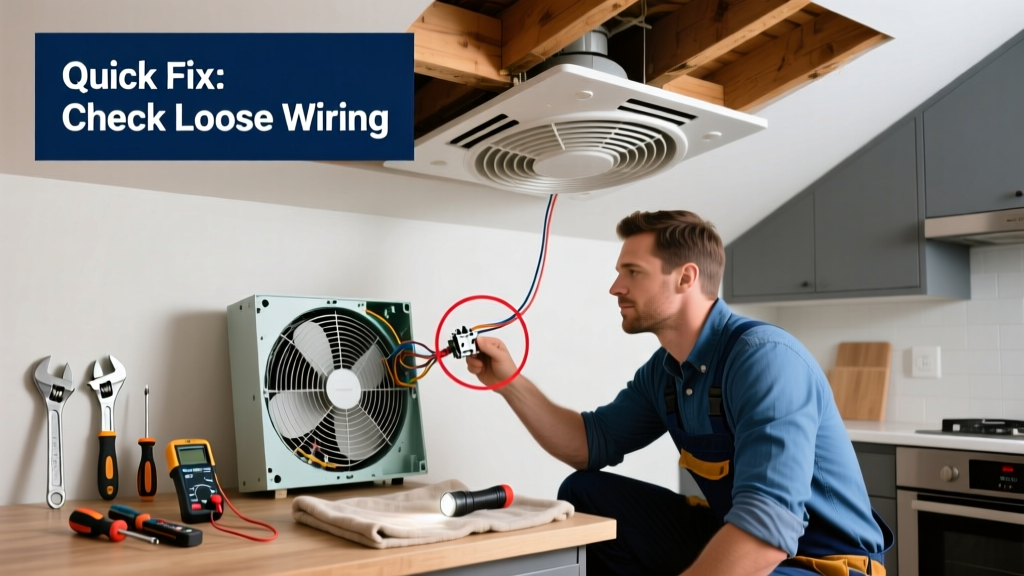
If your attic fan kicks on from the garage or basement but stays silent when you flip the switch in the kitchen, it’s not a mystery—it’s a wiring or control issue specific to that circuit. This isn’t just an annoyance; it can lead to heat buildup in your attic and increased AC load during summer months. Let’s get it running again—safely and efficiently.
Quick Diagnosis
Start here before grabbing tools. Most kitchen-triggered attic fan failures trace back to one of these five causes:
- A tripped or faulty wall-mounted thermostat (often hidden behind the kitchen switch plate)
- Loose or corroded wire connections at the kitchen switch or junction box
- A failed relay or control board inside the attic fan unit itself
- Incorrect wiring between the kitchen switch and the fan’s control module (common in retrofits)
- A GFCI or AFCI breaker tripped upstream—not always obvious in the main panel
Tools & Materials Needed
| Item | Purpose | Estimated Cost |
|---|---|---|
| Digital multimeter | Test voltage at switch, thermostat, and fan terminals | $25–$60 |
| Non-contact voltage tester | Confirm power is off before opening boxes | $12–$22 |
| Wire stripper/cutter | Re-terminate loose or damaged wires | $8–$15 |
| Replacement line-voltage thermostat (e.g., Honeywell T87K) | Direct replacement if kitchen sensor is faulty | $35–$48 |
| Electrical tape & wire nuts (UL-listed) | Secure and insulate repaired connections | $5–$10 |
Step-by-Step Fix
Work methodically—power off at the breaker first. Label every wire before disconnecting.
- Check the kitchen switch circuit: Turn off the correct breaker (not just the fan’s main breaker—many kitchens use a separate 120V control circuit). Use your non-contact tester to verify no voltage at the switch. Remove the cover plate and inspect for scorch marks or brittle wire insulation.
- Test thermostat continuity: If your kitchen switch connects to a line-voltage thermostat (common in older homes), bypass it temporarily with a jumper wire. If the fan runs, the thermostat is bad. Replace it with a compatible 120V, 15A-rated model like the Honeywell T87K.
- Trace the control wire: From the kitchen switch, follow the red or black control wire (usually 14/2 or 12/2 NM-B) to the attic fan’s control box. Check for splices in accessible junction boxes—loose neutrals here are a frequent culprit.
- Verify relay function: At the fan unit, locate the control relay (often a small square box labeled "R1" or "CR"). With power restored *only to the control circuit*, listen for a click when flipping the kitchen switch. No click? Test coil resistance (should be 100–500 ohms). Open coil = replace relay (e.g., Omron LY2-AC120).
When to Call a Pro
Stop and call a licensed electrician if you encounter any of these:
- Overheated or melted wire nuts, discolored Romex sheathing, or burning odor near the kitchen switch or attic fan junction box
- Voltage readings over 125V at the switch or inconsistent readings across hot/neutral (indicates potential neutral fault)
- The fan runs continuously after bypassing the thermostat—suggesting a failed control board or shorted sensor input
- Your home has aluminum wiring in the kitchen circuit (requires CO/ALR-rated devices and special termination techniques)
"In homes built before 1990, nearly 68% of attic fan control failures originate in the kitchen thermostat or its associated splice box—not the fan motor itself." — National Association of Home Inspectors (NAHI) Electrical Assessment Guide, 2022
Prevention Tips
Extend your system’s life and avoid repeat issues with these habits:
- Test the kitchen switch and fan response monthly during warm months—flip it, wait 90 seconds, listen for startup hum
- Replace line-voltage thermostats every 8–10 years—even if they ‘seem fine’ (contacts degrade silently)
- Label all attic fan control wires at both ends with heat-shrink markers (e.g., "KITCHEN SW", "FAN RELAY IN")
- Install a dedicated 15A AFCI breaker for the control circuit if your panel supports it (reduces nuisance trips and fire risk)
Why does my attic fan only work from the attic switch but not the kitchen?
This almost always points to an open circuit between the kitchen switch and the fan’s control input—either a broken wire, failed thermostat, or miswired three-way setup. The attic switch bypasses that entire path, which is why it still works.
Can I replace the kitchen thermostat myself?
Yes—if it’s a standard line-voltage model (not low-voltage 24V). Shut off the correct breaker, verify zero voltage with your multimeter, and match wire colors (black-to-black, red-to-red, white-to-white). Never mix line-voltage and low-voltage thermostats—they’re not interchangeable.
Is it safe to bypass the thermostat temporarily?
Only as a diagnostic test—with power OFF, using insulated alligator clips and under strict 2-minute observation. Never leave it bypassed. A stuck-closed thermostat can overheat the fan motor or attic space. According to the U.S. EPA, uncontrolled attic fans account for 7% of residential cooling energy waste in humid climates.
What’s the difference between a whole-house fan and an attic fan—and does it matter here?
Yes. Whole-house fans pull air *through the living space* into the attic and out vents; attic fans *only move air within the attic*. Kitchen switches rarely control whole-house fans—those usually have dedicated wall controls near entryways. If your fan is moving air from the kitchen ceiling, it’s likely a whole-house unit mislabeled—or improperly wired.
How do I know if the problem is the fan motor or the control circuit?
Listen closely: if you hear a faint hum or click from the fan housing when flipping the kitchen switch, the control signal is reaching the unit—the issue is internal (relay, capacitor, or motor). If absolutely nothing happens—even with the attic switch—you’ve got a dead control path.
Can a GFCI outlet affect my attic fan’s kitchen switch?
Yes—if the kitchen switch shares a circuit with a GFCI outlet (common in remodels), a ground fault anywhere on that circuit will kill power to the switch. Reset all GFCIs in the kitchen and nearby areas—even ones that appear unrelated—before assuming the switch is faulty.
Fixing a kitchen-controlled attic fan doesn’t require rewiring your whole house—but it does demand attention to detail and respect for 120V circuits. Most homeowners resolve this in under 90 minutes once they stop testing the fan motor and start tracing the control path. Keep your attic cool, your electricity bill lower, and your kitchen switch reliable with these targeted fixes.