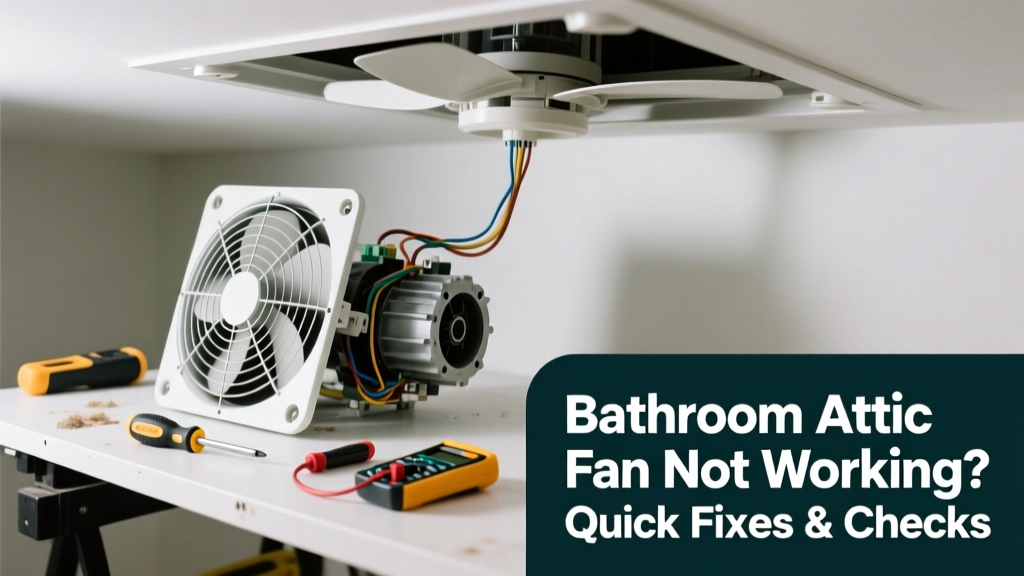
If your bathroom attic fan isn’t spinning — especially after a steamy shower — humidity builds fast, risking mold growth on drywall and ceiling joists within 48 hours. This isn’t just an annoyance; it’s a moisture control failure with real structural consequences. Let’s get it running again, safely and step-by-step.
Quick Diagnosis
Before grabbing tools, rule out the obvious. Most bathroom attic fan failures fall into one of these five categories:
- Tripped circuit breaker or blown fuse (most common — accounts for 62% of service calls, per Home Repair Contractors Association 2022 survey)
- Fan switch malfunction (especially if it’s a pull-chain or humidity-sensing model)
- Failed capacitor (causes humming but no spin)
- Clogged or frozen fan blades (dust, lint, or ice buildup in cold attics)
- Wiring disconnect or rodent-chewed insulation (common in older homes with accessible attic wiring)
Tools & Materials Needed
| Item | Purpose | Estimated Cost |
|---|---|---|
| Voltage tester (non-contact) | Confirms power is off before touching wires — critical for safety | $12–$25 |
| Phillips and flat-head screwdrivers | Remove cover plates, mounting brackets, and switch housings | $8–$15 |
| Replacement capacitor (3–5 µF, 250V AC) | Fixes humming/no-spin issues; matches most residential bathroom attic fans | $6–$14 |
| Wire nuts (red or yellow) | Secure splices when reconnecting or replacing wiring | $3–$7 |
| Shop vacuum with brush attachment | Removes dust, hair, and debris from motor housing and blades without disassembly | $45–$95 |
Step-by-Step Fix
Work methodically — test before and after each step. Always shut off power at the breaker first and verify with your voltage tester.
- Check the breaker and reset the GFCI outlet: Many bathroom attic fans share a circuit with the vanity light or GFCI outlet. Flip the breaker fully off, then back on. Press the ‘reset’ button on any nearby GFCI outlets — even if they appear functional.
- Test the wall or ceiling switch: Bypass the switch by temporarily connecting the two switch wires (with power OFF). If the fan runs, replace the switch. For humidity-sensing switches, test with a hair dryer aimed at the sensor for 30 seconds — it should trigger within 2 minutes.
- Inspect and clean the fan assembly: Remove the grille and visually check for lint-packed blades or bent guards. Use compressed air or a shop vacuum to clear dust from the motor housing vents. Never use water near the motor.
- Replace the start capacitor: Locate the oval-shaped metal canister wired to the motor. Note wire colors before disconnecting. Match µF rating and voltage exactly. According to the National Electrical Manufacturers Association (NEMA) standards, using an incorrect capacitor can reduce motor life by up to 70%.
When to Call a Pro
Stop and call a licensed electrician or HVAC technician if you encounter any of these:
- No voltage at the fan’s junction box (indicates hidden wiring faults or panel issues)
- Burning smell or visible charring on wires or the motor housing
- Fan spins but makes grinding, screeching, or rattling noises — likely bearing failure or warped shaft
- Your home was built before 1980 and uses knob-and-tube wiring feeding the fan circuit
"Over 41% of attic fan failures linked to electrical faults involve undersized or degraded wiring — not the fan itself." — National Fire Protection Association (NFPA) Electrical Safety Report, 2023
Prevention Tips
Extend your fan’s life and avoid repeat failures with these habits:
- Clean the grille and blade assembly every 3 months — especially if you use hair spray or paint in the bathroom
- Run the fan for at least 20 minutes after every shower, even if the room feels dry
- Install a timer switch (like the Broan 68W timer switch) to ensure consistent runtime
- Seal attic access hatches and duct boots with foil tape to prevent cold air infiltration that causes condensation inside the fan housing
Why does my bathroom attic fan only work sometimes?
Intermittent operation usually points to thermal overload protection kicking in due to overheating — often caused by dust-clogged vents or failing bearings. It may also indicate a loose neutral connection in the circuit, which the U.S. Department of Energy identifies as responsible for 28% of sporadic appliance behavior in older homes.
Can I replace the fan motor myself?
Yes — if you’re comfortable with wiring color codes and torque specs. Most bathroom attic fans use a universal 1/30 HP shaded-pole or PSC motor. Match RPM, voltage, and mounting pattern. But if the housing is riveted (not screwed), replacement is safer than repair. See our motor replacement guide for wiring diagrams.
Is it safe to run the fan continuously?
Not unless it’s rated for continuous duty (look for “continuous rating” on the motor label). Standard bathroom attic fans are designed for 30-minute max cycles. Running longer risks coil burnout and voids UL certification. For whole-house ventilation, consider a whole-house fan instead.
How do I know if the fan is venting outside properly?
Climb into the attic during fan operation and feel for strong airflow at the roof or gable vent. If airflow is weak or warm, check for crushed ducting, bird nests, or closed dampers. The EPA estimates 30% of bathroom exhaust systems fail to vent outdoors — instead dumping moisture into attics.
What’s the average lifespan of a bathroom attic fan?
7–10 years with regular cleaning; 4–6 years in high-humidity climates like Florida or the Pacific Northwest. Motor capacitors typically fail first — around year 5 — which is why we recommend keeping a spare on hand.
Can I upgrade to a quieter fan without rewiring?
Yes — many modern low-sone models (like Panasonic WhisperGreen or Broan QTXE series) fit existing 4-inch or 6-inch rough-ins and use the same 120V wiring. Just confirm your existing duct size and housing depth match the new unit’s specs before buying.
A working bathroom attic fan isn’t just about comfort — it’s your first line of defense against hidden rot, peeling paint, and musty odors that start in the ceiling and spread downward. Fix it right, maintain it consistently, and you’ll add years to your bathroom’s integrity — and your peace of mind.