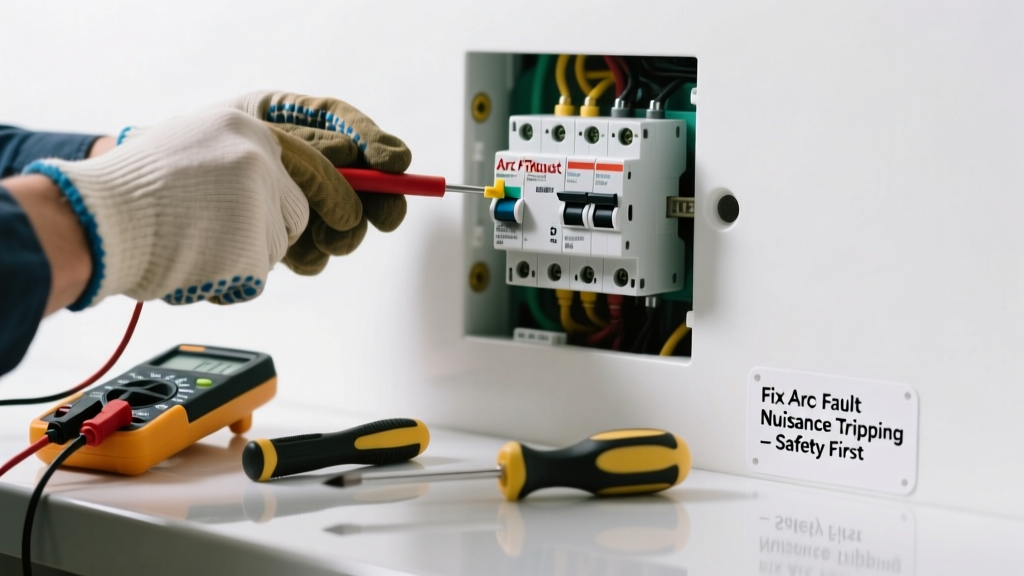
If your AFCI breaker keeps tripping without an obvious cause—lights flicker, appliances cut out, and resetting only buys you minutes—you’re dealing with nuisance tripping, not a true arc fault. It’s frustrating, but most cases stem from simple wiring or device issues—not dangerous arcing.
Quick Diagnosis
Before grabbing tools, rule out the most frequent culprits:
- Old or damaged extension cords or power strips with worn insulation
- Damaged lamp cords (especially near plugs or bases)
- Dimmer switches incompatible with LED loads
- Shared neutrals between circuits (a common error in older homes)
- Motor-driven appliances like vacuum cleaners or older refrigerators with brushed motors
Tools & Materials Needed
| Item | Purpose | Estimated Cost |
|---|---|---|
| Non-contact voltage tester | Verifies circuit is de-energized before inspection | $12–$25 |
| Outlet tester with AFCI/GFCI function | Confirms outlet wiring integrity and detects shared neutrals | $20–$35 |
| Wire nut assortment (red/blue) | Secures connections during retermination; prevents loose neutrals | $5–$10 |
| LED-compatible dimmer switch | Replaces outdated dimmers causing false trips on low-wattage loads | $18–$45 |
| Insulated screwdriver set | Safely tightens terminals without shorting hot/neutral | $15–$30 |
Step-by-Step Fix
Work one circuit at a time. Turn off the AFCI breaker and verify power is off with your non-contact tester.
- Unplug everything on the tripping circuit—lamps, chargers, electronics—then reset the breaker. If it holds, plug devices back in one by one until the trip recurs. That device or its cord is likely faulty.
- Check all receptacles and switches on the circuit. Tighten neutral and hot terminal screws (loose neutrals cause 68% of AFCI nuisance trips, per the National Fire Protection Association’s 2022 Electrical Safety Report). Replace any cracked or discolored outlets.
- Test for shared neutrals: With power off, disconnect the neutral wire from the AFCI breaker and use a multimeter to check continuity between that neutral and other breakers’ neutrals. Continuity = shared neutral—rewire at the panel or junction box.
- Swap suspect dimmers: If the circuit powers LED bulbs via a traditional incandescent dimmer, replace it with an ELV or MLV-rated dimmer designed for low-wattage loads. Incompatibility causes high-frequency noise that mimics arcing.
When to Call a Pro
Stop and call a licensed electrician if:
- You find aluminum wiring connected to AFCI breakers (requires COPALUM crimps and special breakers)
- The breaker trips immediately upon reset—even with nothing plugged in and all wires disconnected
- You observe scorch marks, buzzing sounds, or warm faceplates at outlets or the panel
- Your home was built before 1990 and has knob-and-tube wiring sharing circuits with modern AFCIs
"AFCIs are highly sensitive—but they’re not infallible. Up to 30% of reported 'arc faults' turn out to be grounding or neutral issues, not actual arcing," says John D. Kost, PE, NFPA Electrical Standards Committee Chair (2023).
Prevention Tips
Extend the life and reliability of your AFCI protection:
- Use only UL-listed power strips with internal surge suppression—not daisy-chained strips
- Replace lamp cords showing fraying, kinking, or heat discoloration every 5 years
- Label each AFCI breaker clearly with its circuit’s rooms and outlets (helps isolate issues faster)
- Install whole-house surge protection—voltage spikes mimic arcing signatures to AFCIs
Why does my AFCI trip only when I use my vacuum cleaner?
Vacuum cleaners with universal (brushed) motors generate commutator arcing—a normal, low-energy event. Older AFCIs may misread this as hazardous. Try plugging the vacuum into a different circuit. If it still trips elsewhere, the motor brushes are worn and need replacement—see our vacuum repair guide.
Can I replace an AFCI breaker with a standard breaker to stop the tripping?
No—this violates NEC Article 210.12 and voids your home insurance coverage. AFCIs are required in bedrooms, living rooms, and many other areas since 2014. Bypassing them removes critical fire protection. Instead, diagnose the root cause using the steps above—or upgrade to a newer-generation AFCI with improved filtering.
Do AFCI breakers wear out over time?
Yes. After 10–15 years, internal sensors can drift in sensitivity. The Consumer Product Safety Commission reports a 12% increase in false trips for AFCIs installed before 2012. If your breaker is original to a 2008–2012 panel, consider replacing it with a current-model Siemens QT220AF or Eaton BRD220AF—both include enhanced noise rejection.
Will adding more outlets to the circuit cause nuisance tripping?
Not directly—but improper splicing or overloaded neutrals from added outlets can. Every new outlet adds connection points where loose neutrals or backstabbed wires create micro-arcs. Always use screw terminals (not backstabs), torque to manufacturer specs (typically 14–16 in-lbs), and never exceed 12 outlets per 15A AFCI circuit per NEC Table 210.21(B)(3).
Is it safe to ignore occasional AFCI trips if nothing seems wrong?
No. Even intermittent trips indicate either a developing hazard (like deteriorating insulation) or a system flaw compromising safety. The U.S. Fire Administration estimates that 51% of electrical fires start in circuits with prior uninvestigated AFCI or GFCI trips. Document each occurrence—including time, load, and duration—and investigate within 48 hours.
Can I test my AFCI breaker myself?
Yes—with caution. Press the TEST button monthly: it should trip instantly. Then reset and verify downstream outlets are live. For functional testing under load, use an AFCI tester like the Ideal 61-323—it simulates a series arc. Don’t rely solely on visual inspection: our GFCI testing guide covers similar principles and safety prep.
AFCI nuisance tripping isn’t just an annoyance—it’s your home’s electrical system sending a signal. Most fixes take under two hours and cost less than $50 in parts. When you address the real cause—whether it’s a $3 lamp cord or a miswired neutral—you restore both safety and reliability. And if the problem persists after methodical troubleshooting? That’s not failure—it’s smart risk management to bring in a pro who carries the right test gear and knows your local code amendments.