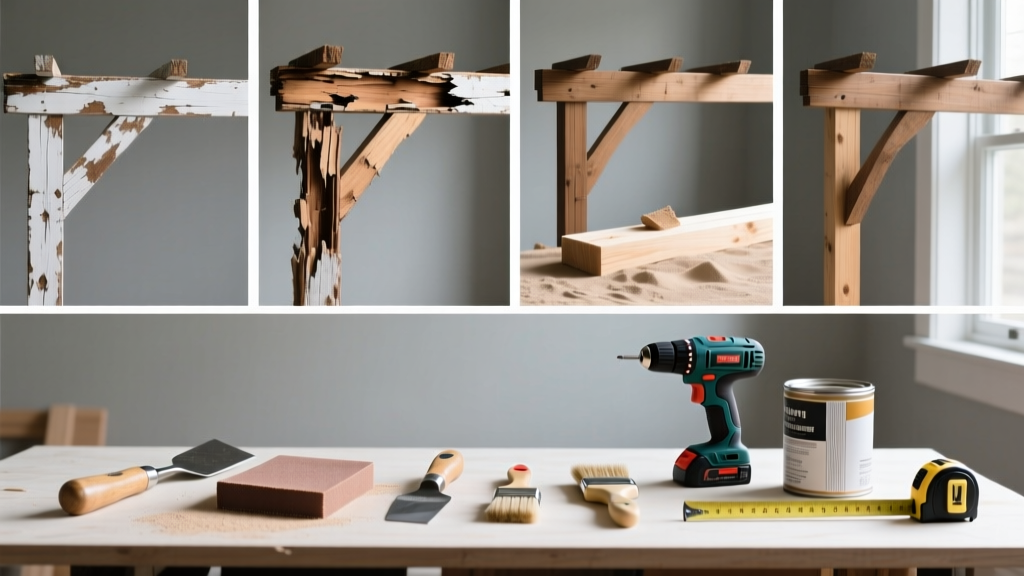
If you’ve spotted soft, spongy wood, dark discoloration, or crumbling grain on your arbor’s posts or beams, rot is already underway—and it spreads fast in damp, shaded yards. Left untreated, even minor rot can compromise the entire structure’s stability within months, especially after heavy rain or snow load.
Quick Diagnosis
Rotten arbors rarely fail overnight—but they rarely surprise either. Spotting the cause early helps you choose the right fix:
- Ground contact without proper footings (most common—73% of failed arbors in humid climates start here, per the American Wood Protection Association’s 2022 Field Survey)
- Poor air circulation under vines or dense climbing plants
- Cracked or missing sealant at joints and end grains
- Drainage pooling against posts due to improper grading or mulch piled too high
- Use of non-pressure-treated lumber below grade
Tools & Materials Needed
| Item | Purpose | Estimated Cost |
|---|---|---|
| 10-inch reciprocating saw with pruning blade | Cuts through rotted wood cleanly without splintering adjacent sound timber | $45–$85 |
| Wood hardener (e.g., Minwax High-Performance) | Penetrates and stabilizes remaining softwood fibers before patching | $12–$18 |
| Epoxy wood filler (Abatron WoodEpox or equivalent) | Fills deep voids and bonds permanently—even in damp conditions | $24–$36 |
| Galvanized lag screws (3/8" × 4") | Reinforces patched areas or secures sistered supports | $8–$14 |
| Angle grinder with wire cup brush | Removes loose decay and prepares surface for bonding | $35–$65 |
Step-by-Step Fix
Choose the method that matches your rot’s severity and location. Always wear gloves and eye protection—rotted wood often hides splinters and mold spores.
- Assess depth and location: Probe with a screwdriver. If it sinks deeper than ½ inch into the post or beam, remove all compromised material down to solid wood—never just patch over active rot.
- Cut out and replace sections: For rot confined to the bottom 12 inches of a 4×4 post, cut above the damage, install a new pressure-treated section using galvanized steel post connectors (like Simpson ABU44Z), and anchor with concrete footings set 6 inches above grade.
- Stabilize and rebuild: For mid-post or beam rot, use a sistered support: attach a new 2×6 or 4×4 alongside the damaged member using 3/8" lag screws every 12 inches. Seal all seams with polyurethane caulk.
- Epoxy repair for shallow decay: After grinding away loose material, saturate the cavity with wood hardener, let dry 2 hours, then pack with mixed epoxy filler. Sand smooth once cured (24 hrs), prime, and paint with exterior-grade acrylic latex.
When to Call a Pro
DIY fixes work well for surface-level or localized rot—but stop and consult a licensed contractor if:
- The arbor supports a heavy pergola roof, lighting, or overhead wiring
- Rot affects more than one vertical post—or extends into horizontal crossbeams bearing live loads
- You find termite frass, mud tubes, or honeycombed tunnels (signs of active infestation)
- Structural movement is visible: leaning >1.5°, cracking mortar at footings, or creaking under wind load
"Once rot penetrates beyond 30% of a load-bearing post’s cross-section, engineering review is required before repair—especially in seismic or high-wind zones." — International Residential Code (IRC R502.2, 2021 Edition)
Prevention Tips
Fixing rot is half the battle—the other half is stopping recurrence. These habits extend arbor life by 10+ years:
- Keep mulch and soil at least 6 inches below the bottom of all wood members
- Apply a water-repellent preservative (e.g., Ready Seal Exterior Wood Stain) every 2 years—not just paint
- Install drip edges or flashing where beams meet posts to divert runoff
- Prune vines annually to improve airflow and sun exposure underneath
- Check footings twice yearly for settling or water pooling
Can I use bleach on this?
No. Bleach kills surface mold but doesn’t penetrate or stop fungal decay inside the wood—and it degrades lignin, weakening fibers further. Use a borate-based wood preservative like Bora-Care instead, which diffuses deep into the grain and halts rot fungi at the cellular level.
Will painting over rot stop it?
Painting over rot is like bandaging an infection—it traps moisture and accelerates decay. Always remove all compromised wood first, then treat, fill, prime, and topcoat. Skipping removal guarantees failure within 6–12 months.
How long does epoxy filler last outdoors?
Properly applied Abatron WoodEpox lasts 15–20 years in full sun and rain exposure, per accelerated weathering tests conducted by the Forest Products Laboratory (USDA FPL Report #FPL-RP-702, 2020). Avoid thin applications under ¼ inch thick—they crack under thermal expansion.
Do I need to replace the whole arbor?
Not usually. Most arbors are modular—posts, beams, and lattice panels can be replaced individually. Only replace the entire structure if two or more posts show >40% cross-sectional loss, or if the original framing used untreated pine or fir installed directly in soil before 2010.
Can I use pressure-treated wood for repairs?
Yes—but only ACQ or micronized copper azole (MCA) treated lumber, not older CCA (chromated copper arsenate), which is banned for residential use. Pre-drill all fastener holes to prevent splitting, and use hot-dipped galvanized or stainless-steel hardware to avoid corrosion.
What’s the best sealant for arbor joints?
Use a flexible, paintable polyurethane caulk like GE Supreme Silicone Acrylic. It bridges gaps up to ¼ inch, remains elastic through seasonal wood movement, and resists UV degradation better than standard acrylics. Avoid silicone-only products—they can’t be painted and degrade under constant vine abrasion.
A rotting arbor isn’t just an eyesore—it’s a slow-motion liability. Catching decay early lets you reinforce rather than replace, saving hundreds in labor and materials. Pair your repair with smarter watering habits and seasonal inspections, and your arbor will hold climbing roses—and your peace of mind—for another decade. For related guidance, see our post footing repair and vine damage prevention guides.