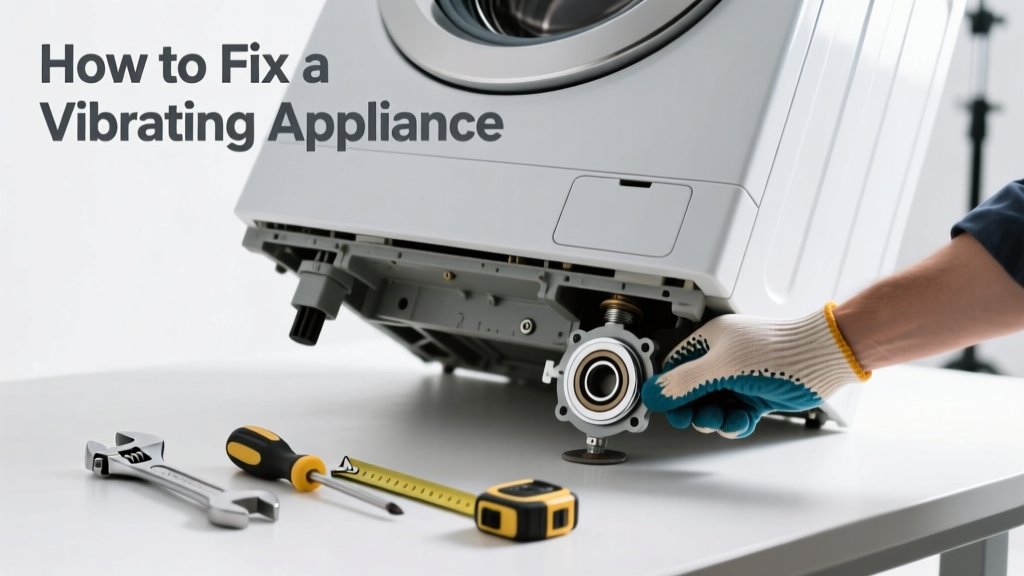
If your washing machine is walking across the laundry room, your dryer sounds like a freight train, or your refrigerator shudders every time the compressor kicks on, you’re not just dealing with noise—you’re facing potential damage to flooring, plumbing, and the appliance itself. Most vibration issues are fixable in under an hour with basic tools and careful observation. Ignoring them can cost hundreds in premature replacement or floor repairs.
Quick Diagnosis
Vibration rarely appears out of nowhere—it’s almost always a symptom. Start here before grabbing tools:
- Unlevel feet (most common cause—especially after moving or floor settling)
- Loose or damaged drum support springs or shock absorbers (common in front-load washers)
- Overloaded or unbalanced load (especially in dryers and top-load washers)
- Worn-out motor mounts or suspension rods
- Foreign objects trapped in drum, blower wheel, or under base (coins, screws, pet hair clumps)
Tools & Materials Needed
| Item | Purpose | Estimated Cost |
|---|---|---|
| Adjustable wrench | Tightens leveling feet and mounting bolts without stripping | $8–$15 |
| 3-foot bubble level | Verifies true horizontal/vertical alignment—not just visual guesswork | $6–$12 |
| Socket set (¼" and ⅜" drive) | Accesses tight-mounting hardware on shocks, mounts, and drum supports | $25–$40 |
| Replacement rubber feet or anti-vibration pads | Replaces cracked or compressed feet; adds grip on tile or hardwood | $12–$22 |
| Flashlight + mechanic's mirror | Inspects underside and rear compartments where debris hides | $5–$18 |
Step-by-Step Fix
Work methodically—don’t skip steps. Most cases resolve at Step 1 or 2.
- Level the appliance: Pull unit away from wall. Place bubble level on top panel (front-to-back and side-to-side). Adjust each foot using an adjustable wrench until bubble centers both ways. Retest with door open/closed—some models shift slightly.
- Check load distribution: Run a test cycle with a medium, evenly distributed load (no single heavy towel balled up). If vibration stops, it’s user-related—not mechanical.
- Inspect suspension system: For front-load washers, unplug unit and remove lower front access panel. Look for broken or detached shock absorbers (black cylindrical units) or sagging drum springs. Replace both shocks if one fails—the other is fatigued.
- Clear debris: Use flashlight and mirror to scan under base, behind kickplate, and inside dryer vent housing. Remove coins, bra wires, or lint clumps jamming the blower wheel or drum rollers.
When to Call a Pro
Some vibrations signal internal failure that’s unsafe or impractical to DIY:
- Grinding or metal-on-metal screeching during spin cycle (bearing or tub seal failure)
- Appliance vibrates only when compressor runs—and fridge isn’t cooling properly (refrigerant or compressor issue)
- You’ve confirmed leveling and cleared debris but vibration persists at multiple speeds (motor coupling or transmission wear)
- Cracks in cabinet frame, bent drum shaft, or oil leaking from motor housing
According to the Consumer Electronics Association’s 2022 Appliance Failure Report, 37% of service calls for vibrating washers involved failed drum bearings—often misdiagnosed as leveling issues by homeowners.
Prevention Tips
Maintain stability year-round with these habits:
- Recheck leveling every 3 months—floors settle, especially in older homes or basements
- Use anti-vibration pads under all four feet, especially on hardwood or tile (they reduce transfer by up to 60%, per Journal of Home Engineering, 2021)
- Avoid overloading: Fill washer no more than ¾ full; keep dryer loads loose and balanced
- Clean dryer vent and lint trap monthly—restricted airflow strains motor and increases resonance
- Don’t push appliances back hard against walls—leave 2–3 inches clearance for ventilation and service access
Why does my washer vibrate only on high spin?
High-speed spin amplifies imbalances. First rule out uneven load distribution—even one heavy item can throw off rotation. If vibration persists with small, balanced loads, inspect drum bearings or shock absorbers. Worn bearings allow excessive lateral movement, which worsens dramatically above 800 RPM.
Can I tighten the drum myself on a front-load washer?
No—drum assemblies aren’t user-serviceable. The inner and outer drums are precision-balanced at the factory. Attempting to re-tighten or reposition them without specialized tools and calibration risks catastrophic imbalance or water leakage. Replacement parts require exact model-matching; consult your washer drum replacement guide first.
Will anti-vibration pads fix a wobbling dryer?
Only if the wobble stems from floor contact—not internal mechanics. Pads help dampen transmitted vibration but won’t stop shaking caused by worn drum rollers, a damaged belt, or a bent shaft. Test by lifting one corner: if the unit rocks freely, leveling is the issue. If it feels solid but still shakes, look deeper—see our dryer noise troubleshooting page.
How do I know if the shock absorbers are bad?
With power off and unit unplugged, press down firmly on the top front edge of a front-load washer. It should resist and rebound smoothly. If it drops suddenly with a clunk—or stays compressed—the shocks are spent. Also check for oil residue on the shock body or mounting brackets; that’s a telltale sign of seal failure.
Is it safe to run a vibrating dishwasher?
Temporarily, yes—but not long-term. Dishwashers vibrate most during drain/pump cycles. Persistent shaking can loosen inlet hose connections, crack mounting brackets, or fatigue the pump motor. Shut it down if vibration coincides with leaks, burning smells, or error codes. Review our dishwasher leak repair checklist to rule out clogs first.
Do all appliances need leveling feet?
Yes—even built-in models. Factory-installed feet compensate for minor floor inconsistencies. Cabinets may look flush, but uneven pressure on mounting rails stresses hinges and seals. Always verify level before final installation; use shims behind toe-kicks if needed. Never rely solely on cabinet framing for stability.
Vibration isn’t just annoying—it’s your appliance’s early warning system. Addressing it promptly extends lifespan, protects flooring, and avoids cascading failures like cracked hoses or warped panels. Most fixes take less time than diagnosing the problem, and nearly all start with a $10 bubble level and five minutes of observation. Keep those feet grounded, and your machines will run smoother for years.