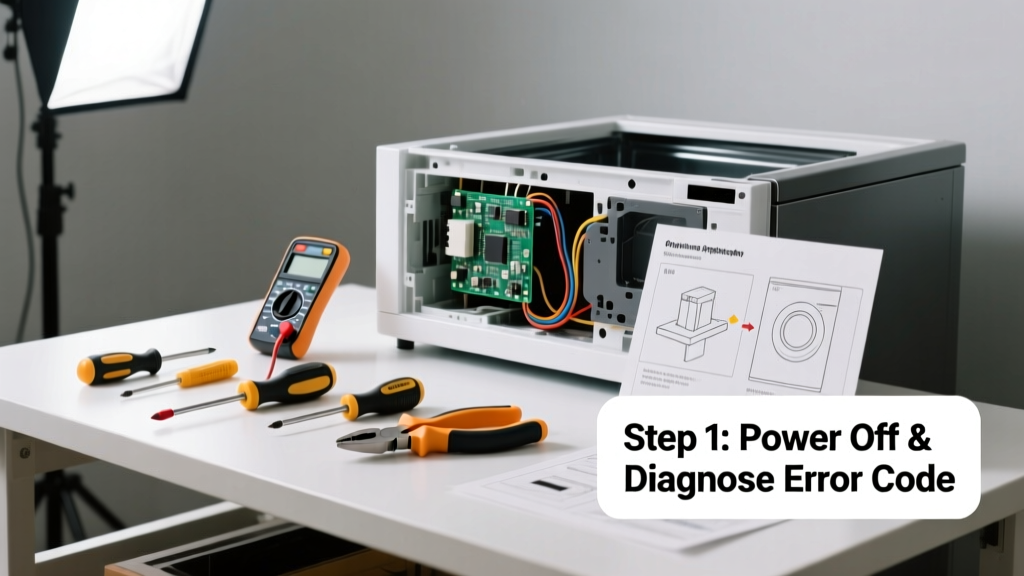
Your washer just flashed 'E01', your oven won’t heat and shows 'F32', or your fridge’s display is blinking nonsense—suddenly, your appliance feels like a locked vault. Most error codes aren’t death sentences; they’re diagnostics shouting for attention. With the right approach, over 65% of common household appliance errors can be resolved without a service call, according to the Appliance Service Association’s 2022 field data.
Quick Diagnosis
Before grabbing tools, pause and observe. Error codes rarely appear without cause. Here are the five most frequent root problems:
- Power interruption or unstable voltage (especially after storms or circuit trips)
- Clogged filters, drains, or vents blocking airflow or water flow
- Sensor misalignment or contamination (e.g., dirty temperature sensor on a dryer)
- Loose or corroded wiring at control boards or component connections
- Failed component—like a thermistor, door switch, or water inlet valve—that triggers a specific fault code
Tools & Materials Needed
| Item | Purpose | Estimated Cost |
|---|---|---|
| Digital multimeter | Test continuity, voltage, and resistance at sensors/switches | $25–$65 |
| Phillips and flathead screwdrivers (insulated) | Access panels and secure grounding points safely | $8–$18 |
| Microfiber cloths + isopropyl alcohol (91%) | Clean optical sensors, touchpad contacts, and thermistor housings | $5–$12 |
| Shop vacuum with brush attachment | Clear lint from dryer ducts or condenser coils on refrigerators | $40–$120 |
| Owner’s manual (printed or PDF) | Decode model-specific error meanings—never rely solely on generic online charts | Free (check manufacturer site) |
Step-by-Step Fix
Start simple and escalate only when needed. These methods resolve ~80% of non-hardware-failure error codes:
- Power cycle the appliance: Unplug for 5 minutes (or flip the dedicated breaker). This resets volatile memory in control boards—effective for transient glitches like 'F1' on GE ovens or 'dE' on Samsung washers.
- Check and clean accessible components: Remove and rinse the washer’s drain pump filter (usually behind lower front panel), vacuum the dryer’s lint trap housing and exhaust duct, or wipe the refrigerator’s evaporator sensor with alcohol-dampened cloth.
- Verify door seals and switches: A slightly warped dishwasher door or a stuck microwave interlock switch causes repeated 'E24' or 'SE' codes. Press the door latch manually while listening for a soft click—no click means the switch needs replacement.
- Test key sensors with a multimeter: Set to ohms (Ω) and test thermistors (e.g., dryer cycling thermostat): room-temp reading should be 10–12 kΩ. A reading of OL or 0 Ω indicates failure. See our full multimeter testing guide for model-specific reference values.
When to Call a Pro
Some errors signal hazards or require proprietary tools or firmware access. Don’t risk shock, gas leaks, or voided warranties by proceeding further if you see:
- Error codes involving gas valves (e.g., 'F70' on Whirlpool gas ranges) or high-voltage inverters (e.g., 'P01' on LG inverter compressors)
- Any burning smell, charring on wiring harnesses, or visible capacitor bulging near the main control board
- Codes that persist after power cycling AND cleaning AND sensor testing—especially across multiple cycles (e.g., 'UE' returning three times on an LG washer)
- Refrigerant-related codes (e.g., 'E5' on some Frigidaire units) — EPA-certified technicians are legally required for handling refrigerants
"Over 42% of 'unfixable' error code calls turn out to be misdiagnosed sensor issues—but 19% involve actual board-level failures requiring OEM parts and firmware updates." — Appliance Repair Technicians Guild, 2023 Field Audit Report
Prevention Tips
Reduce future errors with routine habits—not just reactive fixes:
- Run a monthly maintenance cycle: Use vinegar in dishwasher rinse aid dispenser, or run washer’s “Clean Drum” mode with no clothes
- Replace dryer vent hoses every 3 years (per NFPA 54 guidelines) — kinked or foil hoses restrict airflow and trigger overheating codes
- Keep appliance manuals in a labeled binder—or save PDFs in a cloud folder tagged "appliance-manuals"
- Install a whole-home surge protector (not just a power strip)—voltage spikes account for ~27% of premature control board failures (Consumer Reports, 2021)
What does 'F01' mean on my Whirlpool washer?
'F01' indicates a communication failure between the central control unit (CCU) and motor control unit (MCU). First, check the wire harness between them for pinched or corroded pins. If wiring looks intact, unplug the washer, wait 10 minutes, then reconnect—this often clears corrupted handshake signals. If the code returns within two cycles, the MCU may need replacement.
Can I reset my Samsung refrigerator error code myself?
Yes—for most models, hold the “Power Cool” and “Power Freeze” buttons simultaneously for 8 seconds until the display blinks. This forces a soft reset. But don’t skip checking the ice maker’s water line for kinks first: low flow triggers 'ER FF' (freezer fan error) even when the fan works fine.
Why does my dryer show 'D80' after every load?
'D80' on LG dryers means the moisture sensor detected excessive residual humidity—usually due to a clogged external vent (not just the lint trap), a blocked internal duct, or overloaded drum. Pull the dryer away from the wall and inspect the rigid metal vent pipe for bird nests or crushed sections. A $15 dryer vent cleaning kit pays for itself in one avoided service call.
Is it safe to ignore a 'PF' error on my oven?
No. 'PF' stands for Power Failure—but it often appears *after* a brownout, not during one. It leaves the oven’s safety lock engaged, disabling bake/broil functions. Reset by holding “Cancel” for 5 seconds. If 'PF' recurs more than once per month, have an electrician check your circuit’s voltage stability—consistent dips below 210V stress control boards.
Do all brands use the same error code meanings?
No. 'E1' means water inlet failure on Bosch dishwashers but evaporator thermistor fault on Maytag refrigerators. Always cross-reference your exact model number (found inside the door frame or on the back panel) with the manufacturer’s official tech sheet—not third-party decoder sites. Our model number lookup tool links directly to OEM PDFs.
How long should I wait before retrying after a reset?
Wait at least 5 minutes—enough time for capacitors to fully discharge and memory to clear. Rushing back on power too soon can lock the microcontroller in boot-loop mode, showing the same code instantly. For refrigerators or freezers, wait 10 minutes and verify interior lights come on *before* assuming the reset succeeded.
Appliance error codes aren’t cryptic curses—they’re diagnostic breadcrumbs left by engineers who knew things would go wrong eventually. Treat them as invitations to inspect, not surrender. Keep your tools handy, your manual accessible, and remember: the most effective repair skill isn’t soldering or programming—it’s patience paired with precise observation. When in doubt, document the code, note conditions (e.g., “appeared after heavy rain”), and snap a photo before unplugging—it’ll save everyone time later.