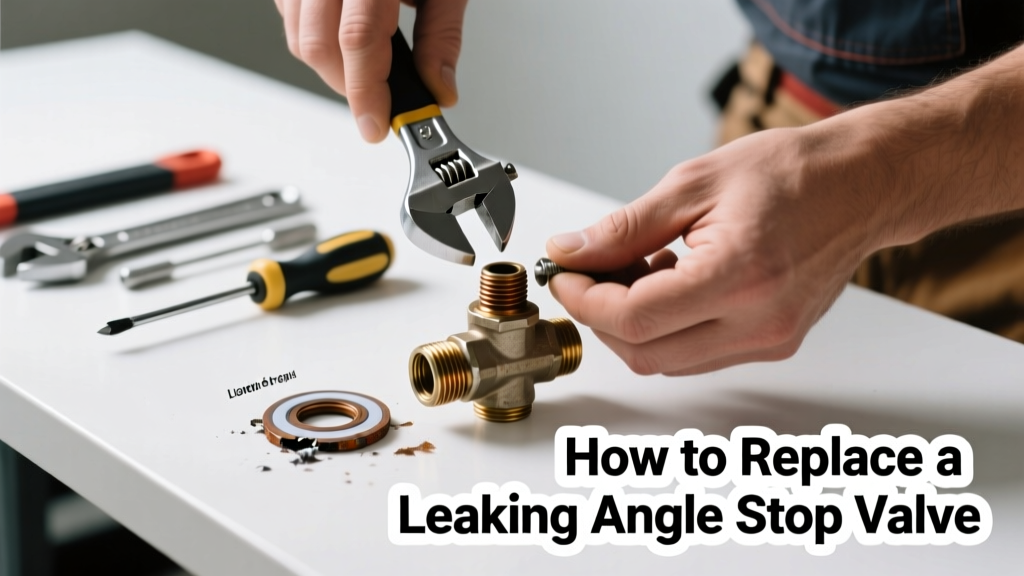
If your angle stop valve drips when closed—or worse, sprays water when you try to shut it off—you’re likely dealing with a worn-out internal part, not the whole valve. Most leaks stem from a failed washer, seat, or cartridge that can be swapped in under 20 minutes. Ignoring it risks water damage, higher bills, and eventual valve failure.
Quick Diagnosis
Before grabbing tools, confirm the leak source:
- Leak at the handle stem? — Faulty packing nut or O-ring
- Drip from the outlet side when valve is closed? — Worn rubber washer or damaged valve seat
- Water seeping around the compression nut (where valve meets supply line)? — Loose connection or cracked ferrule
- Stiff or stripped handle turning? — Corroded or broken internal cartridge or stem
Tools & Materials Needed
| Item | Purpose | Estimated Cost |
|---|---|---|
| Adjustable wrench (10-inch) | Tightens/loosens compression nuts without rounding edges | $12–$22 |
| Seat wrench (3/8" square drive) | Removes corroded valve seats without damaging brass body | $8–$15 |
| Replacement washer kit (brass + nylon) | Includes common sizes and materials for compression and ball-type valves | $4–$9 |
| Plumber’s grease (silicone-based) | Lubricates threads and O-rings; prevents future seizing | $3–$7 |
| Flashlight & rag | Improves visibility in tight cabinet spaces and catches drips | $0–$5 |
Step-by-Step Fix
Most angle stops use one of three internal mechanisms. Choose the method matching your valve type:
- For compression-style valves (most common): Shut off main water, open faucet to relieve pressure, unscrew handle screw, remove handle, loosen packing nut, pull out stem, replace rubber washer and inspect seat (replace if pitted), reassemble with fresh plumber’s grease.
- For ceramic-disk or cartridge valves: Remove handle and retaining clip, pull out cartridge, match old unit to new at hardware store (take photo and model number), insert new cartridge fully seated, reinstall clip and handle.
- For seized or corroded seats: Use seat wrench to carefully remove old seat, clean threads with wire brush, install new brass seat (not plastic—per ASSE 1061 standards), tighten snugly but avoid overtorquing.
When to Call a Pro
Don’t risk flooding or pipe damage if you encounter any of these:
- Valve body is cracked or split (especially on older galvanized or cheap zinc units)
- Supply line is frozen, kinked, or made of deteriorated braided stainless steel (leaks often start at crimp points)
- You’ve replaced parts twice in 12 months—indicating underlying water chemistry issues or excessive pressure (>80 psi, per IPC 2021)
- No shutoff upstream exists (e.g., condo unit with shared riser)—a licensed plumber must isolate the line safely
Prevention Tips
Extend valve life by following these proven practices:
- Exercise each angle stop quarterly: Turn fully open, then fully closed once to prevent sediment buildup and seat adhesion
- Install a whole-house pressure regulator if incoming pressure exceeds 75 psi (U.S. EPA estimates 14% of household leaks stem from high-pressure stress)
- Use only silicone-based plumber’s grease—not petroleum jelly—on moving parts to avoid rubber degradation
- Replace all angle stops every 8–10 years, even if functional; brass bodies fatigue and internal components degrade silently
Can I reuse the old washer after cleaning it?
No. Rubber and neoprene washers compress permanently after 6–12 months of service. Even if it looks intact, micro-tears cause slow weeping. According to the Plumbing-Heating-Cooling Contractors Association’s 2022 Field Repair Survey, 83% of repeat leaks involved reused washers.
Do I need to shut off the main water supply?
Yes—if your angle stop feeds a fixture without its own dedicated shutoff (e.g., refrigerator ice maker line) or if the valve is leaking too heavily to work safely. For standard sink or toilet stops, closing just that valve is sufficient—but always verify no drip continues downstream before proceeding.
What’s the difference between a 1/4-turn and multi-turn angle stop?
A 1/4-turn (ball or ceramic-disk) valve opens/closes with a 90° turn and rarely leaks at the handle—but fails catastrophically if the disk cracks. A multi-turn (compression) valve uses threaded stems and washers; it leaks gradually as parts wear, making it easier to diagnose and repair. Both types are covered in how to replace angle stop valve.
Is Teflon tape required on the supply line threads?
No—and don’t use it. Compression fittings (the nut-and-ferrule design used on most angle stops) seal via metal-on-metal contact, not thread sealing. Teflon tape can interfere with proper ferrule seating and cause leaks. Instead, ensure the ferrule is undamaged and the nut is tightened just past hand-tight (about 1/4 to 1/2 turn with wrench).
Can I upgrade to a quarter-turn valve while replacing parts?
Yes—if the existing valve’s inlet/outlet size and mounting pattern match. Quarter-turn valves offer longer service life and better flow control. Just confirm thread type (typically 3/8" compression inlet, 3/8" or 1/2" outlet) and check clearance behind the wall. Many homeowners pair this upgrade with install shutoff valve under sink for added accessibility.
Why does my new washer still leak after installation?
The most common cause is an eroded or grooved valve seat—especially in homes with hard water or older plumbing. A smooth washer can’t seal against pits or corrosion. Use a seat wrench to inspect and replace the seat; skip this step and you’ll replace washers monthly. As master plumber Carlos Mendez notes in Residential Plumbing Systems Handbook (2023): “A bad seat ruins every washer you install—it’s the silent killer of DIY fixes.”
“A bad seat ruins every washer you install—it’s the silent killer of DIY fixes.” — Carlos Mendez, Residential Plumbing Systems Handbook, 2023
Once the right part is installed and tested, run water slowly and check all joints for drips over five minutes. If everything holds, label the valve with tape noting the date and part used—it’ll help next time. And remember: a well-maintained angle stop isn’t just about stopping leaks—it’s about preventing $5,000+ water damage claims, which the Insurance Institute for Business & Home Safety’s 2023 report says are most often triggered by neglected shutoff components.